Nipah Virus Resurfaces in Kerala with Two Cases
Source:The Hindu ↗
Why It Matters
Zoonotic diseases like Nipah virus represent a recurring public health threat. For UPSC aspirants, understanding the etiology of the virus, associated clinical conditions like Acute Encephalitis Syndrome (AES), and treatments like monoclonal antibodies (a recent Prelims focus) is crucial for GS-3. Furthermore, Kerala's rapid deployment of containment protocols offers an excellent case study on decentralized grassroots healthcare and disaster management (GS-2 and GS-3).
Summary
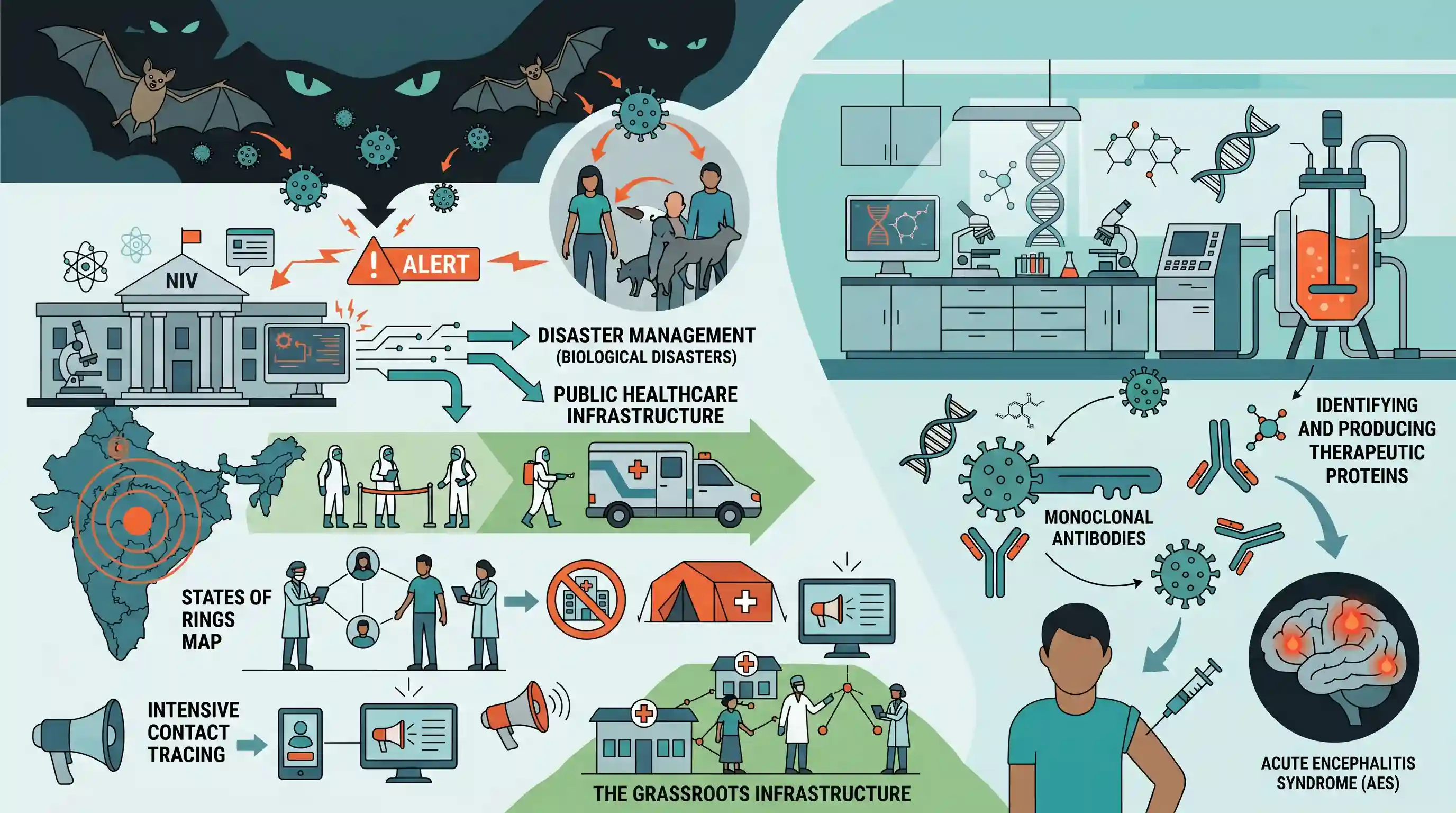
The Nipah virus has resurfaced in Kerala, prompting the activation of strict public health protocols following confirmation by the National Institute of Virology (NIV). Health authorities have launched intensive contact tracing, the isolation of high-risk individuals, and public alerts across affected districts like Malappuram and Kozhikode to contain the zoonotic outbreak. The State's proactive response highlights the vital role of robust grassroots public healthcare infrastructure in managing infectious disease outbreaks. From a scientific perspective, the outbreak draws attention to zoonotic pathogens, clinical complications like Acute Encephalitis Syndrome (AES), and potential medical countermeasures like monoclonal antibodies.
Key Points
- The Nipah virus has resurfaced in Kerala, with two confirmed cases—an 18-year-old and a 38-year-old—identified in the region.
- The Pune-based National Institute of Virology (NIV) has validated the samples, confirming the viral outbreak.
- Authorities have enacted stringent Nipah protocols, including large-scale contact tracing (over 250 contacts isolated) and forming dedicated medical boards and control rooms across Malappuram, Palakkad, and Kozhikode.
- Acute Encephalitis Syndrome (AES) is highlighted as a critical medical manifestation of the infection, necessitating aggressive clinical management and containment protocols.
Important Terms
Nipah virus (NiV)

A highly fatal zoonotic virus of the Paramyxoviridae family, transmitted primarily by fruit bats (Pteropus genus). It causes severe respiratory illness and fatal brain inflammation in humans.
UPSC context
GS Paper III (Science & Tech; Health). Tests understanding of viral transmission, high-fatality pathogens, and emerging public health threats.
Zoonotic Diseases
Infectious diseases that naturally jump from vertebrate animals to humans. They account for 60% of all known human infections and 75% of emerging infectious diseases globally.
UPSC context
GS Paper III (Environment/S&T) and GS Paper II (Health). Tests knowledge of the human-animal-ecosystem interface.
National Institute of Virology (NIV)
A premier virology research institute under the Indian Council of Medical Research (ICMR) in Pune. It is the central body for viral surveillance and diagnostic confirmation in India.
UPSC context
GS Paper II (Institutional Framework; Health). Tests knowledge of India's R&D infrastructure and critical health monitoring bodies.
Acute Encephalitis Syndrome (AES)
A clinical 'basket term' for diseases characterized by high fever and brain inflammation. In India, it is often caused by Japanese Encephalitis, Nipah, or metabolic toxins.
UPSC context
GS Paper II (Issues relating to Health). Tests awareness of regional health crises and diagnostic challenges in infectious diseases.
Monoclonal Antibodies (mAbs)
Laboratory-engineered proteins designed to mimic the immune system's natural antibodies. They target specific antigens, such as the m102.4 antibody used as a countermeasure against Nipah.
UPSC context
GS Paper III (Science & Tech/Biotechnology). Tests knowledge of modern immunology and clinical countermeasures for viral infections.
One Health Approach
An integrated approach balancing the health of people, animals, and the environment. It is the standard framework recommended by WHO to prevent and manage zoonotic outbreaks.
UPSC context
GS Paper III (Environment & Health). Tests knowledge of holistic disaster management and multi-sectoral health governance.
Prelims Trap
Nipah virus transmission is strictly zoonotic and cannot occur via human-to-human contact.
Nipah can spread person-to-person through close contact with infected bodily fluids. This human-to-human transmission risk makes strict isolation protocols absolutely critical during hospital outbreaks.
Static Concepts Connected
How do Monoclonal Antibodies (mAbs) work against viral infections?
- Lab-engineered proteins: They are artificially created antibodies designed to mimic the natural immune system's attack on specific pathogens.
- Targeted binding: They bind to specific viral antigens (such as surface glycoproteins), physically blocking the virus from entering healthy host cells.
- Passive immunity: Unlike vaccines which induce active immunity over time, mAbs provide immediate but temporary therapeutic protection (passive immunity).
What defines Acute Encephalitis Syndrome (AES) in public health?
- Neurological condition: A severe neurological manifestation characterized by acute-onset fever and an altered mental status, such as confusion, disorientation, or coma.
- Multiple pathogens: It is not a single disease but a clinical syndrome caused by a wide range of viruses (Nipah, Japanese Encephalitis), bacteria, or fungi.
- Vector-host variations: Because AES can be triggered by different vectors (mosquitoes for JE) or hosts (bats for Nipah), public health responses must be pathogen-specific.
Cross-Topic Patterns
Zoonosis and Western Ghats ecology
Recurrent Nipah outbreaks in Kerala highlight how deforestation, expanding agriculture, and altered bat habitats increase the human-wildlife interface, driving viral spillover events.
Local governance in epidemic control
Kerala’s containment strategy relies heavily on decentralized control rooms, demonstrating the crucial role of local governance and primary healthcare in managing biological disasters.

Expect a 2026 multi-statement Prelims question contrasting Nipah (bat-borne, human-to-human spread) with JE (mosquito-borne) and AES links.
Linked PYQs · 3
Linked PYQs · 3
- 2025PrelimsGS1
With reference to monoclonal antibodies, often mentioned in news, consider the following statements : I. They are man-made proteins. II. They stimulate immunological function due to their ability to bind to specific antigens. III. They are used in treating viral infections like that of Nipah virus. Which of the statements given above are correct?
- 2024MainsGS2
In a crucial domain like the public healthcare system the Indian State should play a vital role to contain the adverse impact of marketisation of the system. Suggest some measures through which the State can enhance the reach of public healthcare at the grassroots level.
- 2021MainsGS2
“Besides being a moral imperative of a Welfare State, primary health structure is a necessary precondition for sustainable development.” Analyze.
