Kerala Issues Nipah Alert Across Three Districts
Source:The Hindu ↗
Why It Matters
Recurring outbreaks of the Nipah virus emphasize the critical need for resilient public healthcare systems, rapid epidemic response protocols, and proactive containment strategies in managing biological hazards and zoonotic diseases.
Summary
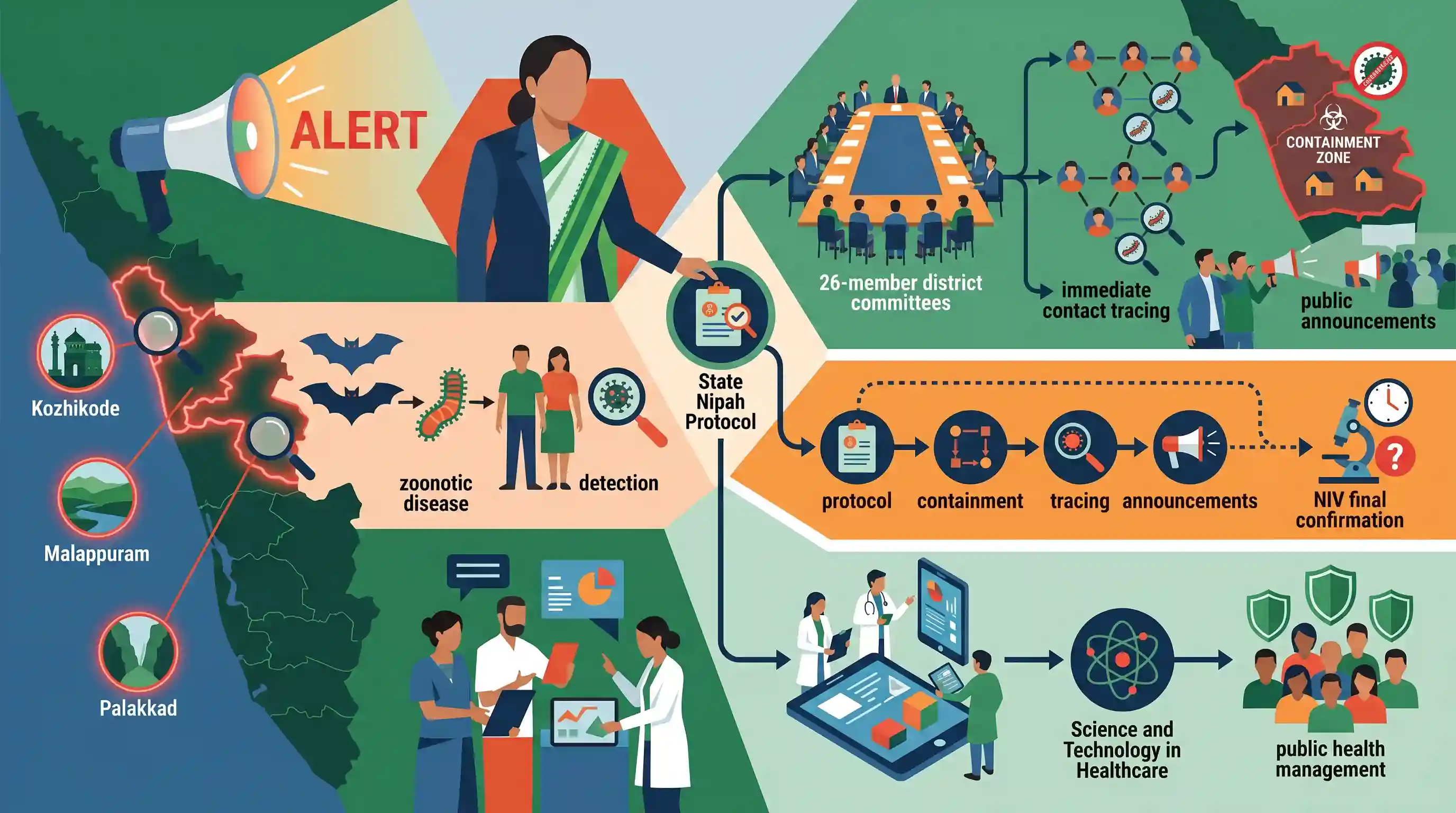
The Kerala Health Department has sounded an alert in three districts—Kozhikode, Malappuram, and Palakkad—after two preliminary cases of the Nipah virus were detected. A high-level response, led by Health Minister Veena George, has initiated the State Nipah protocol, establishing 26-member district committees to oversee immediate contact tracing, containment zones, and public announcements without waiting for final confirmation from the National Institute of Virology.
Key Points
- The Kerala Health Department has issued a high alert in Kozhikode, Malappuram, and Palakkad districts following two preliminary positive cases of the Nipah virus.
- Authorities are implementing the State Nipah protocol immediately, choosing not to wait for final confirmation from the National Institute of Virology (NIV).
- A 26-member committee has been formed in each affected district to oversee preventive and control measures.
- District Collectors have been tasked with declaring containment zones and executing detailed contact tracing with police assistance to prevent the virus's spread.
Important Terms
Nipah Virus (NiV)

A highly pathogenic zoonotic virus (Paramyxoviridae family) naturally hosted by fruit bats. It causes severe respiratory illness and fatal encephalitis with a high case-fatality rate.
UPSC context
GS Paper 3 (S&T/Health); tests knowledge of emerging infectious diseases and epidemiological challenges in India.
National Institute of Virology (NIV)
India's premier virology research institute under the ICMR. It provides definitive diagnostic confirmation and leads research on high-risk pathogens like Nipah and SARS-CoV-2.
UPSC context
GS Paper 3 (Institutions); relevant for India's indigenous medical infrastructure and health security response.
Zoonotic Disease
Infectious diseases that jump from animals to humans. They comprise over 60% of emerging infections and are often driven by ecological disruptions and human-animal proximity.
UPSC context
GS Paper 3 (Environment/Health); central to understanding pandemic origins and the human-wildlife interface.
One Health Approach
An integrated framework balancing the health of people, animals, and ecosystems. It is the primary strategy for managing zoonotic threats at their source.
UPSC context
GS Paper 2 & 3 (Health/Governance); a key policy solution for holistic disease prevention and global health security.
State Nipah Protocol
A specialized Standard Operating Procedure (SOP) established by Kerala to manage outbreaks through systematic isolation, rigorous contact tracing, and community containment.
UPSC context
GS Paper 2 (Governance/Disaster Management); demonstrates state-level administrative resilience and specialized public health policy evolution.
Contact Tracing
A public health strategy to identify and monitor individuals exposed to an infected person to break the chain of transmission during an outbreak.
UPSC context
GS Paper 2 (Governance); a core component of epidemiological surveillance and pandemic management strategy.
Biosafety Level 4 (BSL-4)
The highest level of laboratory biocontainment required for handling dangerous pathogens (like Nipah or Ebola) that pose a high risk of life-threatening disease.
UPSC context
GS Paper 3 (Science & Tech); tests technical understanding of biosecurity and specialized research infrastructure.
Prelims Trap
"Nipah virus is strictly transmitted from bats to humans, and human-to-human transmission does not occur."
Aspirants often assume zoonotic means strict animal-to-human spread. Nipah has well-documented human-to-human transmission, particularly in hospital settings and among close contacts.
Static Concepts Connected
What are the core characteristics of the Nipah virus?
- Pathogen type: It is a highly pathogenic, zoonotic RNA virus belonging to the genus Henipavirus.
- Natural host: Fruit bats of the Pteropus genus (commonly known as flying foxes) are the natural reservoirs.
- Transmission: Spreads via direct contact with infected animals, consumption of contaminated food (like raw date palm sap), and human-to-human contact.
- Medical countermeasures: There is currently no licensed vaccine or specific drug for humans; treatment relies entirely on intensive supportive care.
How are Biological Disasters governed in India?
- Nodal Ministry: The Ministry of Health and Family Welfare (MoHFW) is the nodal agency for handling biological emergencies and epidemics.
- Legal framework: Managed primarily under the Epidemic Diseases Act, 1897, alongside the broader Disaster Management Act, 2005.
- Institutional support: Apex diagnostic confirmation and research are led by the ICMR-National Institute of Virology (NIV), a WHO reference lab.
Cross-Topic Patterns
Western Ghats ecology & zoonotic spillovers
Disruption of bat habitats in the Western Ghats due to agricultural encroachment directly links ecological conservation to public health, explaining recurring zoonotic spillovers in Kerala.
One Health approach implementation
Nipah highlights the urgent need for a 'One Health' strategy, integrating human medical care, veterinary monitoring, and wildlife conservation to prevent cross-species transmission.
Decentralized biological disaster management
Kerala’s preemptive containment without waiting for central NIV confirmation showcases decentralized biological disaster management under the Disaster Management Act, 2005.

Expect a 2026 question linking Nipah's RNA characteristics and human-to-human transmission with the One Health approach and ICMR's role.
Linked PYQs · 3
Linked PYQs · 3
- 2025PrelimsGS1
With reference to monoclonal antibodies, often mentioned in news, consider the following statements : I. They are man-made proteins. II. They stimulate immunological function due to their ability to bind to specific antigens. III. They are used in treating viral infections like that of Nipah virus. Which of the statements given above are correct?
- 2024PrelimsGS1
With reference to monoclonal antibodies, often mentioned in news, consider the following statements : I. They are man-made proteins. II. They stimulate immunological function due to their ability to bind to specific antigens. III. They are used in treating viral infections like that of Nipah virus. Which of the statements given above are correct?
- 2024MainsGS2
In a crucial domain like the public healthcare system the Indian State should play a vital role to contain the adverse impact of marketisation of the system. Suggest some measures through which the State can enhance the reach of public healthcare at the grassroots level.
