Nipah Virus Zoonotic Threat and Public Health Preparedness in India
Source:The Hindu ↗
Why It Matters
Nipah virus is frequently cited in current affairs due to recurring outbreaks in India. Its study is vital for UPSC aspirants to understand zoonotic spillovers, viral mutations, biological countermeasures (like monoclonal antibodies), and the necessity of robust public health infrastructure.
Summary
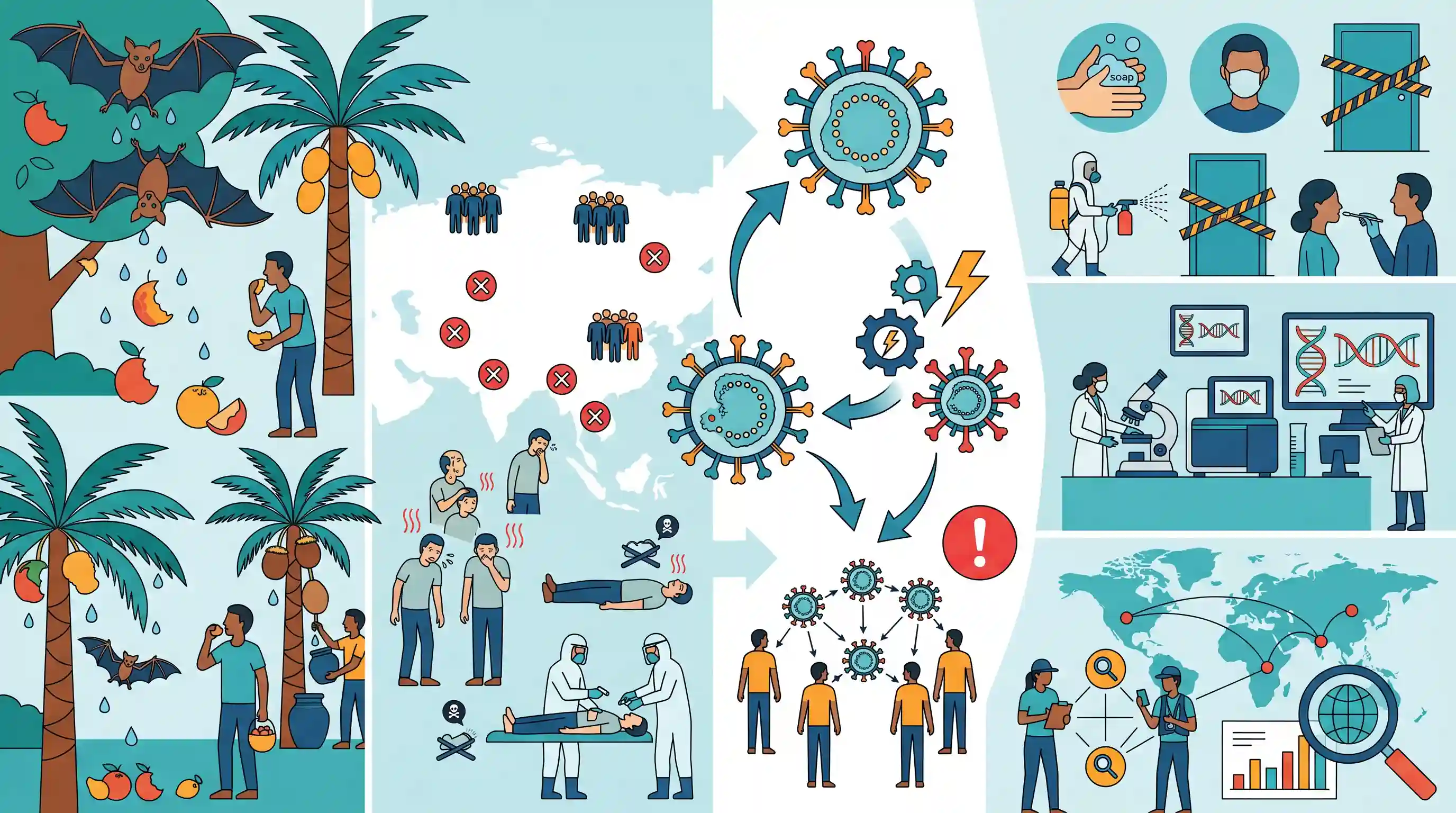
Scientists are sounding the alarm over the Nipah virus, a deadly zoonotic disease with a high mortality rate, warning that it could mutate into an even more transmissible and severe threat. Recurrent outbreaks in regions such as Kerala and Bangladesh highlight the persistent risk of spillover from fruit bats to human populations. Experts emphasize the urgent need for enhanced genomic surveillance, rigorous public health interventions, and robust epidemiological strategies to prevent potential human-to-human transmission that could lead to a broader public health crisis.
Key Points
- Nipah virus (NiV) is a highly lethal zoonotic pathogen primarily hosted by fruit bats of the Pteropodidae family.
- The virus has a case fatality rate ranging from 40% to 75%, presenting a severe risk to infected individuals.
- Recurrent outbreaks have been recorded in South Asia, notably in Bangladesh and Kerala, India, driven by the consumption of contaminated raw date palm sap or close contact with infected animals.
- Scientists warn that NiV could undergo mutations, potentially enhancing its capacity for sustained human-to-human transmission and elevating its pandemic potential.
- Proactive epidemiological surveillance, adherence to the 'One Health' approach, and rapid development of therapeutics such as monoclonal antibodies are critical to mitigate future outbreak risks.
Important Terms
One Health Approach

An integrated framework recognizing the fundamental interdependence of human, animal, and environmental health, aiming to sustainably balance and optimize the health of all three sectors.
UPSC context
GS Paper 2 (Health); tests knowledge of multi-sectoral strategies for preventing zoonotic outbreaks and antimicrobial resistance.
Zoonotic Diseases
Infectious diseases transmitted naturally between animals and humans, caused by bacteria, viruses, or parasites. They account for roughly 75% of emerging human infectious diseases.
UPSC context
GS Paper 3 (Science & Tech); relevant for understanding the origins of pandemics and public health emergencies like Nipah.
Genomic Surveillance
The systematic process of monitoring pathogens by analyzing their genetic material to track mutations, understand transmission routes, and detect new variants of concern.
UPSC context
GS Paper 3 (Biotechnology); assesses understanding of genetic tools in monitoring virus evolution and vaccine development.
Indian Council of Medical Research (ICMR)
India’s apex body for biomedical research, responsible for formulating, coordinating, and promoting medical research, including developing indigenous treatments like monoclonal antibodies for Nipah.
UPSC context
GS Paper 2 (Health Governance); tests awareness of institutional roles in managing domestic health crises and R&D.
Spillover Event
The specific moment when a pathogen jumps from its natural reservoir (like fruit bats) to a new host species, such as humans or domestic animals.
UPSC context
GS Paper 3 (Environment); tests understanding of human-wildlife conflict and ecological factors in disease emergence.
WHO Research and Development Blueprint
A global strategy that identifies priority diseases with pandemic potential—including Nipah—to fast-track the development of diagnostic tests, vaccines, and medicines.
UPSC context
GS Paper 2 (International Institutions); evaluates knowledge of global health priority-setting and pandemic preparedness.
Prelims Trap
"A recently approved viral vaccine is now routinely administered in Kerala to prevent recurrent Nipah outbreaks."
No approved vaccine or specific antiviral drug exists for Nipah. Outbreak management relies entirely on intensive supportive care and experimental therapies like monoclonal antibodies.
Static Concepts Connected
Why do RNA viruses like Nipah mutate faster than DNA viruses?
- Lack of proofreading: RNA polymerases generally lack the proofreading mechanisms found in DNA polymerases, leading to a much higher rate of copying errors during replication.
- Rapid host adaptation: These frequent genetic mutations allow RNA viruses to rapidly adapt to new hosts, facilitating zoonotic spillovers and enhancing human-to-human transmissibility.
What are the core components of the 'One Health' approach?
- Interconnected triad: It recognizes that human health is inextricably linked to the health of animals (domestic and wild) and the broader shared ecosystem.
- Zoonotic surveillance: Focuses on continuous monitoring of wildlife and livestock to identify and contain pathogens before they cross the species barrier into human populations.
- Collaborative governance: Requires multi-sectoral coordination among medical, veterinary, and environmental agencies to manage biological risks holistically.
Cross-Topic Patterns
Habitat fragmentation & zoonotic spillovers
Deforestation and climate-induced habitat shifts force fruit bats into human-dominated landscapes, directly linking ecological degradation in regions like the Western Ghats to recurring public health crises.
Monoclonal antibodies in epidemiology
With no approved vaccines for Nipah, outbreak response relies heavily on biotechnology—particularly monoclonal antibodies—shifting the UPSC focus from traditional immunization to advanced biotherapeutics.

Expect a multi-statement prelims question merging RNA virus characteristics, Nipah transmission vectors, and the One Health framework.
Linked PYQs · 3
Linked PYQs · 3
- 2024PrelimsGS1
With reference to monoclonal antibodies, often mentioned in news, consider the following statements : I. They are man-made proteins. II. They stimulate immunological function due to their ability to bind to specific antigens. III. They are used in treating viral infections like that of Nipah virus. Which of the statements given above are correct?
- 2025PrelimsGS1
With reference to monoclonal antibodies, often mentioned in news, consider the following statements : I. They are man-made proteins. II. They stimulate immunological function due to their ability to bind to specific antigens. III. They are used in treating viral infections like that of Nipah virus. Which of the statements given above are correct?
- 2024MainsGS2
In a crucial domain like the public healthcare system the Indian State should play a vital role to contain the adverse impact of marketisation of the system. Suggest some measures through which the State can enhance the reach of public healthcare at the grassroots level.
