Critical Mineral Block Auctions and Supply Chain Security in India
Source:The Hindu ↗
Why It Matters
Critical minerals are the bedrock of India's green energy transition, high-tech manufacturing, and national security. Tracking ongoing mineral block auctions provides critical insight into India's industrial policy, resource security, and regulatory reforms under the MMDR Act.
Summary
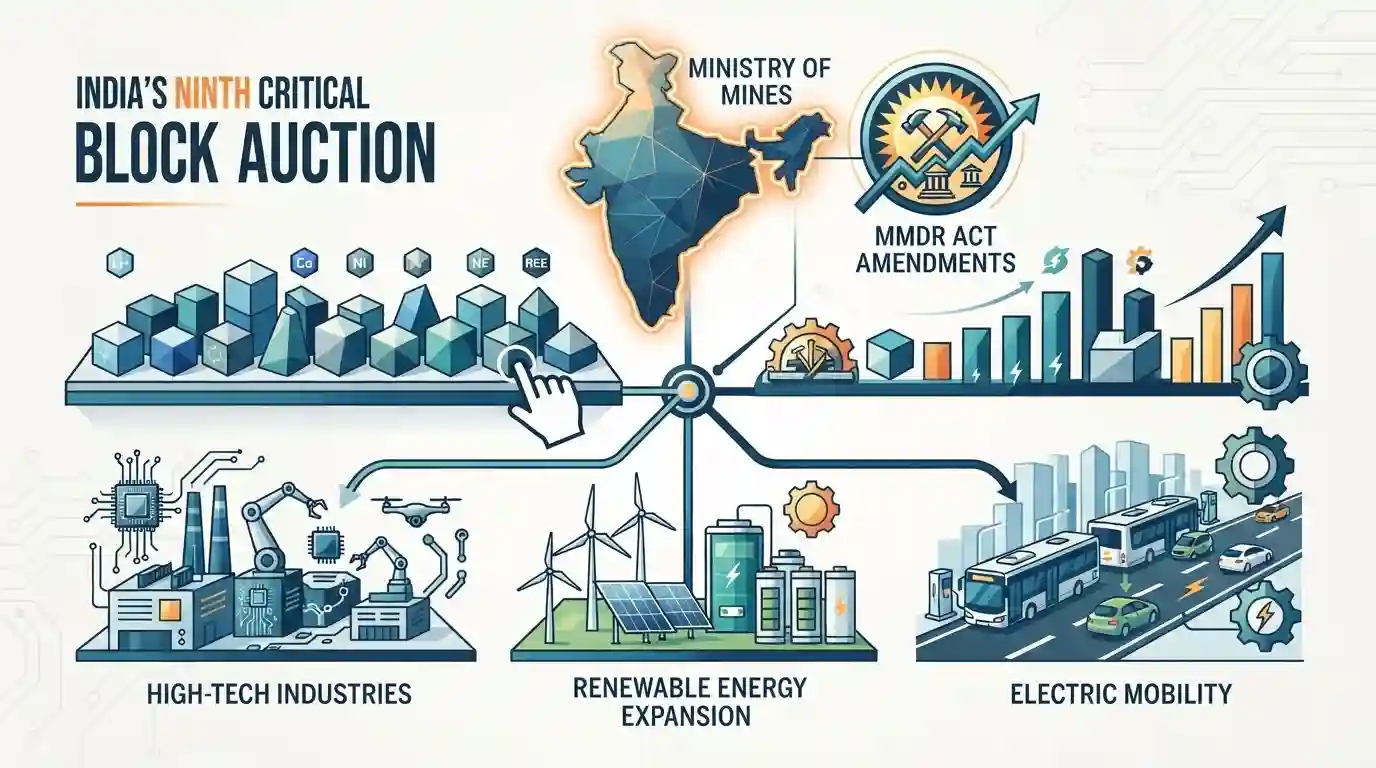
The Ministry of Mines in India has initiated the ninth tranche of critical mineral block auctions, putting 20 critical mineral blocks up for bidding. This move is part of India's ongoing strategy to secure resilient supply chains for high-tech industries, renewable energy expansion, and electric mobility, leveraging the legislative powers granted under the MMDR Act amendments.
Key Points
- The Ministry of Mines has launched the ninth tranche of critical mineral block auctions, offering 20 mineral blocks across various States.
- These auctions aim to boost domestic exploration, reduce import dependency, and secure vital raw materials needed for clean energy, electric vehicles, and high-tech manufacturing.
- The 2023 amendment to the MMDR Act empowered the Central Government to exclusively auction composite licenses and mining leases for critical minerals.
- India continues to expand its strategic self-reliance framework through continuous tranches of mineral block allocations and initiatives like the National Critical Mineral Mission.
Important Terms
Mines and Minerals Development and Regulation Act

The primary central legislation governing the mining sector in India, amended in 2023 to enable private sector auctions of critical and deep-seated minerals like lithium and rare earth elements.
UPSC context
UPSC GS Paper III (Economy / Infrastructure): Tests understanding of mining sector reforms, resource governance, and industrial policy regulations.
National Critical Mineral Mission
A flagship mission approved in 2025 with an outlay of ₹34,300 crore to ensure a secure, self-reliant supply chain of critical minerals through domestic exploration, processing, recycling, and international acquisitions.
UPSC context
UPSC GS Paper III (Energy Security & Clean Energy Transition): Tests knowledge of strategic national initiatives for green mobility and high-tech manufacturing.
Prelims Trap
All atomic minerals can now be freely auctioned by the Central Government to private entities for commercial mining.
Aspirants often confuse atomic minerals with critical minerals; while some restricted atomic minerals were opened up for private mining via the 2023 MMDR Amendment, not all atomic minerals are auctioned by the Central Government under critical mineral tranches.
Static Concepts Connected
What are the key provisions and significance of the MMDR Amendment Act, 2023 regarding critical minerals?
- Central Authority: Empowered the Central Government to exclusively auction composite licenses and mining leases for 24 specified critical and strategic minerals.
- Exploration Licence: Introduced a new 'Exploration Licence' (EL) framework through competitive bidding to attract private investment in deep-seated mineral exploration.
- Atomic De-listing: Removed six minerals—including lithium and titanium—from the restricted list of atomic minerals, opening them up for commercial private mining.
Cross-Topic Patterns
Critical Minerals + Net-Zero Targets
The continuous auction of critical mineral blocks directly underpins India's Nationally Determined Contributions (NDCs) under the Paris Agreement by securing domestic supply chains for EVs and renewable energy.
Mineral Auctions + Make in India
Commercial mining reforms and private exploration licensing leverage the Make in India initiative to substitute high-value technology imports with domestic extraction and refining.

Expect statement-based questions on the MMDR 2023 Amendment: Central vs State powers for critical vs minor minerals and private sector EL framework.
Linked PYQs · 2
Linked PYQs · 2
- 2025PrelimsGS1
Consider the following statements : I. India has joined the Minerals Security Partnership as a member. II. India is a resource-rich country in all the 30 critical minerals that it has identified. III. The Parliament in 2023 has amended the Mines and Minerals (Development and Regulation) Act, 1957 empowering the Central Government to exclusively auction mining lease and composite license for certain critical minerals. Which of the statements given above are correct?
- 2026PrelimsGS1
Which of the following statements about Rare Earth Elements (REEs) and Critical Minerals is/are correct ? 1. Modern technological innovations including Artificial Intelligence, robotics and space exploration extensively utilise Rare Earth Elements (REEs). 2. China has the highest share in mining of REEs followed by India. 3. The Government of India launched the National Critical Mineral Mission (NCMM) in 2025 to establish a robust framework for self-reliance in the critical mineral sector. 4. Rare Earth Elements are a set of 13 metallic elements. Select the answer using the code given below :
