Bihar Lightning Deaths Prompt Ex Gratia and Disaster Caution
Source:theprint ↗
Why It Matters
Lightning strikes are a major natural disaster in Bihar, causing significant casualties annually. Understanding the climatic patterns (like the subtropical monsoon climate of Bihar) and the state's disaster response mechanisms (e.g., ex gratia provisions under the State Disaster Response Fund) is crucial for BPSC aspirants.
Summary
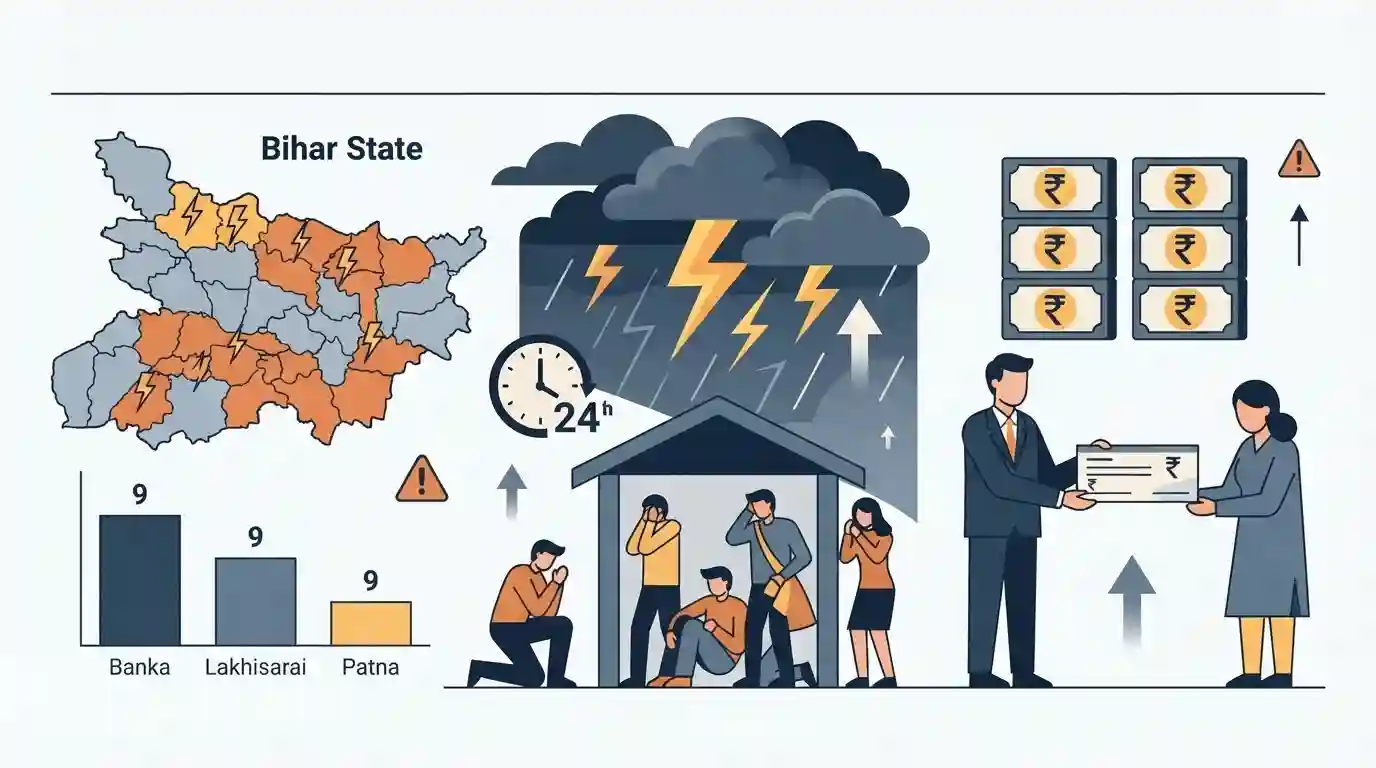
Nine people were killed by lightning strikes in three districts of Bihar (Banka, Lakhisarai, and Patna) in a 24-hour period. In response to the tragedy, the Bihar government announced an ex gratia of Rs 4 lakh for the families of each victim, while officials urged the public to exercise caution during severe weather conditions.
Key Points
- Nine individuals lost their lives due to lightning strikes across Banka, Lakhisarai, and Patna districts in Bihar within 24 hours.
- The Bihar state government announced an ex gratia payment of Rs 4 lakh for the next of kin of each deceased victim.
- Lightning remains a severe and recurring natural disaster in Bihar, particularly during the pre-monsoon and monsoon seasons, necessitating caution and weather monitoring.
Important Terms
Disaster Management Department, Bihar

The nodal agency in Bihar responsible for coordinating emergency responses, issuing weather advisories, and distributing relief—such as ex gratia payments—following natural calamities like lightning strikes.
UPSC context
GS Paper 3 (Disaster Management). Demonstrates the role of state-level institutional frameworks in executing immediate disaster relief protocols.
Bihar State Government
The democratically elected sub-national authority in Bihar. Under India's federal structure, it executes state-list responsibilities, including localized disaster management, public order, and regional welfare distributions.
UPSC context
GS Paper 2 (Polity and Governance). Essential for understanding federal dynamics, state executive powers, and localized public service delivery.
Lightning Strike (State-Specific Disaster)
A massive atmospheric electrostatic discharge. Although not a centrally notified national disaster, states like Bihar classify lightning as a "state-specific disaster" to disburse local relief funds.
UPSC context
GS Paper 1 (Geography) and GS 3. Important for understanding localized weather extremes and sub-national disaster classifications.
Ex Gratia Relief
A lump-sum financial assistance voluntarily provided by the government to the next of kin of disaster victims. In India, standard disaster management protocols prescribe ₹4 lakh per fatality.
UPSC context
GS Paper 2 (Governance) and GS 3 (Disaster Management). Illustrates state welfare mechanisms and financial safety nets during sudden crises.
State Disaster Response Fund (SDRF)
A fund constituted under the Disaster Management Act, 2005. It serves as the primary fund available to State Governments for immediate responses to notified and state-specific disasters.
UPSC context
GS Paper 3 (Disaster Management). Tests knowledge of India's disaster financing mechanisms and standard compensation norms.
Prelims Trap
Lightning is officially classified as a notified national disaster under the Ministry of Home Affairs' SDRF guidelines.
Lightning is NOT currently on the list of 12 notified natural disasters eligible for automatic Central NDRF funding. States must use their discretionary 10% local SDRF window to fund lightning ex-gratia payments.
Static Concepts Connected
What are the physical atmospheric mechanisms that generate lightning?
- convective_instability: Driven by rapid vertical growth of Cumulonimbus clouds due to intense ground heating and high moisture availability.
- charge_separation: Collisions between rising lighter ice crystals and falling denser graupel (soft hail) build positive charges at cloud tops and negative charges at bases.
- electrical_discharge: When the electrical potential gradient overcomes the air's insulating capacity, a rapid discharge occurs (the visible return stroke).
How is the State Disaster Response Fund (SDRF) structured and financed?
- statutory_origin: It is the primary fund available to states, constituted under Section 48(1)(a) of the Disaster Management Act, 2005.
- funding_ratio: The Centre contributes 75% of SDRF allocation for general category states and 90% for North-Eastern and Himalayan states.
- state_discretionary_window: States may utilize up to 10% of their annual SDRF allocation to provide immediate relief for state-specific local disasters not in the federal list.
Cross-Topic Patterns
Climate warming & convective energy (CAPE)
Rising global temperatures increase convective available potential energy (CAPE), causing more intense cumulonimbus formations and a projected 12% rise in lightning strikes per degree of warming.
Rural vulnerability and early warning systems
Over 90% of lightning casualties occur in rural fields; deploying localized early-warning apps like Bihar's 'Indravajra' represents critical, low-cost climate adaptation for agricultural laborers.

2026 Prelims may test the distinction between centrally notified disasters and state-specific disaster funding under the DM Act, 2005.
Linked PYQs · 1
Linked PYQs · 1
- 2025BPSC_PRELIMSGS1
Most of the Bihar comes under which of the following climate type?
