India free trade agreements set to boost West Bengal export sector
Source:tribuneindia ↗
Why It Matters
Highlights India's recent diplomatic and economic strides in establishing FTAs with developed nations and underscores the localized impact of these national policies on regional economies like West Bengal, vital for WBCS economy and geography segments.
Summary
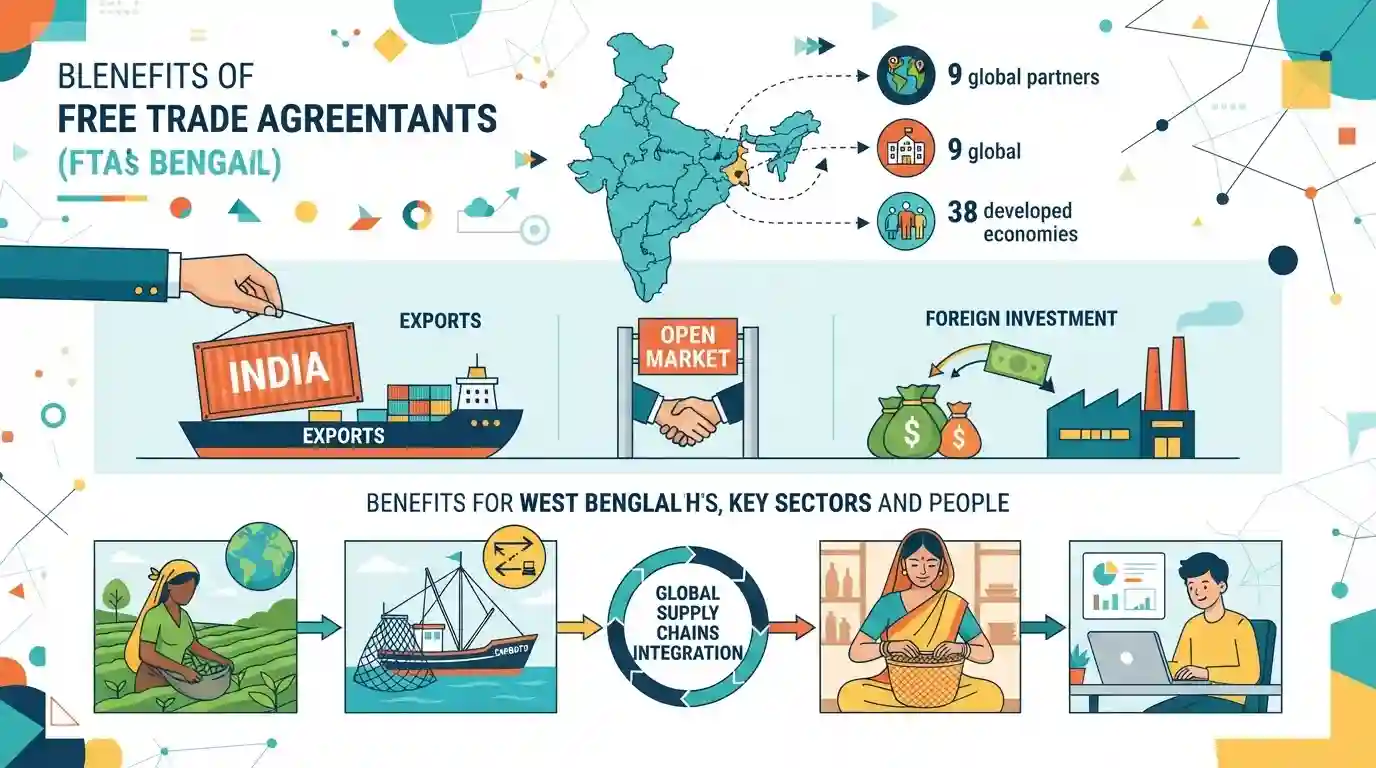
Union Commerce and Industry Minister Piyush Goyal stated that India's conclusion of nine Free Trade Agreements (FTAs) with 38 developed economies over the last three and a half years will bring substantial benefits to West Bengal. The agreements are designed to boost exports, expand market access, and attract foreign investments. In West Bengal, the FTAs are expected to specifically uplift traditional and labor-intensive sectors, offering improved livelihoods for tea growers, fisherfolk, handicraft artisans, women, and the youth by integrating them more deeply into global supply chains.
Key Points
- India has successfully negotiated nine Free Trade Agreements (FTAs) with 38 developed nations over the last 3-3.5 years.
- The FTAs aim to expand global market access, ease trade barriers, and facilitate talent movement to boost Indian exports and attract investments.
- Union Minister Piyush Goyal emphasized that these FTAs will significantly benefit West Bengal, particularly traditional sectors like tea cultivation, fisheries, and handicrafts.
- The trade agreements align with the broader national vision of 'Viksit Bharat', enhancing India's integration into global value chains.
Important Terms
Free Trade Agreements (FTAs)

Treaties between two or more countries or blocs that reduce or eliminate tariffs, quotas, and non-tariff barriers on goods and services to enhance trade and market access.
UPSC context
GS Paper II (International Relations) & GS Paper III (Indian Economy); tests understanding of trade policies, economic integration, and global market access.
Ministry of Commerce and Industry
A nodal Union ministry in India responsible for formulating and implementing national trade policies, enhancing industrial development, regulating foreign trade, and promoting investment.
UPSC context
GS Paper II (Governance) & GS Paper III (Indian Economy); tests knowledge of executive administrative frameworks, export-promotion bodies, and industrial policies.
Global Value Chains (GVCs)
The cross-border fragmentation of a product's lifecycle—including R&D, component manufacture, assembly, and marketing—distributed across multiple countries to maximize cost efficiency and specialization.
UPSC context
GS Paper III (Indian Economy); crucial for analyzing India’s trade competitiveness, domestic manufacturing, FDI inflows, and the 'Make in India' initiative.
Prelims Trap
Free Trade Agreements require signatory nations to completely eliminate customs duties on all traded goods and services without exception.
FTAs feature 'negative lists' or exclusion lists where highly sensitive sectors (like agriculture or dairy in India's trade policy) are excluded from tariff concessions to protect domestic producers.
Static Concepts Connected
What are the main stages of economic integration?
- Preferential Trade Agreement: Provides preferential tariff reduction on a limited list of goods (e.g., India-Mercosur PTA).
- Free Trade Agreement: Eliminates tariffs on a majority of trade, but members maintain individual external tariffs with non-members.
- CEPA vs CECA: A deeper pact covering services, investment, intellectual property, and regulatory standards (e.g., India-UAE CEPA).
- Customs Union: Members apply a common external tariff on imports from non-member nations (e.g., East African Community).
What are 'Rules of Origin' (RoO) in FTAs?
- Definition: The criteria used to determine the national source of a product for tariff application.
- Trade Deflection Prevention: Prevents third-party countries from routing goods through FTA partners to bypass higher tariffs.
- Assessment Methods: Established using value-addition thresholds (e.g., 35% local content) or changes in tariff classification (CTC).
Cross-Topic Patterns
Federalism and foreign trade policy
Explores how foreign trade policies increasingly require state-level export strategies, shifting international trade policy from a purely central domain to cooperative federalism realities.
Global Value Chains and MSMEs
Connects trade liberalization with local employment; easing rules of origin and tariff barriers allows regional clusters (like Darjeeling tea and GI crafts) to join global supply chains.

2026 Prelims may test features of new-generation FTAs, contrasting tariff concessions with non-tariff barriers, RoO, and services mobility.
Linked PYQs · 3
Linked PYQs · 3
- 2024WBCS_PRELIMSGS1
The tax imposed on import and export commodity is known as
- 2014WBCS_PRELIMSGS1
World Trade Organisation (WTO) directed LDCs including India to
- 2011WBCS_PRELIMSGS1
The most ideal region for cultivation of Tea in West Bengal is
