Bihar Police Arrests Individuals for NEET-UG Re-Exam Irregularities
Source:The Hindu ↗
Why It Matters
The incident highlights major systemic vulnerabilities in digital verification processes and the critical need for strict enforcement of public examination security acts (like the Public Examinations Act, 2024) to maintain the sanctity of national competitive examinations.
Summary
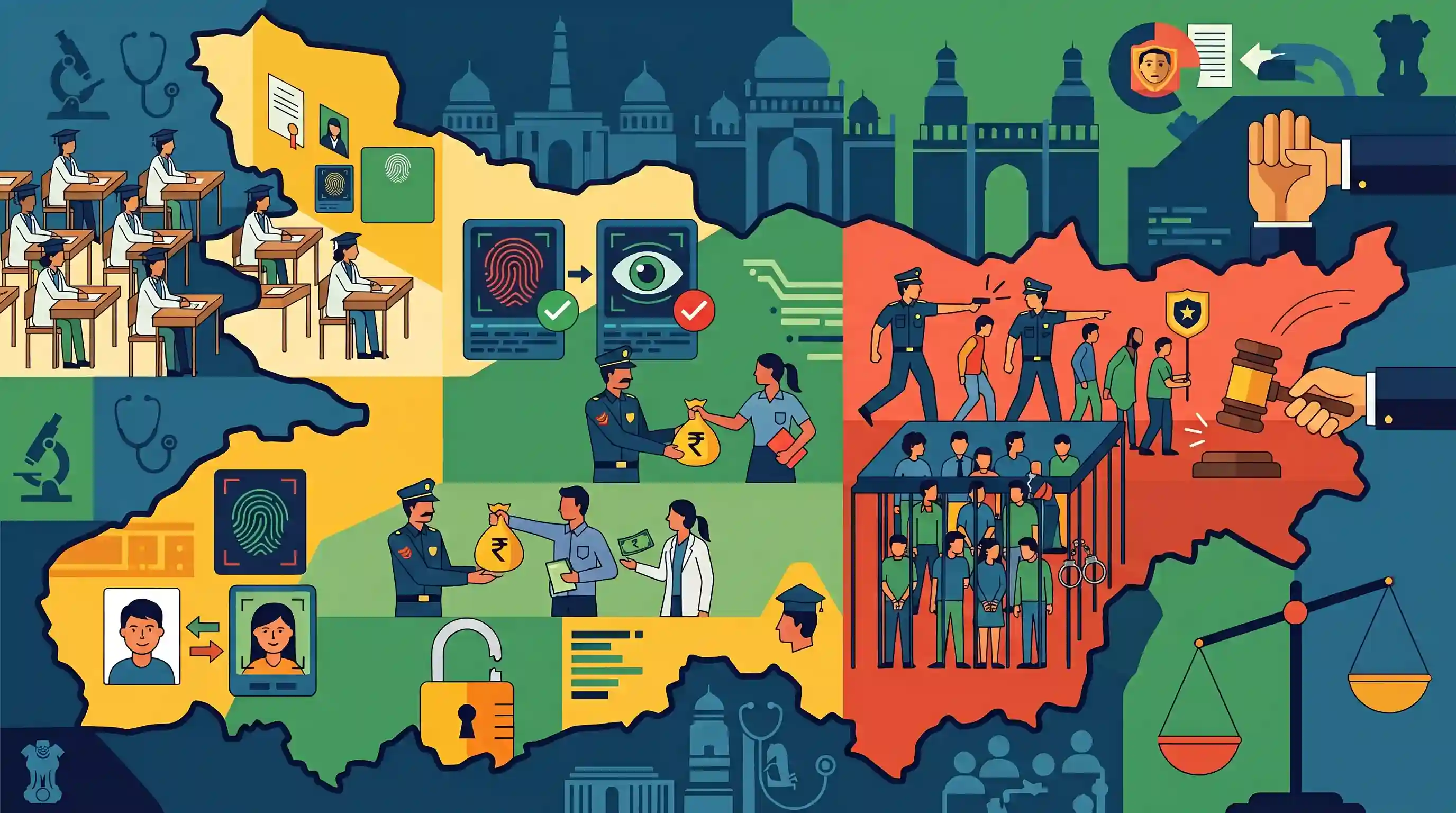
Bihar police arrested 30 individuals, including 18 biometric verification agency staff and several medical students, for orchestrating an impersonation racket during the NEET-UG re-examination. The biometric staff colluded with middlemen to let dummy candidates sit for exams in exchange for bribes.
Key Points
- At least 30 people were arrested across Bihar for attempting irregularities during the NEET-UG re-examination.
- The arrests included 18 staff members of the private agency responsible for biometric verification, who colluded with middlemen to bypass fingerprinting and iris scanning processes.
- Impersonators (dummy candidates) were enrolled medical/nursing/pharmacy students from reputed institutes including PMCH Patna, NMCH Patna, UCMS Delhi, BHU, and AIIMS Raebareli.
- In Lakhisarai district alone, police detained 9 impersonators, 1 genuine candidate, and 2 associates, lodging FIRs at Kiul and Kavaiyya police stations.
- The middlemen and candidates reportedly transacted between ₹5 lakh and ₹10 lakh to bypass the biometric security checks.
Important Terms
Public Examinations (Prevention of Unfair Means) Act, 2024

Central legislation enacted to curb malpractices like paper leaks, cheating, and impersonation in public entrance/recruitment examinations, prescribing stringent penalties including jail and heavy fines for offenders and institutions.
UPSC context
GS Paper II: Governance and Education; tests legislative measures to reform India's public examination system and ensure administrative integrity.
National Testing Agency (NTA)
An autonomous, self-sustained premier testing organization established by the Ministry of Education to conduct highly standardized, transparent, and secure entrance examinations for admission to higher educational institutions.
UPSC context
GS Paper II: Governance and Autonomous Bodies; crucial for topics on educational reforms and administrative transparency.
Bihar Conduct of Examinations Act, 1981
A state-level legislation designed to provide penal action for adopting unfair means, cheating, or aiding malpractices in recognized public and university examinations within the state of Bihar.
UPSC context
GS Paper II: Governance and State Legislations; relevant for understanding regional legal frameworks to curb examination malpractice.
Patna Medical College and Hospital (PMCH)
One of Bihar's premier and oldest state-run medical colleges, whose students and affiliated personnel are periodically implicated in solver-gang activities and entrance examination impersonation rackets.
UPSC context
GS Paper II: Issues related to education; represents the challenge of ethical erosion among professional students in competitive examinations.
AN Magadh Medical College
Formally known as Anugrah Narayan Magadh Medical College and Hospital in Gaya, Bihar, it is a state-run medical institution whose students have been implicated in competitive exam impersonation networks.
UPSC context
GS Paper II: Human resources and education; highlights vulnerabilities in professional colleges where students collude in examination malpractices.
Prelims Trap
The National Testing Agency (NTA) is a statutory body established by an Act of Parliament to conduct public entrance examinations.
UPSC often states that major national exam bodies are established by statutory acts. NTA is an autonomous society registered under the Societies Registration Act, 1860, not a statutory body.
Static Concepts Connected
What is the legal status of the NTA and the Public Examinations Act, 2024?
- NTA Legal Status: The National Testing Agency (NTA) is registered as an autonomous, self-sustained society under the Societies Registration Act, 1860.
- Applicability of Act: The central Public Examinations (Prevention of Unfair Means) Act, 2024 covers central bodies like NTA, UPSC, SSC, RRBs, and IBPS.
- Offense Classification: All offenses registered under this 2024 Act are classified as strictly cognizable, non-bailable, and non-compoundable.
What are the key recommendations of the K. Radhakrishnan Committee on Exam Reforms?
- Infrastructure Shift: Recommended moving exams from outsourced private centers to government-controlled venues like Kendriya Vidyalayas and technical institutes.
- Robust Authentication: Advised implementing Aadhaar-linked multi-stage biometric checks and advanced facial recognition to combat dummy candidate impersonation.
- Digital Transmission: Proposed transitioning to highly secure, encrypted digital transmission of question papers (hybrid/OMR models) to prevent physical leaks.
Cross-Topic Patterns
Cybersecurity vs. insider threats in public exams
Exam leaks focus heavily on cybersecurity, but insider collusion by outsourced biometric staff highlights how human elements and private agencies remain the weakest link in public digital infrastructure.
Exam integrity and demographic dividend friction
Repeated exam irregularities erode meritocracy, driving youth trust deficits, structural unemployment anxiety, and challenging the state's capacity to productively harness its demographic dividend.

UPSC is highly likely to test the non-statutory status of the NTA alongside the strict penal classifications of the 2024 Public Exams Act.
Linked PYQs · 2
Linked PYQs · 2
- 2024-IBPSC_PRELIMSGS1
When was the Patna College established?
- 2022BPSC_PRELIMSGS1
The 'Digital India Award, 2020' was given to the Bihar Government for
