Climate Tech Startups and Urban Sustainability Solutions
Source:The Hindu ↗
Why It Matters
This is highly relevant for UPSC GS3 as it integrates technological innovations (climate-tech startups) with critical environmental challenges in urbanization (waste, water, and energy management). It also touches upon GS1 urban infrastructure and smart cities themes. Candidates can use these startups as case studies for tech-driven solutions to urban sustainability.
Summary
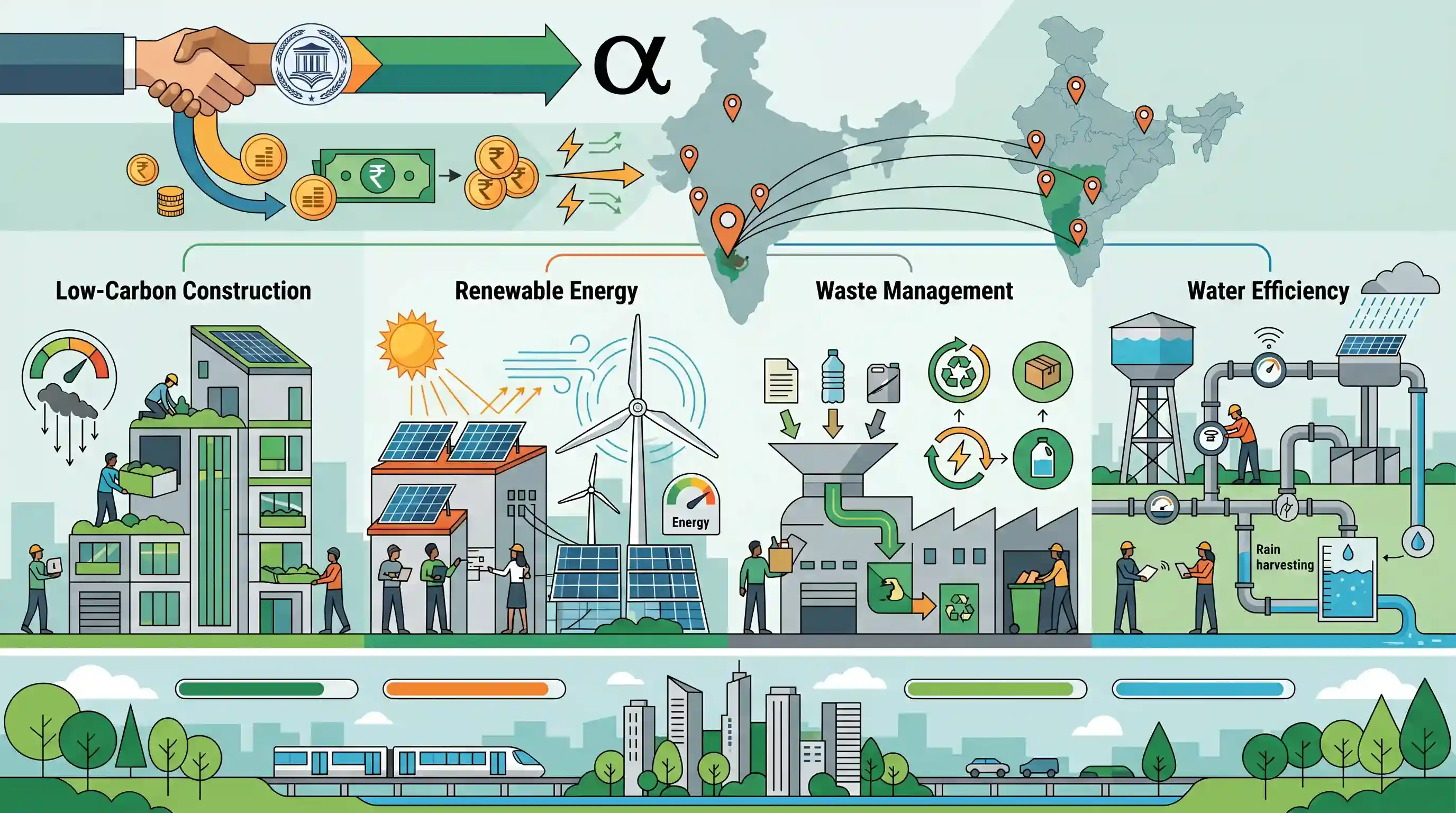
Nine climate-tech start-ups will deploy urban sustainability solutions across 10 Indian cities, including Bengaluru, under the Innovations in Sustainable Urban Transition Program. Led by Social Alpha and the University of Toronto India Foundation, the initiative provides grants of up to ₹35 lakh for projects targeting low-carbon construction, renewable energy, waste management, and water efficiency. The interventions aim to yield measurable environmental outcomes, such as emissions reduction, improved energy efficiency, and better management of urban water resources, contributing to climate-resilient urbanization.
Key Points
- The 'Innovations in Sustainable Urban Transition Program', led by Social Alpha and UTIF, has selected nine climate-tech startups to implement sustainability solutions across 10 Indian cities.
- The startups will receive grants up to ₹35 lakh to test solutions involving low-carbon construction materials, renewable energy, waste management, and water efficiency.
- Key targeted outcomes include mitigating greenhouse gas emissions, increasing solid waste diversion, improving energy efficiency, and reducing non-revenue water losses.
- The initiative underscores the growing intersection of climate technology and urban infrastructure planning to achieve sustainable, resilient cities.
Important Terms
Innovations in Sustainable Urban Transition Program

A collaborative initiative by Social Alpha and UTIF to pilot and scale climate-resilient technologies in Indian cities, targeting net-zero goals and urban resource efficiency.
UPSC context
GS III: Environment/S&T. Tests knowledge of public-private partnerships in achieving climate goals and sustainable urbanization.
Social Alpha
A multi-stage innovation curation and venture development platform supported by Tata Trusts, focused on accelerating science-led start-ups that address critical social and environmental challenges.
UPSC context
GS III: Economy/Innovation. Relevant for understanding the role of incubators and non-profits in the Indian startup ecosystem.
Climate-tech
A technology subset focused on mitigating climate change through emissions reduction, carbon capture, and sustainable resource management (e.g., renewable energy, low-carbon construction).
UPSC context
GS III: Environment. A key sector for climate change mitigation and India's 'Net Zero 2070' commitment.
Office of the Principal Scientific Adviser (PSA)
The premier executive office advising the Indian government on S&T policy, innovation strategy, and inter-ministerial coordination for scientific research.
UPSC context
GS II & III: Governance/S&T. High-level institutional body crucial for national science and innovation policy.
University of Toronto India Foundation (UTIF)
A Mumbai-based non-profit fostering research and entrepreneurship collaborations between the University of Toronto and Indian partners to solve pressing urban sustainability issues.
UPSC context
GS II: International Relations/Education. Highlights international research collaborations and knowledge transfer in urban development.
Urban Local Bodies (ULBs)
Constitutional units of local self-government in India (e.g., Municipal Corporations) responsible for providing urban infrastructure and implementing city-level sustainability projects.
UPSC context
GS I & II: Urbanization/Governance. Key for decentralization, 74th Amendment, and ground-level execution of smart city initiatives.
Prelims Trap
"The Innovations in Sustainable Urban Transition Program is a sub-scheme launched under the Smart Cities Mission by MoHUA."
It is an independent accelerator program led by Social Alpha and the University of Toronto India Foundation, not a statutory MoHUA scheme.
Static Concepts Connected
What is 'Non-Revenue Water' (NRW) in the context of urban infrastructure?
- Definition: Water that has been treated and is "lost" before it reaches the customer due to pipeline leaks, illegal theft, or metering inaccuracies.
- India's Challenge: NRW averages 40-50% in Indian cities, leading to massive energy and financial losses for municipal corporations.
- AMRUT 2.0 Goal: The AMRUT 2.0 national scheme explicitly mandates urban local bodies to implement reforms to bring NRW levels down to below 20%.
How do low-carbon construction materials reduce urban greenhouse gas emissions?
- Emitting Baseline: Conventional kilned clay bricks contribute heavily to emissions (approx. 300 million tonnes of CO2 annually in India) due to the fossil fuels burned in kilns.
- Alternate Materials: Materials like fly ash, mycelium, and recycled demolition waste avoid high-heat kilning and instead utilize industrial or agricultural waste, sequestering carbon.
- Policy Push: The MoEFCC already mandates 100% fly ash utilization for brick manufacturing within a specified radius of coal/lignite-based thermal power plants.
Cross-Topic Patterns
NRW & AMRUT 2.0 Mandates
Tech-driven interventions to curb Non-Revenue Water (NRW) align directly with AMRUT 2.0's core mandate, which requires Urban Local Bodies to reduce water losses to below 20%.
Circular Economy in Construction
Substituting traditional clay bricks with mycelium or agri-waste panels connects urban development with the broader 'Waste-to-Wealth' mission and circular economy policies.

Expect a multi-statement question blending AMRUT 2.0's 'Non-Revenue Water' targets with climate-tech interventions in urban governance.
Linked PYQs · 4
Linked PYQs · 4
- 2024MainsGS3
The world is facing an acute shortage of clean and safe freshwater. What are the alternative technologies which can solve this crisis? Briefly discuss any three such technologies citing their key merits and demerits.
- 2024MainsGS3
Flooding in urban areas is an emerging climate-induced disaster. Discuss the causes of this disaster. Mention the features of two such major floods in the last two decades in India. Describe the policies and frameworks in India that aim at tackling such floods.
- 2025MainsGS1
How does smart city in India, address the issues of urban poverty and distributive justice?
- 2016MainsGS1
With a brief background of quality of urban life in India, introduce the objectives and strategy of the 'Smart City Programme'.
