Nilgiri Tahr and Its Ecological Role in Western Ghats Grasslands
Source:The Hindu ↗
Why It Matters
The Nilgiri Tahr is a vital endemic species of the Western Ghats with high ecological and cultural value. Its conservation ties directly to grassland ecology, invasive species management, and water security in the Shola ecosystem, making it a recurrent theme in both GS3 (Environment) and GS1 (Geography/Culture).
Summary
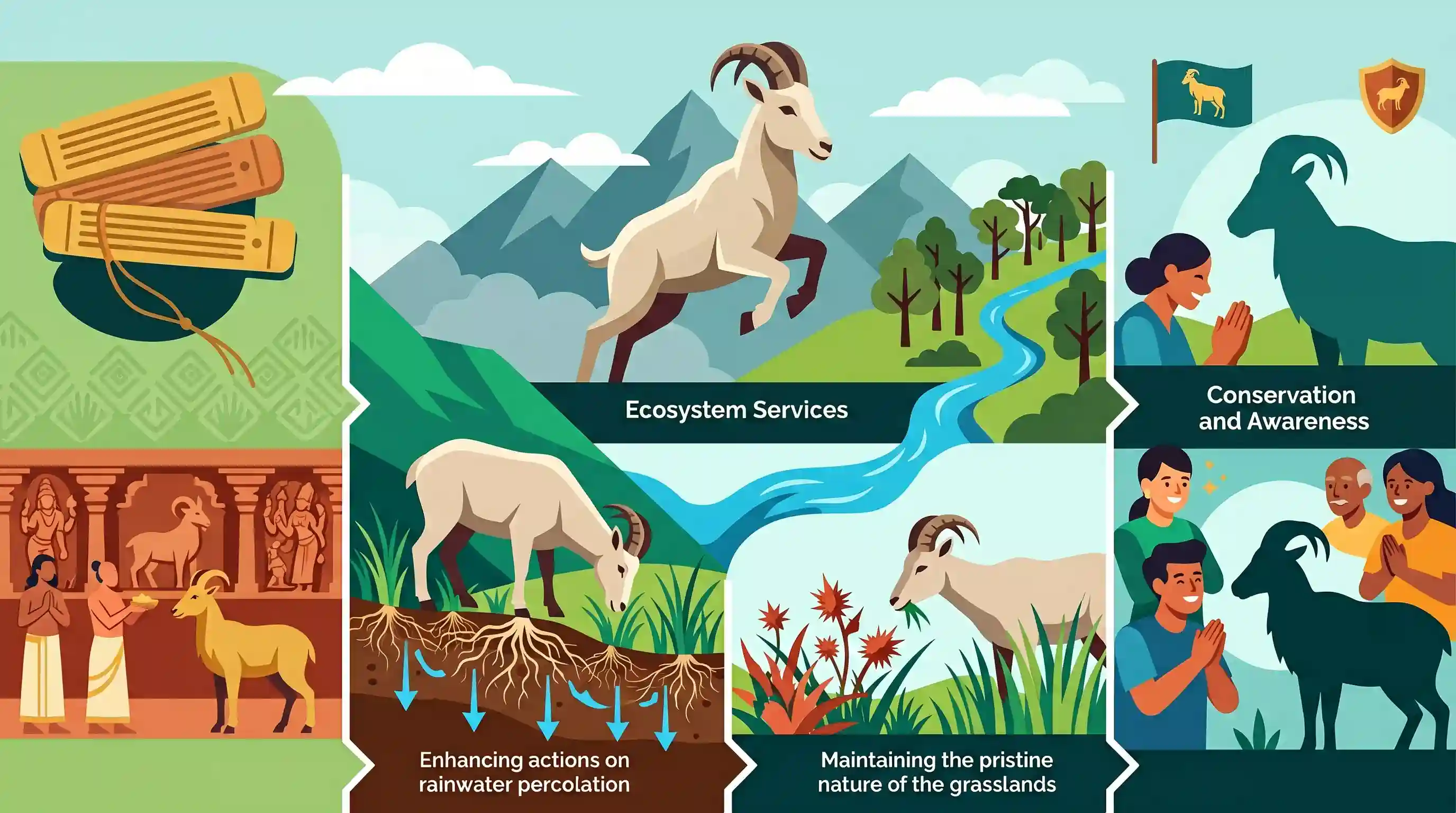
The Tamil Nadu Forest Department recently celebrated 'Nilgiri Tahr Day' on October 7 to raise awareness about the state's iconic animal and its crucial ecological role. Declared the State Animal of Tamil Nadu in 2023, the Nilgiri Tahr is historically celebrated in Sangam literature and acts as a 'saviour of grasslands.' The article highlights that the Tahr's foraging strengthens grass root systems, enhancing rainwater percolation and fostering the birth of streams and rivers in Shola landscapes. Furthermore, these wild goats help maintain the pristine nature of high-elevation grasslands by naturally keeping invasive weeds in check, with current population estimates standing at 1,303 individuals across the state.
Key Points
- The Tamil Nadu Forest Department celebrated 'Nilgiri Tahr Day' on October 7 to promote the conservation of the State Animal.
- The Nilgiri Tahr is culturally significant, with historical references found in ancient Tamil Sangam literature.
- Ecologically, the Tahr acts as a 'saviour of grasslands' by foraging, which strengthens grass root systems and prevents soil erosion.
- Strengthened roots enhance rainwater percolation in Shola grasslands, directly aiding the formation of streams and rivers.
- The grazing habits of the Tahr help maintain the pristineness of high-elevation grasslands by naturally keeping invasive weed species in check.
- Tamil Nadu estimates a population of 1,303 Nilgiri Tahrs across 177 locations, with the highest concentration above the Valparai Shola forests.
Important Terms
Nilgiri Tahr

An endangered mountain ungulate endemic to the southern Western Ghats; it is Tamil Nadu's state animal and the only mountain goat species found in southern India.
UPSC context
GS III (Environment); Prelims (Endemism/Species in News). Tests IUCN status and geographical distribution.
Project Nilgiri Tahr
India's first state-led conservation initiative (2022-2027) focused on population monitoring, radio-collaring, and restoring the high-altitude habitats of the Nilgiri Tahr.
UPSC context
GS III (Conservation); Prelims (Government Initiatives). Tests knowledge of specific state-led wildlife protection strategies.
Shola-grassland Ecosystem
A tropical montane forest-grassland mosaic in the Western Ghats where stunted evergreen forests (Sholas) alternate with high-altitude grasslands, functioning as critical water catchments.
UPSC context
GS I (Geography) & III (Environment). Tests understanding of niche ecosystems and their role in hydrology.
Sangam Literature
Ancient Tamil corpus (c. 300 BCE–300 CE) containing epics like Silappathikaram that describe the Nilgiri Tahr, providing historical context for its cultural and ecological significance.
UPSC context
GS I (Art & Culture/History). Tests connection between historical texts and biodiversity heritage.
Nilgiri Tahr Day
Observed on October 7th to honor conservationist E.R.C. Davidar and raise awareness about the Tahr’s role in maintaining grassland health and stream formation.
UPSC context
Prelims (Environment/Current Affairs). Focuses on state-specific conservation days and ecological awareness campaigns.
Indicator Species
A species whose status reflects the health of its entire habitat; the Tahr serves this role for the fragile high-altitude Western Ghats ecosystem.
UPSC context
GS III (Environment). Tests conceptual understanding of ecosystem health markers and flagship species.
Prelims Trap
"Project Nilgiri Tahr is a Centrally Sponsored Scheme launched by the MoEFCC."
Project Nilgiri Tahr is India's first state-led conservation initiative dedicated to a mountain ungulate, funded and launched by Tamil Nadu, not the Centre.
Static Concepts Connected
What are the key ecological characteristics of Shola-grassland ecosystems?
- High altitude: Found above 1,500m in the Western Ghats (Nilgiris, Anamalais, Munnar), featuring dense patches of stunted evergreen trees.
- Montane grasslands: Tree patches are naturally confined to valleys and folds, surrounded by vast rolling grasslands that host endemic grazers.
- Hydrological sponge: The soil and grass root networks act as a giant sponge, absorbing monsoon rain and releasing it to form perennial streams.
How is ecology classified under the 'Thinai' concept in Sangam literature?
- Five landscapes: Ancient Tamil poetry categorized land into five eco-zones: Kurinji, Mullai, Marutham, Neithal, and Palai.
- Kurinji zone: Represents mountainous regions and their associated flora, fauna, and indigenous tribes. The Nilgiri Tahr (Varaiaadu) belongs to this mountainous literary classification.
Cross-Topic Patterns
Species ecology paired with ancient literature
UPSC increasingly tests species through historical lenses (e.g., ancient texts). The Nilgiri Tahr's mention in epics like Silappathigaram makes it a prime candidate for a history-ecology hybrid question.
Endemic grazers fighting invasive exotics
There is a growing syllabus focus on invasive species. Highlighting native fauna (like the Tahr) as a natural check against invasive weeds in the Western Ghats shows a modern habitat restoration approach.

Expect a 2026 Prelims question linking the Nilgiri Tahr's IUCN status, Shola forest water retention, and its Sangam literature ties.
Linked PYQs · 4
Linked PYQs · 4
- 2023PrelimsGS1
'Invasive Species Specialist Group' (that develops Global Invasive Species Database) belongs to which one of the following organizations?
- 2022PrelimsGS1
Which one of the following statements about Sangam literature in ancient South India is correct?
- 2017PrelimsGS1
From the ecological point of view, which one of the following assumes importance in being a good link between the Eastern Ghats and the Western Ghats?
- 2022PrelimsGS1
"If rainforests and tropical forests are the lungs of the Earth, then surely wetlands function as its kidneys." Which one of the following functions of wetlands best reflects the above statement?
