Nicobarese Opposition to Great Nicobar Wildlife Sanctuaries Proposal
Source:The Hindu ↗
Why It Matters
The Great Nicobar development project is a critical case study for UPSC aspirants on the 'Environment vs. Development' debate. It interlinks multiple high-yield themes: the ecological impact of large infrastructure (GS3), the procedural nuances of Environmental Impact Assessments (GS3), and the legal protections afforded to indigenous and vulnerable tribes under the Forest Rights Act (GS2/Prelims). Questions on the roles of Gram Sabhas vs. Tribal Councils, PVTGs like the Shompen, and endemic species of the Andaman & Nicobar islands are frequent in both Prelims and Mains.
Summary
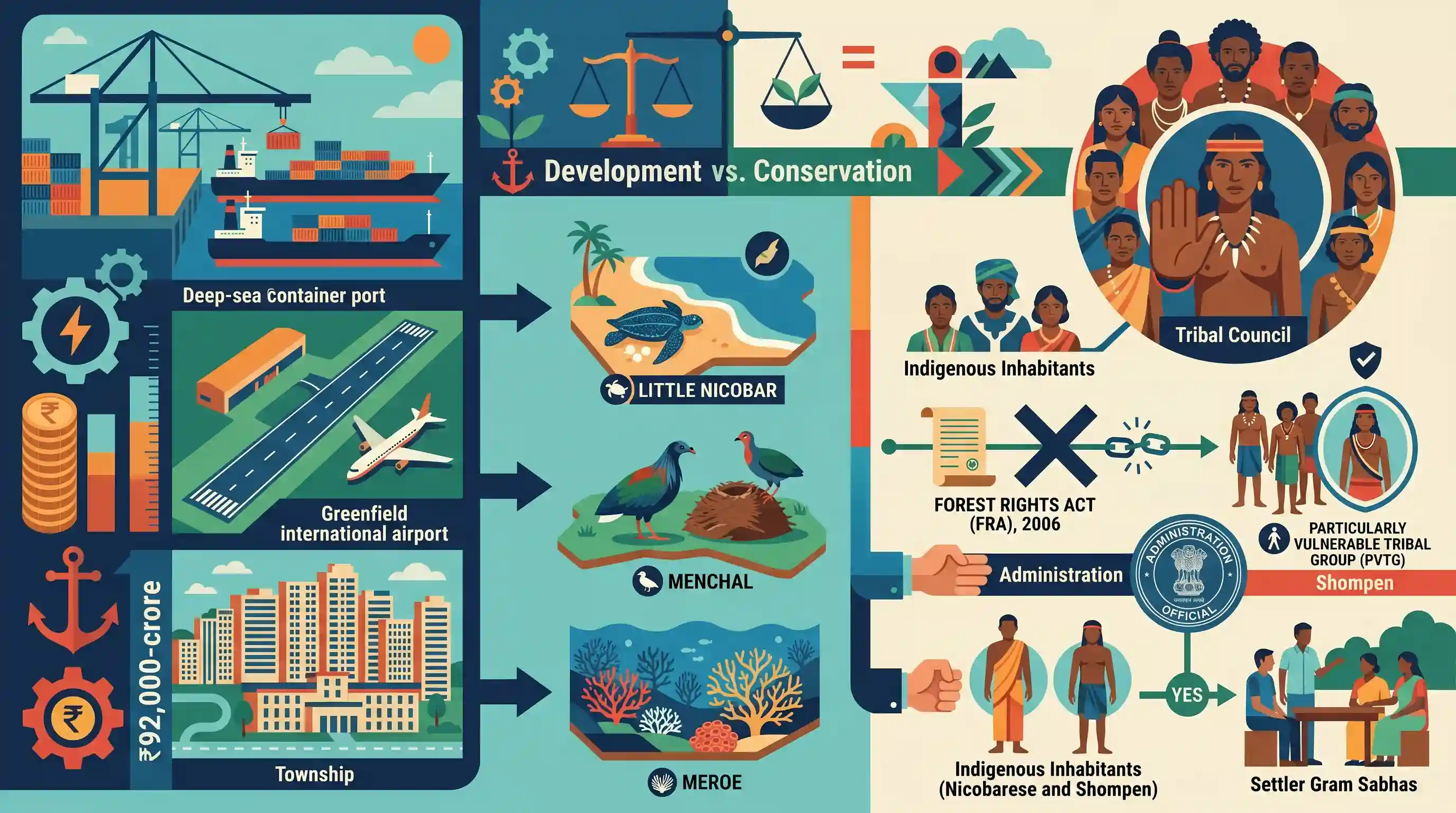
The Tribal Council of Little and Great Nicobar has strongly opposed the Union government's proposal to establish three wildlife sanctuaries on Little Nicobar, Menchal, and Meroe islands. These sanctuaries—intended to protect leatherback turtles, megapodes, and corals—are being established as mitigation measures for the ₹92,000-crore Great Nicobar Island (GNI) infrastructure project. The Nicobarese community claims the administration bypassed their Tribal Council and violated the Forest Rights Act (FRA), 2006, by seeking consent from settler Gram Sabhas rather than the indigenous inhabitants, including the Shompen, a Particularly Vulnerable Tribal Group (PVTG). The conflict highlights the tension between strategic infrastructure development and the socio-cultural and environmental rights of indigenous populations.
Key Points
- The Union government's ₹92,000-crore Great Nicobar Island (GNI) project includes an international container transhipment port, an airport, and a township, requiring the diversion of 130 sq. km of forest land.
- As a mitigation measure, the government plans to notify three wildlife sanctuaries for leatherback turtles, megapodes, and corals on Little Nicobar, Menchal, and Meroe islands.
- The Tribal Council of Little and Great Nicobar is protesting the sanctuaries, alleging the administration bypassed them and violated the Forest Rights Act (FRA), 2006.
- The tribal council claims the administration inappropriately obtained project consent from settler Gram Sabhas instead of the indigenous Nicobarese and Shompen (a PVTG) communities.
- The islands hold high cultural and spiritual significance for the tribes, who rely on the local forests and coasts for their livelihood.
Important Terms
Forest Rights Act (FRA), 2006

Legislation recognizing the rights of forest-dwelling Scheduled Tribes and traditional dwellers over land and resources. It mandates Gram Sabha consent for any diversion of forest land for non-forest purposes.
UPSC context
GS Paper II (Governance) and GS Paper III (Environment); tests rights of vulnerable sections and decentralized forest management.
Great Nicobar Island (GNI) Project
A ₹92,000-crore 'Holistic Development' plan on Great Nicobar featuring an international transshipment terminal, greenfield airport, power plant, and smart city. It is strategically located near the Malacca Strait.
UPSC context
GS Paper III (Environment & Infrastructure); highlights the 'Development vs. Conservation' debate and India's maritime strategy.
Tribal Council of Little and Great Nicobar
A statutory representative body for the Nicobarese and Shompen tribes. It possesses civil-court-like powers to monitor tribal safeguards and must be consulted on matters affecting indigenous lands.
UPSC context
GS Paper II (Governance/Polity); tests understanding of tribal self-governance and statutory bodies in Union Territories.
Gram Sabha
The full assembly of all adults in a village. Under the FRA, it is the primary authority to initiate and verify claims for individual and community forest rights.
UPSC context
GS Paper II (Local Self-Government) and GS Paper III (Environment); focuses on grassroots democracy and community-led conservation.
Particularly Vulnerable Tribal Groups (PVTGs)
A classification for 75 tribal groups (like the Shompen) characterized by stagnant populations, pre-agricultural technology, and low literacy, requiring high-level protection and targeted development.
UPSC context
GS Paper II (Social Justice) and Prelims; tests identification criteria (Dhebar Commission) and special safeguards for marginalized tribes.
Habitat Rights
Special rights granted to PVTGs under Section 3(1)(e) of the FRA, protecting their traditional territories, socio-cultural practices, and ecological knowledge beyond simple land ownership.
UPSC context
GS Paper III (Environment/Social Justice); tests specialized legal protections for the most isolated and vulnerable tribal communities.
Prelims Trap
Both the Shompen and the Nicobarese communities are classified as Particularly Vulnerable Tribal Groups (PVTGs).
Only five tribes in A&N are PVTGs: Great Andamanese, Jarawas, Onges, Sentinelese, and Shompens. The Nicobarese are a Scheduled Tribe, but they are not classified as a PVTG.
Static Concepts Connected
What is the statutory role of the Gram Sabha under the Forest Rights Act (FRA), 2006?
- Initiation Authority: It is the sole authority to initiate the process of determining the nature and extent of Individual and Community Forest Rights (CFR).
- Resolution Passing: It passes a resolution confirming these rights, which is then forwarded to the Sub-Divisional Level Committee (SDLC) for verification.
- Protection Mandate: It is empowered to protect wildlife, forests, and biodiversity, ensuring community habitats are preserved from destructive practices.
What are the ecological characteristics of the species targeted for GNI mitigation?
- Giant Leatherback Turtle: The world's largest marine turtle (Vulnerable). Galathea Bay in Great Nicobar serves as one of its most critical global nesting sites.
- Nicobar Megapode: A Vulnerable ground-dwelling scrubfowl endemic to the Nicobar Islands that uniquely incubates its eggs using the heat from decomposing vegetation mounds.
Cross-Topic Patterns
Strategic Geography vs Ecological Preservation
The Galathea Bay transshipment port is vital to India's Indo-Pacific strategy to monitor the Malacca Strait, directly pitting maritime security imperatives against pristine ecology and indigenous rights.
Compensatory Conservation vs FRA 2006
Establishing new sanctuaries to 'mitigate' infrastructure damage often triggers secondary displacement of indigenous groups, highlighting how compensatory conservation can clash with the Forest Rights Act (FRA).

Expect a multi-statement question on A&N tribes (Shompen/Nicobarese) linked with FRA 2006 Gram Sabha authority and Galathea Bay geography.
Linked PYQs · 5
Linked PYQs · 5
- 2013PrelimsGS1
Under the Scheduled Tribes and Other Traditional Forest Dwellers (Recognition of Forest Rights) Act, 2006, who shall be the authority to initiate the process for determining the nature and extent of individual or community forest rights or both?
- 2021PrelimsGS1
At the national level, which ministry is the nodal agency to ensure effective implementation of the Scheduled Tribes and Other Traditional Forest Dwellers (Recognition of Forest Rights) Act, 2006?
- 2022PrelimsGS1
"Biorock technology" is talked about in which one of the following situations?
- 2024MainsGS3
What role do environmental NGOs and activists play in influencing Environmental Impact Assessment (EIA) outcomes for major projects in India? Cite four examples with all important details.
- 2020MainsGS3
How does the draft Environment Impact Assessment (EIA) Notification, 2020 differ from the existing EIA Notification, 2006?
