Great Nicobar Project and Indigenous Land Rights
Source:The Hindu ↗
Why It Matters
This issue highlights the classic conflict between large-scale infrastructural development and the rights of indigenous communities (Scheduled Tribes/PVTGs). It provides a concrete case study for Mains answers regarding the enforcement of the Forest Rights Act (FRA), the efficacy of Environmental Impact Assessments (EIAs), and the socio-economic displacement of vulnerable groups.
Summary
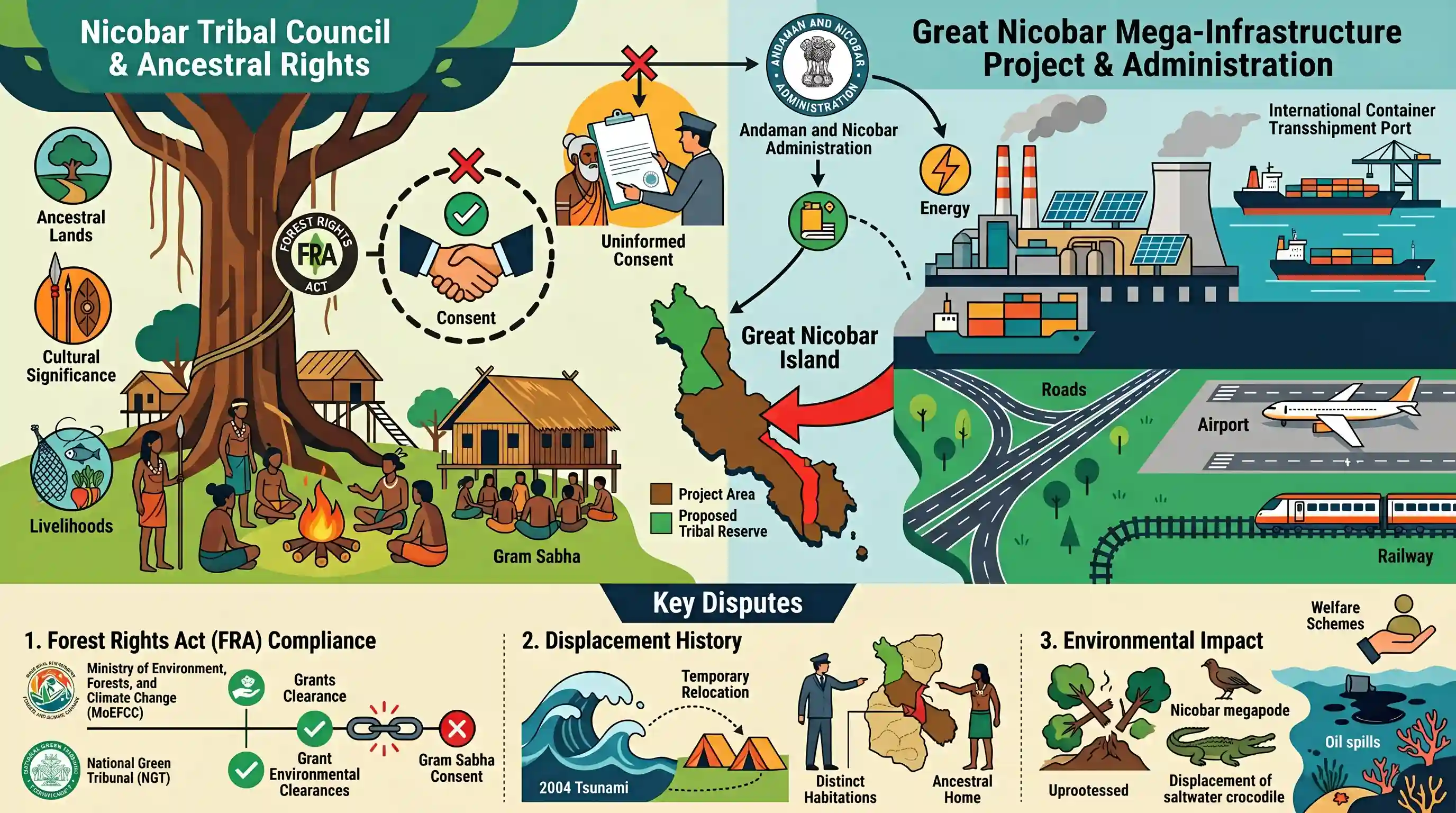
The Nicobar Tribal Council has formally alleged that the Andaman and Nicobar administration is coercing them to sign 'surrender certificates' for their ancestral lands to facilitate the ₹92,000 crore Great Nicobar mega-infrastructure project. The administration maintains that the tribal communities were relocated after the 2004 tsunami and their original habitations are distinct from the project area. However, the Tribal Council contends that this relocation was temporary and that the proposed developmental sites in Galathea Bay are historically and culturally significant to them. The tribal body also questions the environmental clearances granted by the Ministry of Environment, Forests, and Climate Change (MoEFCC) and upheld by the National Green Tribunal (NGT), alleging that mandatory Forest Rights Act (FRA) compliance—specifically informed consent from the Gram Sabha—has been systematically bypassed.
Key Points
- The ₹92,000 crore Great Nicobar mega project includes an International Container Transhipment Port, an international airport, a power plant, and a township, overseen by ANIIDCO.
- The Nicobar Tribal Council alleges coercion by the local administration to sign surrender certificates for ancestral lands, bypassing the requirement for informed Gram Sabha consent under the Forest Rights Act (FRA).
- While the government claims the project site is uninhabited and will cause no displacement, the tribal communities assert that their post-2004 tsunami relocation to Campbell Bay was temporary, and their ancestral domains lie within the project's footprint.
- Disputed territories include Galathea Bay, Pemmaya Bay, and Nanjappa Bay, which the tribes historically utilized for settlement and sustenance prior to the tsunami.
- Despite initial objections, the National Green Tribunal (NGT) upheld the environmental clearances granted by the MoEFCC, a decision the Tribal Council intends to legally challenge.
Important Terms
Great Nicobar Island project

A ₹72,000–92,000 crore mega-project comprising a transshipment port at Galathea Bay, an international airport, a power plant, and a township, aimed at strategic Indo-Pacific maritime dominance.
UPSC context
GS III: Infrastructure/Environment. Tests the trade-offs between strategic maritime interests and the rights of indigenous Shompen and Nicobarese tribes.
Forest Rights Act (FRA)
Legislation that recognizes and vests land and resource rights in forest-dwelling tribes. Crucially, it mandates informed consent from the Gram Sabha before forest land can be diverted for development.
UPSC context
GS II & III: Social Justice/Environment. Key for understanding tribal land alienation and the legal requirement for Gram Sabha consent in forest diversion.
National Commission for Scheduled Tribes (NCST)
A constitutional body established under Article 338A to safeguard tribal interests. It investigates complaints regarding the violation of rights and monitors safeguards provided to Scheduled Tribes.
UPSC context
GS II: Constitutional Bodies. Relevant for institutional mechanisms protecting vulnerable sections and oversight of projects in Scheduled Areas.
National Green Tribunal (NGT)
A specialized statutory body for effective and expeditious disposal of cases relating to environmental protection and conservation of forests, including reviewing environmental clearances for large projects.
UPSC context
GS II & III: Statutory Bodies/Environment. Tests environmental jurisprudence and the balance of 'Strategic Importance' versus 'Ecological Safeguards.'
Andaman and Nicobar Islands Integrated Development Corporation (ANIIDCO)
The nodal agency and project proponent for the Great Nicobar project. It manages the commercial exploitation of natural resources in the A&N Islands under the local administration.
UPSC context
GS III: Economy/Infrastructure. Relevant for studying the role of Public Sector Undertakings (PSUs) in regional development and associated conflicts of interest.
Nicobar Tribal Council
The traditional representative governance body of the Nicobarese tribe that manages ancestral land claims and communal affairs under the islands' aboriginal protection regulations.
UPSC context
GS II: Polity. Highlights traditional tribal leadership structures and their legal standing in federal disputes over land and resources.
Prelims Trap
"Both Shompen and Nicobarese tribes of Great Nicobar are classified as Particularly Vulnerable Tribal Groups (PVTGs)."
While the Shompen are recognized as a PVTG, the Nicobarese are classified only as a Scheduled Tribe. Conflating the two due to shared geography is a common error.
Static Concepts Connected
What is the role of the Gram Sabha under the Forest Rights Act (FRA), 2006?
- Initiating Authority: The Gram Sabha is the statutory authority to initiate the process for determining the nature and extent of Individual/Community Forest Rights.
- Consent for Relocation: No forest dwellers can be resettled or have their rights modified without the free, prior, and informed consent of the Gram Sabha.
- Nodal Ministry: The Ministry of Tribal Affairs (MoTA) acts as the nodal agency for implementing the FRA, not the MoEFCC.
What are the key ecological and demographic features of Great Nicobar Island?
- Biosphere Reserve: It is a designated Biosphere Reserve included in the UNESCO World Network of Biosphere Reserves.
- Key Species: Galathea Bay is a globally significant nesting site for the Giant Leatherback turtle. Other endemics include the Nicobar megapode.
- Indigenous Tribes: Inhabited by the Shompen (an inland, forest-dwelling PVTG) and the Nicobarese (a coastal, agricultural Scheduled Tribe).
Cross-Topic Patterns
Mega-projects in fragile ecosystems
The Great Nicobar project mirrors tensions in the Char Dham Pariyojana and Ken-Betwa link, where strategic infrastructure necessitates massive forest diversion, testing the robustness of Environmental Impact Assessments (EIA).
Strategic island geography vs tribal welfare
The proposed Galathea Bay transhipment terminal is driven by the need to secure the Malacca Strait chokepoint, highlighting the friction between national maritime security and indigenous tribal rights.

Expect a multi-statement question interlinking Galathea Bay ecology, Shompen PVTG status, and FRA Gram Sabha consent powers in 2026 Prelims.
Linked PYQs · 5
Linked PYQs · 5
- 2013PrelimsGS1
Under the Scheduled Tribes and Other Traditional Forest Dwellers (Recognition of Forest Rights) Act, 2006, who shall be the authority to initiate the process for determining the nature and extent of individual or community forest rights or both?
- 2021PrelimsGS1
At the national level, which ministry is the nodal agency to ensure effective implementation of the Scheduled Tribes and Other Traditional Forest Dwellers (Recognition of Forest Rights) Act, 2006?
- 2019PrelimsGS1
Consider the following statements: 1. As per recent amendment to the Indian Forest Act, 1927, forest dwellers have the right to fell the bamboos grown on forest areas. 2. As per the Scheduled Tribes and Other Traditional Forest Dwellers (Recognition of Forest Rights) Act, 2006, bamboo is a minor forest produce. 3. The Scheduled Tribes and Other Traditional Forest Dwellers (Recognition of Forest Rights) Act, 2006 allows ownership of minor forest produce to forest dwellers. Which of the statements given above is/are correct?
- 2024MainsGS3
What role do environmental NGOs and activists play in influencing Environmental Impact Assessment (EIA) outcomes for major projects in India? Cite four examples with all important details.
- 2014MainsGS3
Environmental Impact Assessment studies are increasingly undertaken before a project is cleared by the Government. Discuss the environmental impacts of coal-fired thermal plants located at coal pitheads.
