Indigenous Garudastra Mortar System Tested for Indian Army
Source:The Hindu ↗
Why It Matters
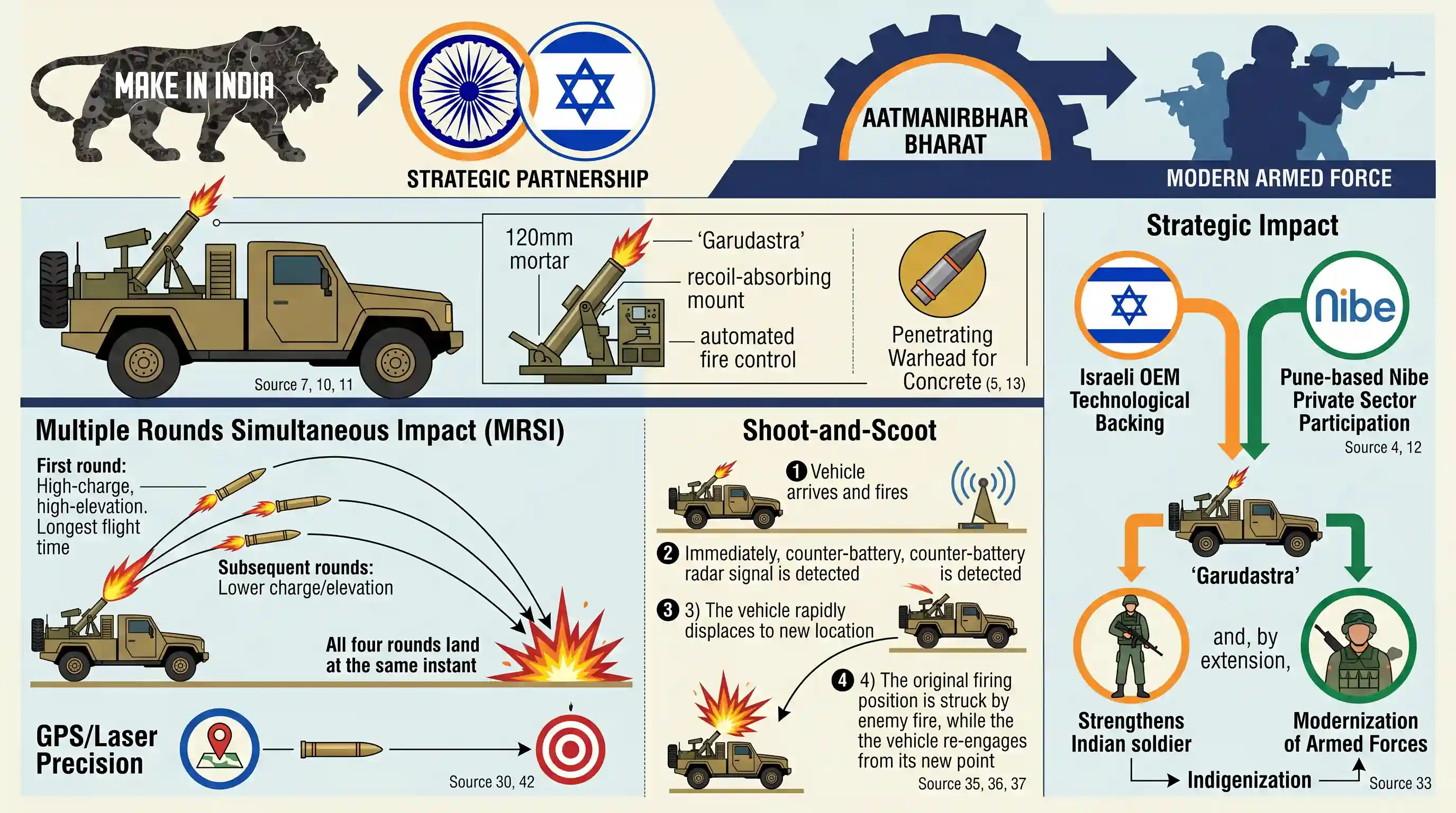
It showcases the practical implementation of defense indigenization, highlighting how private Indian defense startups are leveraging foreign strategic partnerships (Israel) to develop advanced warfare technologies (like MRSI and shoot-and-scoot artillery) for the armed forces.
Summary
Pune-based Nibe Limited successfully demonstrated its 120mm vehicle-mounted mortar system, 'Garudastra', at the Infantry School in Mhow during a no-cost-no-commitment evaluation for the Indian Army. Developed with technological backing from Israeli OEM partners, the mortar system is equipped with precision-guided munitions, a 10-km range, and 'shoot-and-scoot' capabilities to evade counter-battery fire. Crucially, it features Multiple Rounds Simultaneous Impact (MRSI) technology for enhanced lethality. The system's successful demonstration represents a significant stride in India's defense indigenization efforts under the 'Make in India' and Aatmanirbhar Bharat initiatives, highlighting the value of private sector participation and strategic international collaborations.
Key Points
- 'Garudastra' is a 120mm vehicle-mounted mortar system developed by Pune-based Nibe Limited, recently demonstrated at the Infantry School in Mhow.
- The system features advanced 'shoot-and-scoot' capabilities, meaning it can take firing position in under 30 seconds, fire rounds, and relocate quickly to avoid counter-battery fire.
- It possesses a Multiple Rounds Simultaneous Impact (MRSI) capability, firing multiple rounds at different trajectories to hit the target concurrently.
- The system fires GPS and laser-guided munitions with a range of up to 10 kilometers, providing highly accurate indirect fire support.
- Developed in collaboration with Israeli OEM partners, the project underscores the success of 'Make in India' and strategic defense partnerships in boosting domestic manufacturing.
Important Terms
Indigenization of Technology

The development and production of defense equipment within India using local resources and expertise to achieve strategic autonomy and reduce reliance on imports.
UPSC context
GS Paper 3 (Science and Tech; Defense); tests understanding of strategic autonomy and domestic manufacturing ecosystems.
Make in India
A national initiative launched in 2014 to transform India into a global manufacturing hub by facilitating investment, fostering innovation, and enhancing skill development.
UPSC context
GS Paper 3 (Economy); relevant for questions on industrial growth, FDI, and sectoral manufacturing targets.
Aatmanirbhar Bharat
A vision for a 'Self-Reliant India' launched in 2020, resting on five pillars: Economy, Infrastructure, System, Vibrant Demography, and Demand.
UPSC context
GS Paper 2 (Government Policies) and GS Paper 3 (Growth/Development); central to current administrative and economic strategies.
Multiple Rounds Simultaneous Impact (MRSI)
An artillery technique where a single gun fires multiple shells at different angles and speeds so they impact the target at the same moment.
UPSC context
GS Paper 3 (Science and Tech); demonstrates advancements in ballistic computing and modern artillery lethality.
Garudastra
An indigenous 120mm vehicle-mounted mortar system featuring 'shoot-and-scoot' capabilities, precision-guided munitions, and a 10-km range.
UPSC context
GS Paper 3 (Internal Security/Defense); example of private sector participation in high-tech defense production.
Infantry School, Mhow
A premier training and tactical research institution of the Indian Army in Madhya Pradesh, responsible for developing infantry doctrine and training.
UPSC context
General awareness of key national defense institutions and their role in military modernization.
Prelims Trap
"Garudastra is an indigenous beyond-visual-range (BVR) air-to-air missile developed by DRDO."
The suffix 'astra' often tricks candidates into assuming it is a missile like the DRDO's Astra. Garudastra is actually a vehicle-mounted mortar system.
Static Concepts Connected
What are tactical artillery capabilities like 'Shoot-and-Scoot' and 'MRSI'?
- Shoot-and-Scoot: Tactics where mobile artillery rapidly fires and relocates to evade enemy counter-battery radar detection and retaliatory strikes.
- MRSI: Firing several shells at varying trajectories and elevations so they strike a single target at the exact same moment, maximizing initial lethality.
How does DAP promote private sector participation via 'Make' categories?
- Make-I: Government-funded projects where the Ministry of Defence provides substantial funding (historically 70-90%) for prototype development.
- Make-II: Industry-funded prototype development primarily focused on import substitution and innovative solutions by private Indian vendors.
- Make-III: Indigenously manufactured equipment relying on foreign designs, promoting localized production and technology transfer.
Cross-Topic Patterns
India-Israel defense co-production
Demonstrates the strategic shift in India-Israel defense ties from mere buyer-seller transactions (e.g., Heron drones, Phalcon AWACS) to active joint research, co-development, and private-sector OEM partnerships.
Private sector defense ecosystem
Highlights the transition from a DPSU-dominated landscape to an active private-sector defense ecosystem, driven by import embargo lists, DAP 2020 'Make' categories, and Defense Industrial Corridors.

Expect a match-the-following Prelims question pairing defense systems like "Garudastra", "Vajra", and "Pinaka" with their tactical functions.
Linked PYQs · 3
Linked PYQs · 3
- 2014MainsGS3
Foreign Direct Investment (FDI) in the defence sector is now set to be liberalized. What influence this is expected to have on Indian defence and economy in the short and long run?
- 2018MainsGS2
“India’s relations with Israel have, of late, acquired a depth and diversity, which cannot be rolled back.” Discuss.
- 2023PrelimsGS1
Consider the following statements: 1. Ballistic missiles are jet-propelled at subsonic speeds throughout their flights, while cruise missiles are rocket-powered only in the initial phase of flight. 2. Agni-V is a medium-range supersonic cruise missile, while BrahMos is a solid-fuelled intercontinental ballistic missile. Which of the statements given above is/are correct?
