Judicial Officers Protection and National Investigation Agency Probe
Source:The Hindu ↗
Why It Matters
The incident highlights the vulnerability of officials conducting sensitive demographic or electoral exercises. It underscores the intersection of judicial independence, electoral integrity, and federal intervention, demonstrating how the Supreme Court and the NIA step in when state-level law and order mechanisms fail to protect judicial officers.
Summary
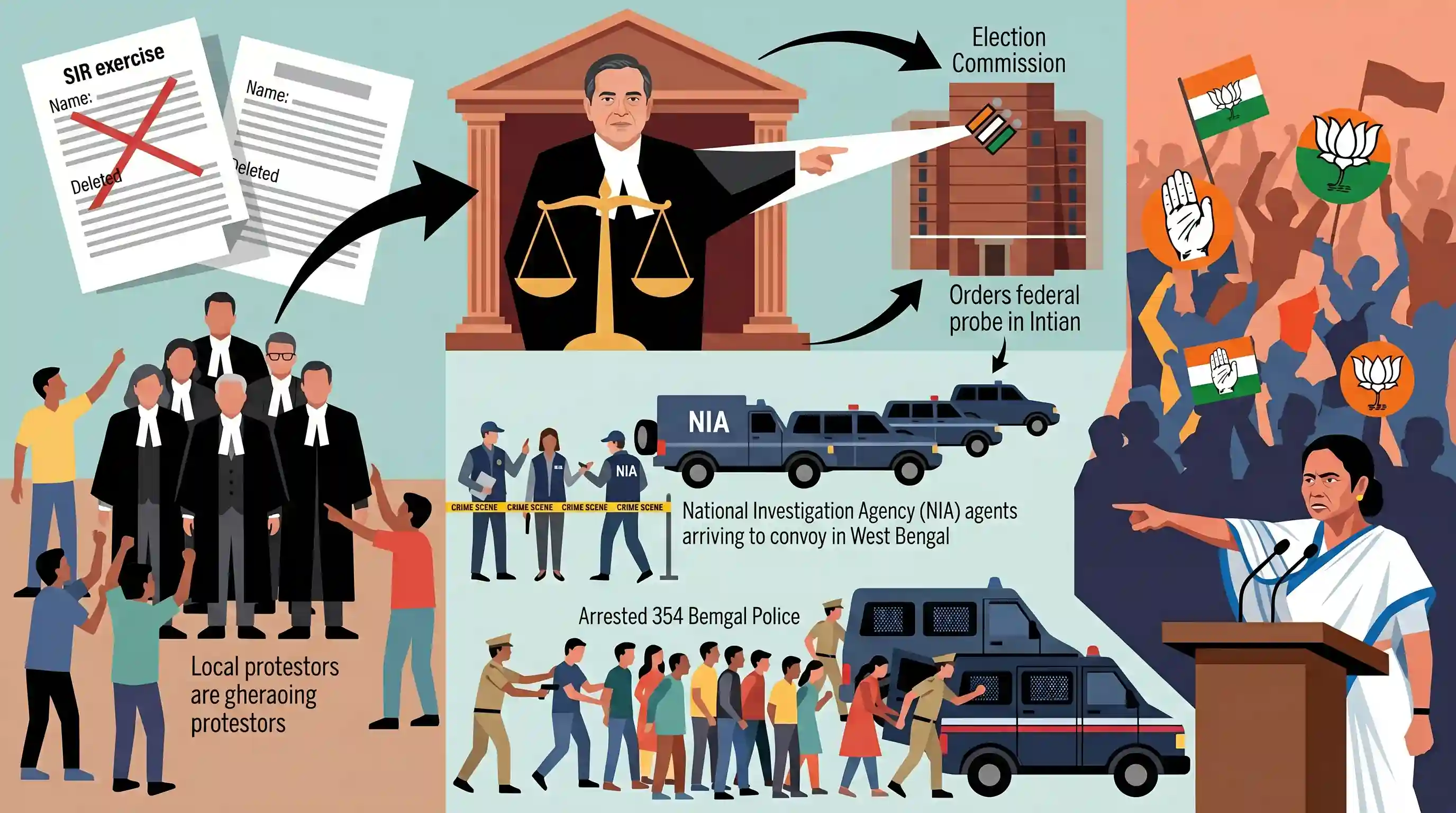
An NIA team has arrived in Malda, West Bengal, to investigate the gherao of seven judicial officers by locals protesting the deletion of names during the 'SIR exercise'. The probe was ordered by the Election Commission following a Supreme Court directive, with the Chief Justice of India remarking that the incident is a direct challenge to the apex court's authority. The West Bengal Police have arrested 35 individuals, while Chief Minister Mamata Banerjee has blamed opposition political parties for instigating the mob violence.
Key Points
- An NIA team visited Malda, West Bengal, to investigate the gherao of seven judicial officers by locals protesting the deletion of names during the SIR exercise.
- The probe was initiated by the Election Commission following a directive from the Supreme Court, which censured the state administration over the security lapse.
- The Chief Justice of India termed the gherao of judicial officers a direct challenge to the Supreme Court\'s authority.
- West Bengal police have arrested 35 people, including the alleged mastermind, while CM Mamata Banerjee accused opposition parties of instigating the violence.
Important Terms
Special Intensive Revision (SIR)

A comprehensive, door-to-door electoral roll overhaul by the ECI to verify voter eligibility, remove duplicates, and ensure 'roll purity' before elections.
UPSC context
GS Paper II: Elections and the Representation of People Act. Tests knowledge of electoral reforms and administrative procedures.
National Investigation Agency (NIA)
India's specialized counter-terrorism law enforcement agency. It can investigate cases across states without special permission, often taking over sensitive probes involving national security or institutional integrity.
UPSC context
GS Paper III: Internal Security and Central Agencies. Relevant for understanding federal agency mandates and jurisdictional issues.
Article 142
Constitutional provision granting the Supreme Court plenary power to pass any order necessary to ensure 'complete justice' in any cause or matter pending before it.
UPSC context
GS Paper II: Indian Constitution. Tests understanding of judicial activism and the extraordinary powers of the apex court.
Election Commission of India (ECI)
A permanent, independent constitutional body responsible for the superintendence, direction, and control of the entire process for conduct of elections in India.
UPSC context
GS Paper II: Constitutional Bodies. Fundamental for topics on democratic governance and election management.
Gherao
A form of protest involving the surrounding of a person or office to prevent entry/exit. When applied to judicial officers, it is treated as a threat to judicial independence.
UPSC context
GS Paper II: Judiciary/Internal Security. Relates to the protection of judicial independence and the limits of the right to protest.
Electoral Appellate Tribunal
A quasi-judicial body or official (often a district-level judge) empowered to hear and decide on voter claims and objections regarding names in electoral rolls.
UPSC context
GS Paper II: Statutory/Quasi-judicial bodies. Important for understanding the dispute resolution mechanism in electoral processes.
Prelims Trap
"The NIA requires state government consent to investigate law and order offenses within a state."
Unlike the CBI (DSPE Act), the NIA Act 2008 grants the agency concurrent jurisdiction to investigate scheduled offenses anywhere in India without needing prior state consent.
Static Concepts Connected
How does NIA jurisdiction differ from CBI under Indian federalism?
- NIA Act 2008: Empowers the NIA with concurrent jurisdiction to investigate scheduled federal offenses across India without requiring prior state consent.
- CBI jurisdiction: Operates under the DSPE Act 1946 and generally requires specific or general consent from the state government to investigate crimes there.
What is the constitutional and statutory basis for punishing criminal contempt?
- Article 129: Designates the Supreme Court as a "Court of Record," inherently granting it the constitutional authority to punish for contempt of itself.
- Criminal contempt: Under the 1971 Act, interfering with judicial proceedings or scandalizing the court is criminal contempt, distinct from mere willful disobedience (civil contempt).
Cross-Topic Patterns
Federalism vs. Central Investigative Agencies
NIA deployment in opposition-ruled states often fuels center-state disputes, contrasting the constitutional mandate of 'Police' as a State Subject with overriding federal counter-terrorism laws.
Electoral Roll Purity & RPA 1950
The Special Intensive Revision (SIR) exercise highlights the tension between the EC’s mandate for clean voter lists and the potential for severe law-and-order disruptions during enumeration.

Expect a 2026 prelims multi-statement question comparing NIA vs CBI jurisdiction, paired with EC's powers for electoral roll revision.
Linked PYQs · 3
Linked PYQs · 3
- 2023MainsGS3
What are the internal security challenges being faced by India? Give out the role of Central Intelligence and Investigative Agencies tasked to counter such threats.
- 2023MainsGS2
“Constitutionally guaranteed judicial independence is a prerequisite of democracy.” Comment.
- 2022MainsGS2
Discuss the role of the Election Commission of India in the light of the evolution of the Model Code of Conduct.
