कश्मीर में राष्ट्रीय जांच एजेंसी की आतंकवाद विरोधी छापेमारी
स्रोत:द हिंदू ↗
क्यों मायने रखता है
Highlights the ongoing institutional efforts by India's premier counter-terrorism agency (NIA) to root out extremism and dismantle the underlying terror ecosystem in Jammu and Kashmir. Important for understanding internal security challenges and the mandate of security agencies.
सारांश
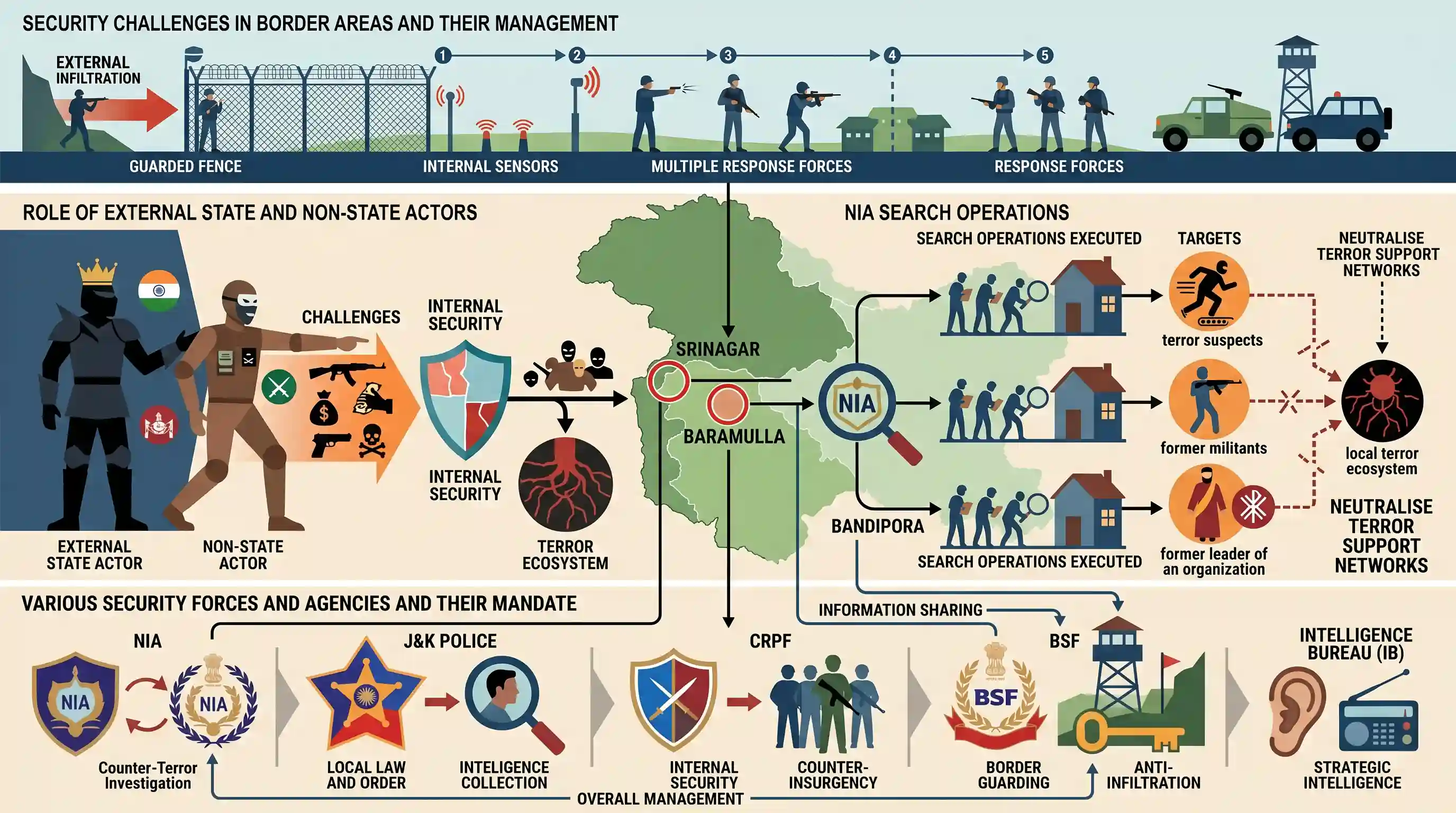
The National Investigation Agency (NIA) executed multiple search operations across Jammu and Kashmir, specifically in Srinagar, Baramulla, and Bandipora, as part of an ongoing investigation into the local terror ecosystem. The raids targeted the residences of terror suspects, former militants, and former Jamaat-e-Islami leaders, underlining the agency's efforts to neutralise terror support networks in the Kashmir Valley.
मुख्य बिंदु
- The NIA conducted early morning searches at the residence of a suspect in Srinagar's Rainawari area to dismantle the terror ecosystem in the Kashmir Valley.
- Separate raids were carried out across six locations in Baramulla, Bandipora, and Srinagar districts.
- The targeted premises belonged to former Jamaat-e-Islami leaders, former militants, and former government employees.
- These operations reflect the NIA's continuous mandate to investigate and disrupt terror financing and support structures in the region.
महत्वपूर्ण शब्द
National Investigation Agency (NIA)

India’s premier counter-terrorism law enforcement agency, established under the NIA Act 2008. It is empowered to investigate and prosecute offences affecting national security, sovereignty, and integrity across the country without state permission.
UPSC context
GS Paper III: Internal Security. Vital for questions on security agencies and their mandates or the federal structure of law enforcement.
जमात-ए-इस्लामी (JeI) जम्मू और कश्मीर
A socio-religious-political organisation in Jammu and Kashmir declared an 'unlawful association' under the UAPA. It is accused of supporting secessionist activities and maintaining links with militant groups to destabilise the region.
UPSC context
GS Paper III: Internal Security. Relevant for topics on internal security challenges and the role of non-state actors in border areas.
Unlawful Activities (Prevention) Act (UAPA)
India's primary anti-terror law enacted to prevent activities threatening national sovereignty and integrity. It allows the government to designate organisations and individuals as terrorists and provides special procedures for investigation.
UPSC context
GS Paper II & III: Governance and Internal Security. Critical for discussing legal frameworks against terrorism and their impact on civil liberties.
Terror Ecosystem
The comprehensive support network consisting of ideologues, recruiters, financiers, and logistical providers that facilitates and sustains militant activities within a specific geographic or social environment.
UPSC context
GS Paper III: Internal Security. Used in the context of 'holistic security' and the strategy of 'Operation All Out' in Kashmir.
Over Ground Workers (OGWs)
Individuals who do not actively join militant ranks but provide essential logistical support such as shelter, transport, intelligence gathering, and recruitment for terrorist organisations while maintaining a normal public life.
UPSC context
GS Paper III: Internal Security. Frequently tested in the context of insurgency management and intelligence-led operations in J&K.
प्रारंभिक ट्रैप
NIA requires the respective State DGP's prior approval to seize or attach terrorism-linked properties.
The UAPA Amendment Act 2019 empowered the NIA Director-General to independently approve the seizure of terrorism-linked properties, removing the previous requirement for State DGP clearance.
संबंधित अवधारणाएँ
What are the expanded powers of the NIA under the 2019 Amendment Act?
- Extra-territorial jurisdiction: The agency can now investigate scheduled offences committed outside India, subject to international treaties and domestic laws of other nations.
- New offences added: The amendment added human trafficking, counterfeit currency, cyber-terrorism, and offences under the Explosive Substances Act to the NIA's schedule.
- Special Courts: The Central government is empowered to designate ordinary Sessions Courts as Special Courts for speedy NIA trials.
How did the 2019 UAPA Amendment alter India's counter-terrorism legal framework?
- Individual designation: It empowered the Central Government to designate individuals (not just organizations) as terrorists if they participate in or promote terrorism.
- Property seizure: The NIA Director-General was granted authority to approve the seizure of properties connected to terrorism without needing the State DGP's nod.
- Investigating rank: Officers of the rank of Inspector in the NIA were authorized to investigate UAPA cases (previously restricted to DSP or ACP rank).
अंतर-विषय पैटर्न
आतंकवाद का वित्तपोषण और FATF अनुपालन
Dismantling terror ecosystems and OGW networks directly links to India's FATF mutual evaluations, demonstrating proactive measures against terror financing and money laundering.
CBI vs NIA Jurisdiction Frameworks
UPSC frequently tests statutory bodies. The NIA's suo motu national jurisdiction sharply contrasts with the CBI, which relies on the Delhi Special Police Establishment Act and requires state consent.

NIA की क्षेत्रातीत शक्तियों (extra-territorial powers) और राज्य की सहमति से छूट की तुलना CBI के अधिकार क्षेत्र (mandate) से करने वाले एक बहु-कथनीय (multi-statement) Prelims प्रश्न की अपेक्षा करें।
संबद्ध PYQ · 2
संबद्ध PYQ · 2
- 2019MainsGS3
Indian Government has recently strengthened the anti-terrorism laws by amending the Unlawful Activities (Prevention) Act (UAPA), 1967 and the NIA Act. Analyze the changes in the context of prevailing security environment while discussing the scope and reasons for opposing the UAPA by human rights organizations.
- 2025MainsGS3
Terrorism is a global scourge. How has it manifested in India? Elaborate with contemporary examples. What are the counter measures adopted by the State? Explain.
