NIA Files Chargesheet in Amritsar Temple Grenade Attack
Source:Indian Express ↗
Why It Matters
The article illustrates the modernization of terror financing through platforms like UPI and MTSS, emphasizing the intersection of emerging technologies and national security. It is highly relevant for GS3 topics on internal security challenges, money laundering, and the role of agencies like the NIA in managing cross-border terrorism in sensitive border states like Punjab.
Summary
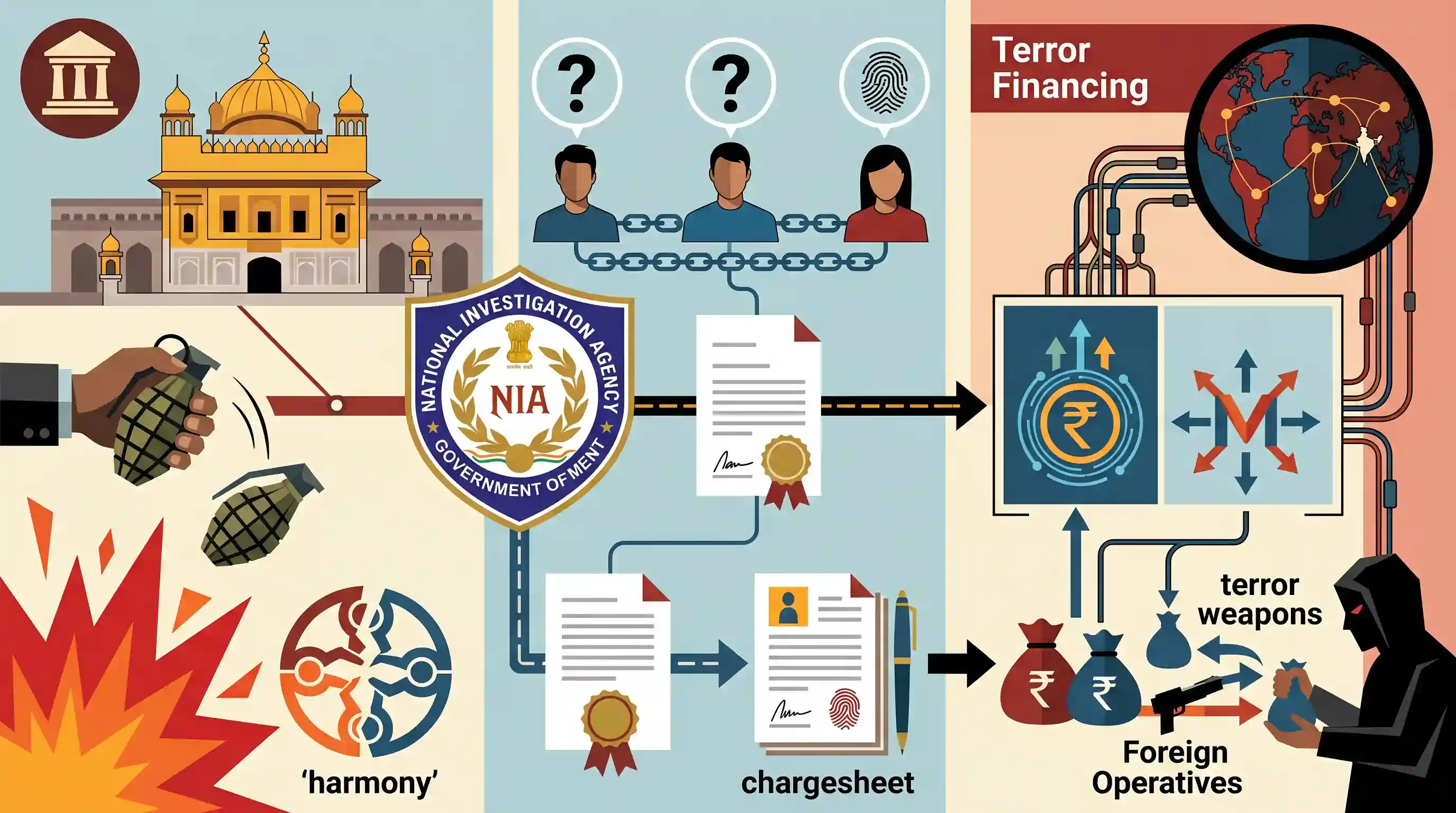
The National Investigation Agency (NIA) has filed a chargesheet against three individuals involved in the March 2025 grenade attack on the Thakurdwara Sanatan Temple in Amritsar. The attack, aimed at disrupting communal harmony in Punjab, was allegedly orchestrated by a broader network including foreign-based operatives. Crucially, the investigation uncovered the use of digital payment platforms like UPI and the Money Transfer Service Scheme (MTSS) for terror financing. The case underscores the evolving methods of terror funding and the persistent cross-border threats to internal security, highlighting the NIA's role in dismantling transnational terror linkages.
Key Points
- The NIA filed a chargesheet against three individuals for their roles in the March 2025 grenade attack on the Thakurdwara Sanatan Temple in Amritsar, Punjab.
- The attack was part of a coordinated conspiracy involving local and foreign-based operatives aiming to incite communal disharmony and instill fear.
- Investigations revealed the use of digital and formal remittance channels, specifically UPI and the Money Transfer Service Scheme (MTSS), to route terror funds.
- The case highlights persistent cross-border security threats in Punjab and the NIA's ongoing efforts to trace financial networks and dismantle international terror modules.
Important Terms
National Investigation Agency (NIA)

India's federal counter-terrorism agency established under the NIA Act, 2008. It investigates offences affecting national security, sovereignty, and integrity, with pan-India jurisdiction and powers to take over cases from state police without prior consent.
UPSC context
GS Paper III (Internal Security) and GS II (Statutory Bodies); tests knowledge of federal investigative architecture and counter-terrorism mandates.
Money Transfer Service Scheme (MTSS)
An RBI-regulated framework facilitating quick inward personal remittances (like family maintenance) from abroad via partnerships between overseas principals and Indian agents. It is subject to strict transaction limits to prevent money laundering and terror financing.
UPSC context
GS Paper III (Economy/Internal Security); tests understanding of formal remittance channels and their potential exploitation by transnational terror networks.
Terror Financing
The solicitation, collection, or provision of funds—from licit or illicit sources—intended to support terrorist acts or organizations. It sustains recruitment, training, and logistics, forming the "lifeblood" of terrorist operations.
UPSC context
GS Paper III (Internal Security); critical for understanding FATF standards, NMFT conferences, and the disruption of non-state actor logistics.
Unified Payments Interface (UPI)
A real-time payment system developed by NPCI enabling instant inter-bank transactions via mobile devices. Its speed and accessibility make it a target for "micro-financing" or "lone-actor" terror funding, requiring enhanced regulatory scrutiny.
UPSC context
GS Paper III (Economy/Security); highlights the security implications of Digital Public Infrastructure and emerging fintech risks in internal security.
Unlawful Activities (Prevention) Act (UAPA)
India's primary anti-terror law providing the legal framework to prevent unlawful activities and deal with terrorism. It empowers the government to designate individuals/organisations as terrorists and facilitates asset seizures by the NIA.
UPSC context
GS Paper II (Polity/Laws) and GS III (Internal Security); central to discussions on balancing national security with civil liberties and procedural safeguards.
Prelims Trap
"The Money Transfer Service Scheme (MTSS) facilitates both inward and outward international remittances."
MTSS is regulated by the RBI exclusively for inward personal remittances. It strictly prohibits outward remittances, commercial transfers, or FDI, making it a targeted conduit.
Static Concepts Connected
What are the jurisdictional powers of the National Investigation Agency (NIA)?
- State consent:: Can investigate scheduled offenses across India without requiring prior permission from state governments.
- Extraterritorial reach:: The 2019 amendment empowers NIA to investigate terror crimes committed against Indians outside India.
- Scheduled offenses:: Covers UAPA, human trafficking, counterfeit currency, cyber terrorism, and offenses under the Explosive Substances Act.
What are the regulatory constraints of the Money Transfer Service Scheme (MTSS)?
- Inward personal only:: Restricted to inbound remittances for family maintenance or foreign tourists; outward or commercial transfers prohibited.
- Transaction caps:: Capped at a maximum of USD 2,500 per transaction to limit bulk money movement.
- Frequency limits:: A single individual beneficiary can receive a maximum of 30 remittances in a calendar year.
Cross-Topic Patterns
FinTech and FATF compliance
Exploitation of UPI for terror funding links India's Digital Public Infrastructure (DPI) success with the Financial Action Task Force's (FATF) focus on mitigating decentralized financial networks.
Transnational crime-terror nexus
Reliance on foreign-based operatives directly ties into GS3 syllabus on linkages between organized crime (narco-smuggling via drones) and cross-border terrorism in border states like Punjab.

Expect a 2026 multi-statement prelims question testing MTSS inward-only constraints alongside the NIA's extraterritorial powers.
Linked PYQs · 3
Linked PYQs · 3
- 2023MainsGS3
Give out the major sources of terror funding in India and the efforts being made to curtail these sources. In the light of this, also discuss the aim and objective of the 'No Money for Terror (NMFT)' Conference recently held at New Delhi in November 2022.
- 2021MainsGS3
Discuss how emerging technologies and globalisation contribute to money laundering. Elaborate measures to tackle the problem of money laundering both at national and international levels.
- 2017MainsGS3
The scourge of terrorism is a grave challenge to national security. What solutions do you suggest to curb this growing menace? What are the major sources of terrorist funding?
