NIA Crackdown on Transnational Cyber Scam Trafficking Ring
Source:Indian Express ↗
આ શા માટે મહત્વનું છે
It sheds light on the rising trend of 'cyber scam compounds' in South East Asia, revealing how human trafficking and transnational cybercrime now heavily intersect. It is highly relevant for GS3 questions on the linkages within organized crime, cyber threats, and the evolving mandate of central agencies like the NIA to secure India's interests both internally and externally.
સારાંશ
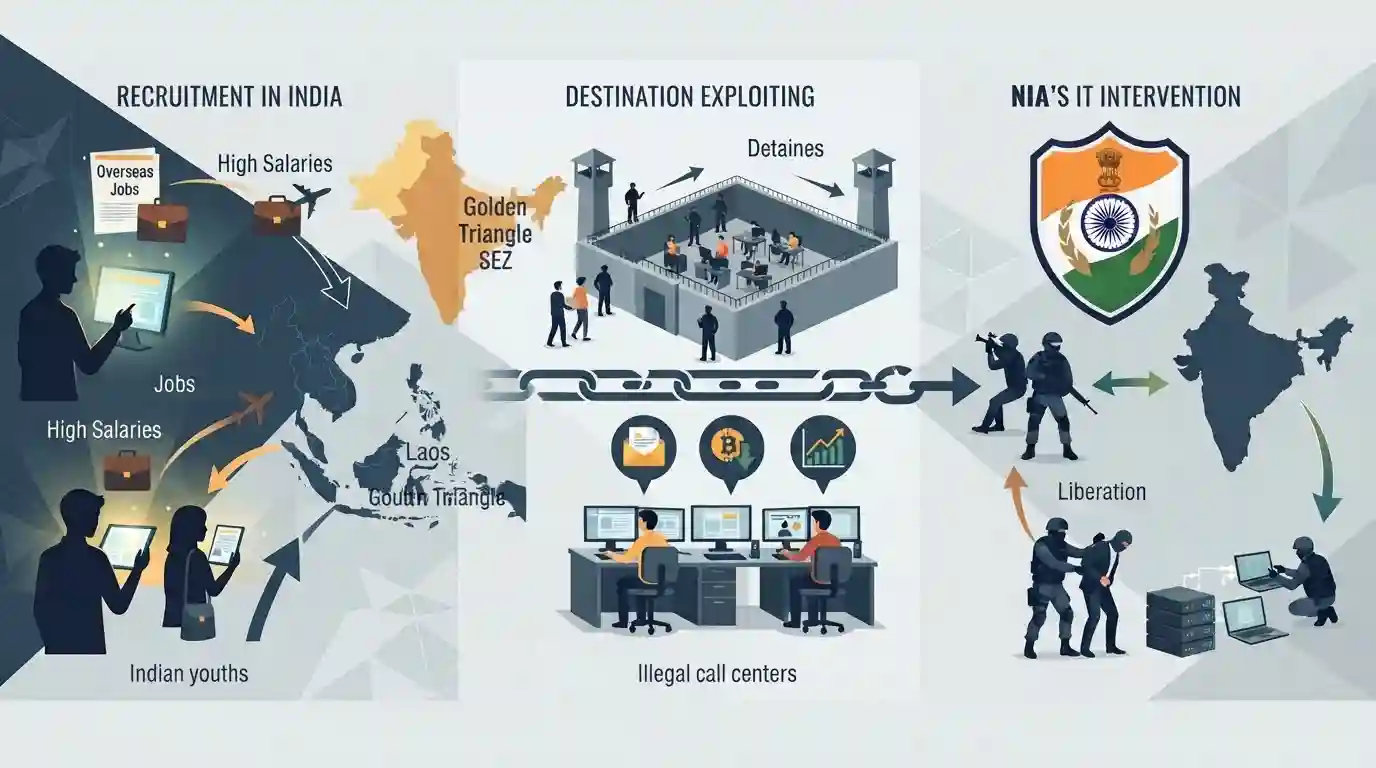
The National Investigation Agency (NIA) has arrested four individuals involved in a transnational human trafficking syndicate. This network lured Indian youths with fake job offers and trafficked them to South East Asia, particularly the Golden Triangle Special Economic Zone in Laos. Once there, the victims were forced to work in illegal call centers and participate in widespread cyber frauds, such as cryptocurrency and investment scams. The incident illustrates a dangerous evolution in organized crime, where human trafficking is explicitly weaponized to fuel global cyber extortion operations. The NIA's takeover of the case highlights the agency's expanding role in neutralizing sophisticated transnational criminal networks that pose severe security and economic challenges.
મુખ્ય મુદ્દા
- The National Investigation Agency (NIA) has arrested members of a major international human trafficking syndicate operating across India, Laos, and other parts of South East Asia.
- Indian youths were lured with lucrative job offers and trafficked to places like the Golden Triangle Special Economic Zone in Laos.
- Victims were coerced into working in illegal, fake call centers and forced to execute cyber frauds, including investment, relationship, and cryptocurrency scams.
- The case highlights the growing nexus between human trafficking and transnational cybercrime syndicates targeting Indian citizens.
- The intervention of the NIA underscores the agency's critical role in investigating organized crime and complex internal security threats beyond traditional terrorism.
મહત્વપૂર્ણ શબ્દો
National Investigation Agency (NIA) Act

A 2008 legislation establishing India's central counter-terrorism agency. Amended in 2019 to grant extraterritorial jurisdiction and expand its mandate to include human trafficking, cyber-terrorism, and counterfeit currency, tackling evolving transnational threats.
UPSC context
GS Paper 3 (Internal Security). Tests knowledge of counter-terrorism frameworks, statutory bodies, and legislative responses to organized crime.
National Investigation Agency (NIA)
India's primary federal counter-terrorism law enforcement agency, operating under the Ministry of Home Affairs. It investigates national security threats, including terrorism, illicit arms trade, cyber-terrorism, and human trafficking, across state boundaries.
UPSC context
GS Paper 3 (Security Agencies). Tested on its jurisdiction, federalism concerns, and overall efficacy in tackling terrorism and human trafficking.
Golden Triangle Special Economic Zone (GTSEZ)
A semi-autonomous economic zone in Laos along the Mekong River, initially established for trade. It has gained notoriety as a hub for illicit activities, including human trafficking, transnational cyber fraud, and illegal gambling.
UPSC context
GS Paper 2 & 3. Tests awareness of regional geopolitical flashpoints, border security, and transnational cyber-crime hubs in Southeast Asia.
Transnational Organized Crime (TOC)
Illegal activities conducted by criminal networks across national borders, leveraging globalization and weak regulations. It encompasses drug and human trafficking, cyber-extortion, and money laundering, posing severe security and economic challenges worldwide.
UPSC context
GS Paper 3 (Internal Security). Tests the linkages between organized crime, terrorism, cyber threats, and border management challenges.
પ્રિલિમ્સ ટ્રેપ
The NIA's jurisdiction is strictly limited to terrorism-related offenses committed within the territorial boundaries of India.
The NIA (Amendment) Act, 2019 granted extra-territorial jurisdiction and expanded its mandate to include human trafficking and cyber-terrorism.
સંલગ્ન સ્થિર ખ્યાલો
How did the NIA (Amendment) Act, 2019 expand the agency's powers?
- Extra-territorial jurisdiction: Empowered the NIA to investigate scheduled offenses committed outside India, subject to international treaties and domestic laws of other countries.
- New Scheduled Offenses: Added human trafficking, counterfeit currency, manufacture/sale of prohibited arms, cyber-terrorism, and Explosive Substances Act offenses to its mandate.
- Special Courts: Allowed the central and state governments to designate existing Sessions Courts as Special Courts for conducting NIA trials.
What distinguishes the 'Golden Triangle' in the context of organized crime?
- Geographic Location: Located at the tri-junction of Myanmar, Laos, and Thailand, near the confluence of the Ruak and Mekong rivers.
- Evolution of Crime: Historically a global hub for illicit opium production, it has recently morphed into a base for transnational cybercrime and forced-labor scam farms.
આંતર-વિષય પેટર્ન
Cyber Slavery & Organized Crime Nexus
Links traditional organized crime (human trafficking) with modern cybersecurity threats (crypto scams), creating a hybrid challenge for agencies like I4C and NIA.
SE Asia & Economic Migration Vulnerabilities
Highlights the flip side of Southeast Asian economic migration, where illicit Special Economic Zones (SEZs) in Laos/Myanmar exploit relaxed visa or border policies.

The nexus of 'Golden Triangle' cyber-scam farms and the NIA's extraterritorial jurisdiction (2019 Amendment) is a prime 2026 Prelims target.
સંલગ્ન PYQ · 4
સંલગ્ન PYQ · 4
- 2022MainsGS3
Discuss the types of organised crimes. Describe the linkages between terrorists and organised crime that exist at the national and transnational levels.
- 2023MainsGS3
What are the internal security challenges being faced by India? Give out the role of Central Intelligence and Investigative Agencies tasked to counter such threats.
- 2019MainsGS3
Indian Government has recently strengthened the anti-terrorism laws by amending the Unlawful Activities (Prevention) Act (UAPA), 1967 and the NIA Act. Analyze the changes in the context of prevailing security environment while discussing the scope and reasons for opposing the UAPA by human rights organizations.
- 2020MainsGS3
Discuss different types of cyber crimes and measures required to be taken to fight the menace.
