NHRC Notice Over Medical Neglect and Institutional Apathy in Kanpur
Source:The Hindu ↗
Why It Matters
The incident exposes critical failures in public healthcare delivery and coordination between civil administration and law enforcement. It serves as an important case study for GS-2 (functioning and interventions of statutory bodies like NHRC, public healthcare infrastructure) and GS-4 (apathy in public service, devotion to duty, and medical ethics).
Summary
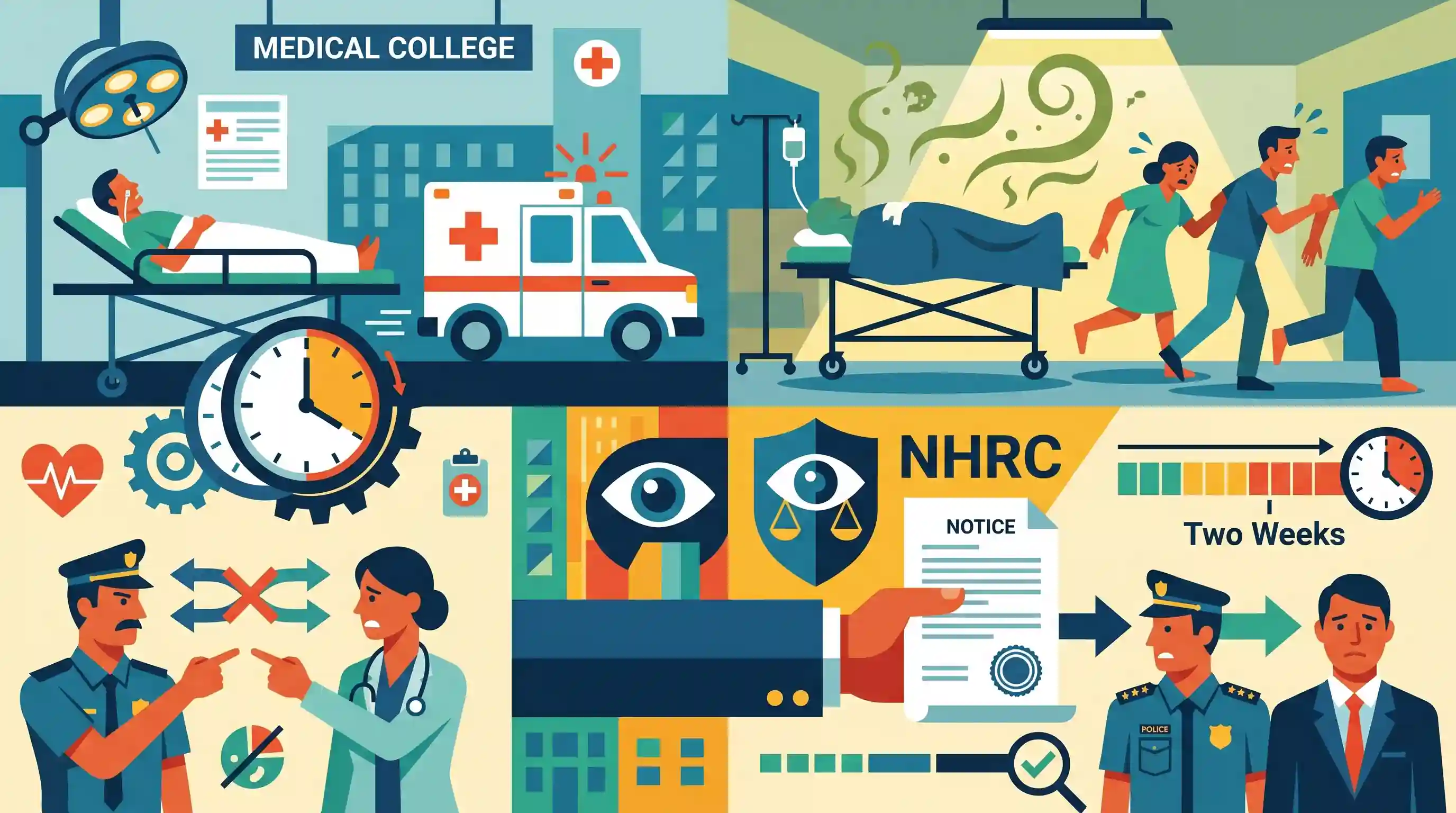
The National Human Rights Commission (NHRC) has issued a notice to the Uttar Pradesh Chief Secretary and Director General of Police following the death of a 25-year-old patient at Kanpur Medical College. The death resulted from severe administrative apathy, as a requested police escort for a hospital transfer was delayed by 6 to 7 hours. In a further display of negligence, the deceased's body was left in the ward until it started emitting a foul smell, causing other patients to flee. Conflicting claims between the police and hospital authorities over ambulance availability highlight a systemic failure in public service coordination, prompting the NHRC to demand a comprehensive report on the human rights violations within two weeks.
Key Points
- The National Human Rights Commission (NHRC) issued a notice to the Uttar Pradesh government over the death of a 25-year-old patient at Kanpur Medical College.
- The patient died after a 6-7 hour delay in the arrival of a police escort required to transfer him to a referral hospital.
- The body was left in the ward for several hours until it began decomposing, forcing other patients to vacate due to the foul smell.
- Police and hospital authorities presented contradictory claims regarding the availability of an ambulance for the patient's transfer.
- The NHRC noted serious human rights violations and sought a detailed report from the state's Chief Secretary and DGP within two weeks.
Important Terms
National Human Rights Commission (NHRC)

A statutory body established in 1993 to protect and promote human rights related to life, liberty, equality, and dignity as guaranteed by the Constitution and international covenants.
UPSC context
GS Paper II: Statutory, Regulatory, and various Quasi-judicial bodies; tests understanding of human rights watchdogs and their mandates.
Suo Motu Cognizance
The power of a body like the NHRC to take notice of a matter on its own without a formal complaint, often based on media reports or news.
UPSC context
GS Paper II: Governance and Judiciary; refers to the proactive legal powers of commissions and courts to address rights violations.
Statutory Body
Non-constitutional bodies established by an Act of Parliament or State Legislature to oversee specific sectors or fulfill dedicated administrative functions.
UPSC context
GS Paper II: Polity and Governance; essential for distinguishing between constitutional, statutory, and executive entities in Indian administration.
Public Service Accountability
The obligation of public officials and institutions to report on their activities and take responsibility for failures in service delivery or administrative conduct.
UPSC context
GS Paper IV: Ethics, Integrity, and Aptitude; focuses on transparency, ethical governance, and the consequences of administrative apathy.
Medical Ethics
A system of moral principles that applies values to the practice of clinical medicine and scientific research, emphasizing patient dignity, care, and professional duty.
UPSC context
GS Paper IV: Ethics and Human Interface; relevant for case studies involving hospital mismanagement, negligence, and patient rights.
Protection of Human Rights (PHR) Act, 1993
The central legislation in India that provides for the constitution of the National and State Human Rights Commissions and Human Rights Courts.
UPSC context
GS Paper II: Important Acts/Legislation; tests knowledge of the legal framework protecting fundamental freedoms in India.
Prelims Trap
"NHRC has the statutory authority to directly penalize public servants or mandate compensation."
NHRC's powers are strictly recommendatory. Under the Protection of Human Rights Act, 1993, it can recommend compensation or prosecution, but cannot issue binding punitive or penal orders itself.
Static Concepts Connected
What are the primary limitations on the NHRC's investigative powers?
- Recommendatory body: Its advice is not binding on governments, though authorities must report the action taken within one month.
- One-year limitation: It cannot inquire into any matter after the expiry of one year from the date on which the alleged human rights violation occurred.
- Armed forces: It has severely restricted powers and procedures regarding the investigation of human rights violations committed by members of the armed forces.
How does Article 21 protect patients in medical emergencies?
- Right to Health: The Supreme Court ruled (Paschim Banga Khet Mazdoor case) that the denial of emergency care in state hospitals violates the fundamental Right to Life.
- Procedural delays: The Pt. Parmanand Katara ruling established that medico-legal formalities cannot override the immediate professional obligation of doctors and police to save a life.
- Dignity in death: The right to life extends beyond mere physical existence, explicitly covering fair treatment and condemning the neglect or mistreatment of deceased bodies.
Cross-Topic Patterns
GS-2 & GS-4: Protocols vs. Compassion
Delayed police escorts causing patient death directly bridges GS-2 health governance failures with GS-4 concepts of administrative apathy and lack of empathy in public servants.
Expansion of Article 21 jurisprudence
NHRC interventions often build on judicial precedents, expanding the 'Right to Life' to cover dignity in death and seamless inter-departmental emergency medical coordination.

Expect a GS-4 case study on rigid inter-departmental protocols delaying emergency care, or a GS-2 question on the NHRC's mandate efficacy.
Linked PYQs · 5
Linked PYQs · 5
- 2014MainsGS2
National Human Rights Commission (NHRC) in India can be most effective when its tasks are adequately supported by other mechanisms that ensure the accountability of a government. In light of the above observation assess the role of NHRC as an effective complement to the judiciary and other institutions in promoting and protecting human rights standards.
- 2021MainsGS2
Though the Human Rights Commissions have contributed immensely to the protection of human rights in India, yet they have failed to assert themselves against the mighty and powerful. Analyzing their structural and practical limitations, suggest remedial measures.
- 2024MainsGS2
In a crucial domain like the public healthcare system the Indian State should play a vital role to contain the adverse impact of marketisation of the system. Suggest some measures through which the State can enhance the reach of public healthcare at the grassroots level.
- 2021MainsGS2
“Besides being a moral imperative of a Welfare State, primary health structure is a necessary precondition for sustainable development.” Analyze.
- 2022MainsGS4
Apart from intellectual competency and moral qualities, empathy and compassion are some of the other vital attributes that facilitate the civil servants to be more competent in tackling the crucial issues or taking critical decisions. Explain with suitable illustrations.
