NHRC Issues Notice to UP Officials Over Meerut Police Excess
Source:The Hindu ↗
Why It Matters
This article highlights the institutional role of the NHRC in acting as a human rights watchdog against state excesses. It underscores ongoing governance challenges in India, including police accountability, the prevention of custodial torture, and the protection of vulnerable communities (Dalits) and their constitutional right to peaceful assembly under Article 19(1)(b).
Summary
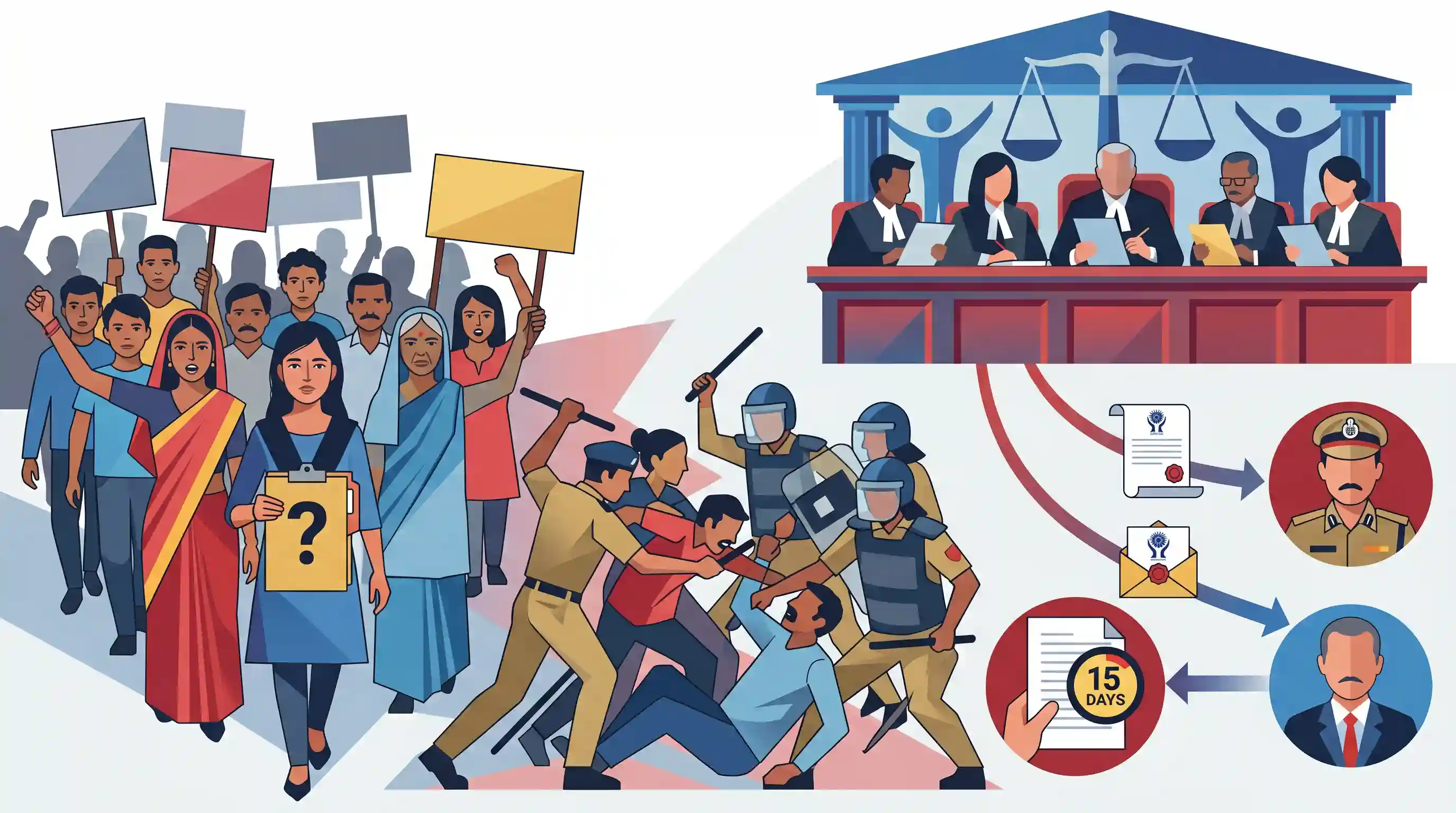
The National Human Rights Commission (NHRC) has issued notices to the Uttar Pradesh Director General of Police and the Home Secretary following allegations of police brutality, excessive force, and custodial torture during a protest in Meerut. The protest was organized to demand justice for a 20-year-old Dalit student, Lalita Gautam, whose murder investigation by local police has been questioned by her family. Acting on a complaint filed under Section 12 of the Protection of Human Rights Act, 1993, the NHRC has directed state authorities to submit an Action Taken Report within 15 days.
Key Points
- The National Human Rights Commission (NHRC) issued notices to the Uttar Pradesh DGP and Home Secretary demanding an Action Taken Report (ATR) within 15 days over allegations of police excess in Meerut.
- The NHRC Bench, led by member Priyank Kanoongo, took cognisance of a complaint filed under Section 12 of the Protection of Human Rights Act (PHRA), 1993.
- The complaint alleges that police conducted an 'unprovoked, brutal lathi-charge' against a peaceful demonstration and committed custodial torture by assaulting individuals already taken into custody.
- The public demonstration was organized to demand justice and a comprehensive probe into the suspected murder of Lalita Gautam, a 20-year-old Dalit student, whose family disputed the police\'s initial investigation.
- The complainant has sought an independent inquiry, verification of viral social media videos to hold officers accountable, medical rehabilitation, compensation, and departmental and criminal action against errant police personnel.
Important Terms
National Human Rights Commission

An independent statutory watchdog established in 1993 to protect and promote fundamental human rights—namely life, liberty, equality, and dignity—guaranteed by the Indian Constitution and international covenants.
UPSC context
GS Paper II: Quasi-judicial bodies. Tests understanding of its mandate, limitations, and role in holding public servants accountable for rights abuses.
Protection of Human Rights Act, 1993
The landmark central legislation in India that provides the statutory framework for establishing the National and State Human Rights Commissions, alongside specialized Human Rights Courts to address violations.
UPSC context
GS Paper II: Important legislative acts. Tests knowledge of India's statutory mechanism for safeguarding human rights and the powers of associated bodies.
Custodial Violence
The infliction of physical, mental, or sexual abuse, torture, or death upon an individual by public servants while held in police or judicial custody, violating fundamental constitutional protections.
UPSC context
GS Paper II & IV: Police reforms and ethics. Tests awareness of human rights abuses, constitutional safeguards (Article 21), and institutional transparency.
Quasi-judicial Body
A non-judicial statutory or constitutional authority possessing court-like powers to hold hearings, resolve disputes, and pass legally binding orders within its specialized, defined area of jurisdiction.
UPSC context
GS Paper II: Statutory, regulatory, and quasi-judicial bodies. Tests structural characteristics, advantages over traditional courts, and issues like lack of enforcement power.
Prelims Trap
The NHRC possesses suo motu powers to investigate and grant compensation for any historical human rights violation regardless of when it occurred.
Section 36(2) of the PHRA explicitly bars the NHRC from inquiring into any matter after one year from the date of the alleged violation.
Static Concepts Connected
What are the core jurisdictional limitations of the NHRC under the PHRA, 1993?
- One-year limitation: Section 36(2) bars inquiry into any complaint filed more than one year after the alleged human rights violation occurred.
- Armed forces restriction: For violations by armed forces, NHRC can only seek a report from the Central Government and make recommendations, not investigate directly.
- Advisory status: NHRC recommendations are not legally binding; the government is only required to intimate action taken within one month.
Cross-Topic Patterns
Custodial violence and law commission reforms
NHRC's intervention in police brutality highlights persistent demands to insert Section 114B into the Evidence Act, reversing the burden of proof for custodial injuries.
Federalism and statutory police oversight
While 'Police' is a State List subject, central statutory bodies like NHRC issue notices to state police chiefs, demonstrating federal administrative oversight.

PHRA 1993 statutory limits (Section 36) and the 2019 NHRC composition amendments are highly likely targets for a multi-statement 2026 Prelims Q.
Linked PYQs · 2
Linked PYQs · 2
- 2021MainsGS2
Though the Human Rights Commissions have contributed immensely to the protection of human rights in India, yet they have failed to assert themselves against the mighty and powerful. Analyzing their structural and practical limitations, suggest remedial measures.
- 2023PrelimsGS1
Consider the following organizations/bodies in India: 1. The National Commission for Backward Classes 2. The National Human Rights Commission 3. The National Law Commission 4. The National Consumer Disputes Redressal Commission How many of the above are constitutional bodies?
