NHRC Notice to MP Government Over School Caste Assault
Source:newsonair ↗
Why It Matters
Highlights the operational role of the NHRC in taking suo motu cognizance of rights violations and the continued relevance of protective legislation (like the SC/ST Atrocities Act) in addressing caste-based discrimination.
Summary
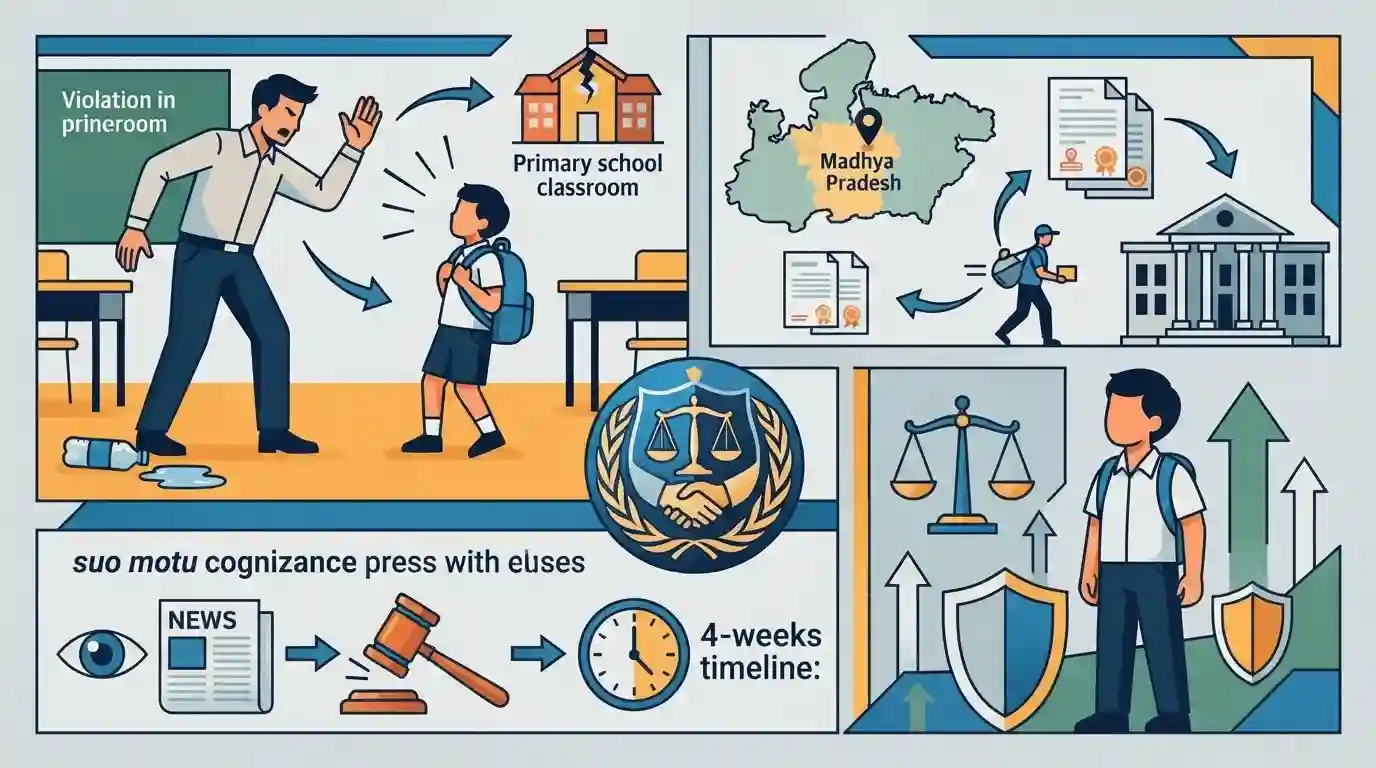
The National Human Rights Commission (NHRC) has issued notices to the Madhya Pradesh government and the Shivpuri Superintendent of Police over an alleged caste-based assault. A government primary school teacher in Ukawal village reportedly assaulted a boy from a Scheduled Caste community and made casteist remarks after the student drank water from his bottle. Taking suo motu cognizance, the NHRC demanded a detailed report within four weeks, highlighting the grave human rights implications of the incident.
Key Points
- The NHRC took suo motu cognizance of a reported incident where a Scheduled Caste student was assaulted by a teacher for drinking water from the teacher's bottle.
- Notices have been issued to the Chief Secretary of Madhya Pradesh and the Superintendent of Police of Shivpuri district.
- The authorities are required to submit a detailed report regarding the incident within four weeks.
- The incident underscores serious human rights violations and invokes protections meant to safeguard marginalized communities against caste-based discrimination.
Important Terms
National Human Rights Commission (NHRC)

An independent statutory body established in 1993 to protect and promote human rights in India, acting as a national watchdog against violations regarding life, liberty, equality, and dignity.
UPSC context
Covers GS Paper II (Statutory Bodies) and tests knowledge of institutional mechanisms safeguarding human rights and ensuring accountability.
Protection of Human Rights Act, 1993
The legislation that established the NHRC, State Human Rights Commissions, and Human Rights Courts to provide an institutional framework for investigating and addressing human rights violations across India.
UPSC context
Relevant for GS Paper II (Polity & Governance) concerning the statutory mandate, powers, and limitations of India's human rights bodies.
Scheduled Castes and Scheduled Tribes (Prevention of Atrocities) Act, 1989
A landmark law enacted to prevent caste-based discrimination, hate crimes, and atrocities against SC/ST communities, mandating special courts and stringent punishments to ensure speedy justice.
UPSC context
Highly relevant for GS Paper II (Mechanisms for Vulnerable Sections) and GS Paper I (Indian Society) regarding social justice.
Protection of Civil Rights Act, 1955
A federal law aimed at enforcing Article 17 of the Constitution by criminalizing untouchability practices and prescribing penalties to combat systemic social discrimination and inequality.
UPSC context
Significant for GS Paper II (Welfare Schemes & Laws for Vulnerable Sections), tracking India's legal evolution in abolishing untouchability.
Prelims Trap
The NHRC holds the statutory power to investigate and take cognizance of human rights violations regardless of when the incident occurred.
Under Section 36(2) of the Protection of Human Rights Act, 1993, the NHRC is legally barred from inquiring into any matter after the expiry of one year from the date of the alleged violation.
Static Concepts Connected
What is the 'horizontal application' of Fundamental Rights under the Indian Constitution?
- Definition: Refers to constitutional rights that can be enforced against private individuals or non-state actors, rather than just against the State (vertical application).
- Key Articles: Articles 15(2) (access to public places/water sources), 17 (abolition of untouchability), and 23 (prohibition of forced labor) apply horizontally.
- Significance: These provisions empower marginalized groups to seek legal redress directly against private citizens who practice social discrimination.
What are the major structural and functional limitations of the NHRC?
- Advisory nature: The commission's recommendations are purely advisory and not binding on the executive; it cannot punish violators.
- Time limitation: It cannot entertain or investigate any complaint filed more than one year after the incident took place.
- Armed Forces restriction: Its powers to investigate human rights violations committed by members of the armed forces are highly restricted.
Cross-Topic Patterns
Social untouchability vs. Public Education governance
Connects Constitutional safeguards against caste discrimination (GS2) with institutional failures in primary education delivery and the persistence of social untouchability (GS1 Social Issues).
Institutional overlap: NHRC vs. NCSC mandates
Analyzes potential jurisdictional overlaps and cooperation when NHRC and NCSC concurrently investigate civil rights violations against marginalized groups.

GS-2 may contrast the statutory limitations of NHRC (one-year bar) with NCSC's constitutional civil court powers in handling atrocities.
Linked PYQs · 4
Linked PYQs · 4
- 2023MPPSC_PRELIMSGS1
Which of the following is NOT a function of the National Human Rights Commission (NHRC)?
- 2017MPPSC_PRELIMSGS1
The tenure of the Chairman of the National Human Rights Commission is
- 2014MPPSC_PRELIMSGS1
Offences are tried under the protection of civil rights act, 1955 by the court of
- 2012MPPSC_PRELIMSGS1
The Scheduled Castes and Scheduled Tribes (Prevention of Atrocities) Act is a special provision for the advancement of Scheduled Caste and Scheduled Tribes which is based on which one of the following doctrines?
