NHRC Notice on Tribal Residential School Infrastructure Failures
Source:The Hindu ↗
हे का महत्त्वाचे आहे
This incident underscores critical governance gaps in tribal welfare administration, children's safety, and the realization of basic human rights under Article 21. It also highlights the interventionist role of the NHRC in holding state machinery accountable for infrastructure deficits in welfare institutions and reflects the persistent rural public health challenge of snakebites in India.
सारांश
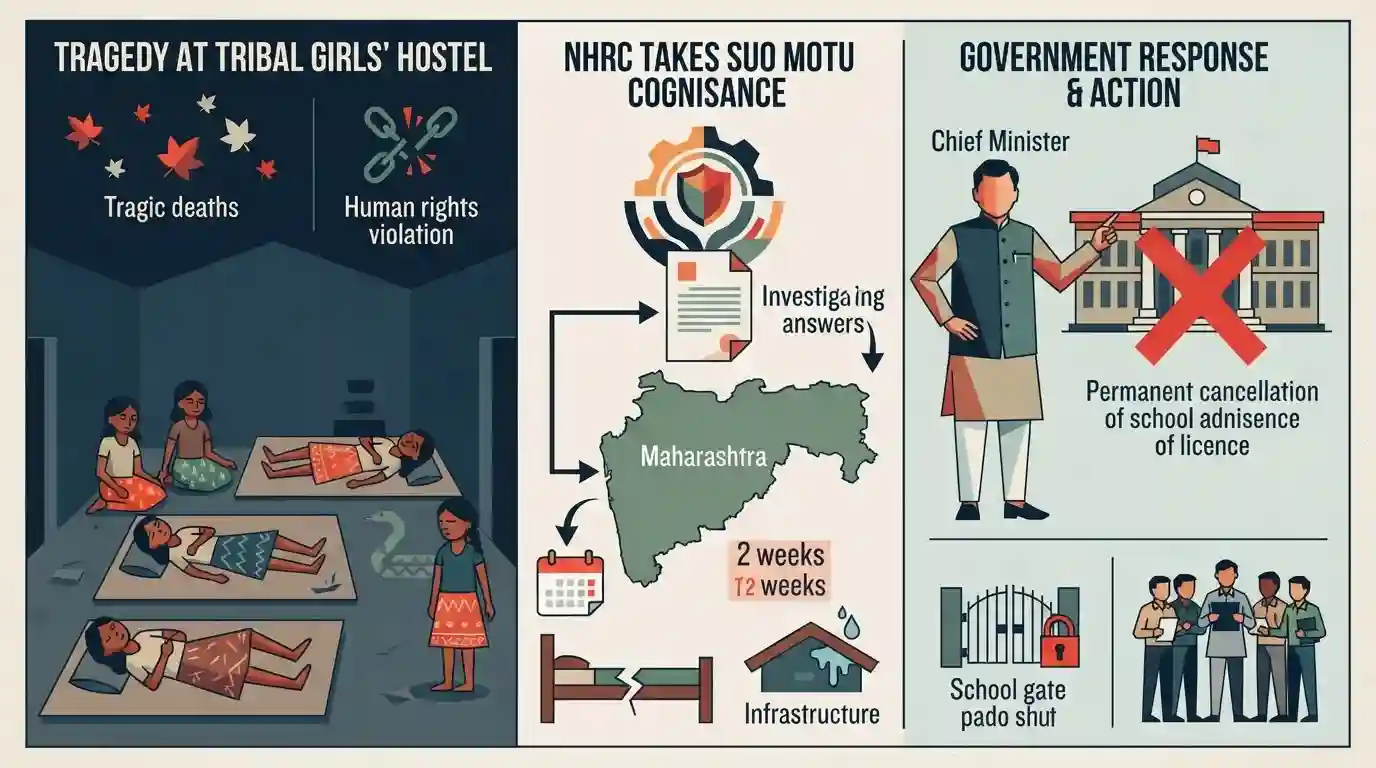
The National Human Rights Commission (NHRC) has issued a notice to the Maharashtra government after taking suo motu cognisance of the tragic deaths of three tribal girls from snakebite at a residential school hostel in Gadchiroli. The students, along with three others who survived, were sleeping on the floor due to a lack of cots in the hostel. Highlighting the grave violation of human rights and basic infrastructure failures, the NHRC directed the state government to submit a detailed report within two weeks. In response to the incident, Chief Minister Devendra Fadnavis ordered the permanent cancellation of the school's licence.
मुख्य मुद्दे
- The National Human Rights Commission (NHRC) took suo motu cognisance of the deaths of three tribal schoolgirls from snakebite at a residential school hostel in Gadchiroli district, Maharashtra.
- The incident occurred because the victims, along with three other surviving students, were forced to sleep on the floor due to a severe shortage of cots in the hostel.
- The NHRC issued a notice to the Maharashtra Chief Secretary, demanding a detailed report on the incident, the current health status of the surviving students, and the status of basic facilities in the residential school within two weeks.
- Following the tragedy, Maharashtra Chief Minister Devendra Fadnavis ordered the permanent cancellation of the 25-year-old tribal residential school's licence.
- The incident highlights critical deficits in basic infrastructure, safety, and public health preparedness in tribal welfare residential schools (ashram schools), especially in regions like Gadchiroli that report high annual snakebite cases.
महत्त्वाच्या संज्ञा
National Human Rights Commission (NHRC)

An independent statutory body established under the Protection of Human Rights Act, 1993. It acts as a national watchdog to protect, promote, and investigate violations of human rights in India.
UPSC context
GS Paper 2 (Statutory Bodies). Tests knowledge of institutional frameworks designed to safeguard citizens' rights and ensure executive accountability.
Suo motu cognisance
A legal action where a court or statutory authority initiates proceedings on its own motion, based on media reports or other information, without a formal complaint being filed.
UPSC context
GS Paper 2 (Polity & Governance). Relevant for discussions on judicial activism, procedural fairness, and institutional responsiveness to public issues.
Ashram Schools
Government-funded residential schools that provide free boarding, lodging, and education to students from Scheduled Tribes to ensure educational access in remote areas.
UPSC context
GS Paper 2 (Welfare Schemes, Education). Highlights state interventions targeting the socio-economic empowerment and educational development of vulnerable tribal populations.
पूर्वपरीक्षा सापळा
NHRC recommendations are legally binding on state governments.
While the NHRC has the power of a civil court and can take suo motu cognisance, its final recommendations remain strictly advisory, not legally binding.
संबंधित स्थिर संकल्पना
What are the investigative powers of the NHRC under the Protection of Human Rights Act?
- Civil Court Powers: It has the powers of a civil court to summon witnesses, receive evidence on affidavits, and requisition public records.
- Suo Motu Cognisance: It can initiate inquiries on its own into human rights violations or negligence by a public servant.
- Independent Agency Use: It can utilize the services of any officer or investigation agency of the Central or State Government for its inquiries.
What are the criteria and governance structure for Eklavya Model Residential Schools (EMRS)?
- Target Criteria: Targeted to be set up in every block with over 50% ST population and at least 20,000 tribal persons.
- Nodal Body: Governed by the autonomous National Education Society for Tribal Students (NESTS) under the Ministry of Tribal Affairs.
- Primary Objective: To provide quality upper primary, secondary, and senior secondary education to ST students in remote areas.
आंतर-विषय नमुने
Tribal infra & Neglected Tropical Diseases
Snakebite envenoming is a WHO Category A NTD. Its high incidence in tribal belts connects healthcare access gaps directly to grassroots tribal infrastructure deficits.
Article 275(1) & Tribal Education
Funding for state-run Ashram schools relies on grants-in-aid under Article 275(1), linking constitutional financial provisions to on-ground tribal welfare interventions like DAJGUA.

NHRC's suo motu powers combined with EMRS criteria or WHO's classification of snakebites (NTD) is prime material for a composite MCQ.
संबंधित PYQ · 3
संबंधित PYQ · 3
- 2014MainsGS2
National Human Rights Commission (NHRC) in India can be most effective when its tasks are adequately supported by other mechanisms that ensure the accountability of a government. In light of the above observation assess the role of NHRC as an effective complement to the judiciary and other institutions in promoting and protecting human rights standards.
- 2021MainsGS2
Though the Human Rights Commissions have contributed immensely to the protection of human rights in India, yet they have failed to assert themselves against the mighty and powerful. Analyzing their structural and practical limitations, suggest remedial measures.
- 2023MainsGS2
The crucial aspect of development process has been the inadequate attention paid to Human Resource Development in India. Suggest measures that can address this inadequacy.
