NHRC Seeks Report on Alleged Mass Detention in Uttarakhand
Source:Indian Express ↗
Why It Matters
Highlights the practical role and intervention capacity of the NHRC in cases of alleged mass human rights violations and arbitrary state action, relevant for analyzing the efficacy of statutory human rights bodies and the protection of Article 21.
Summary
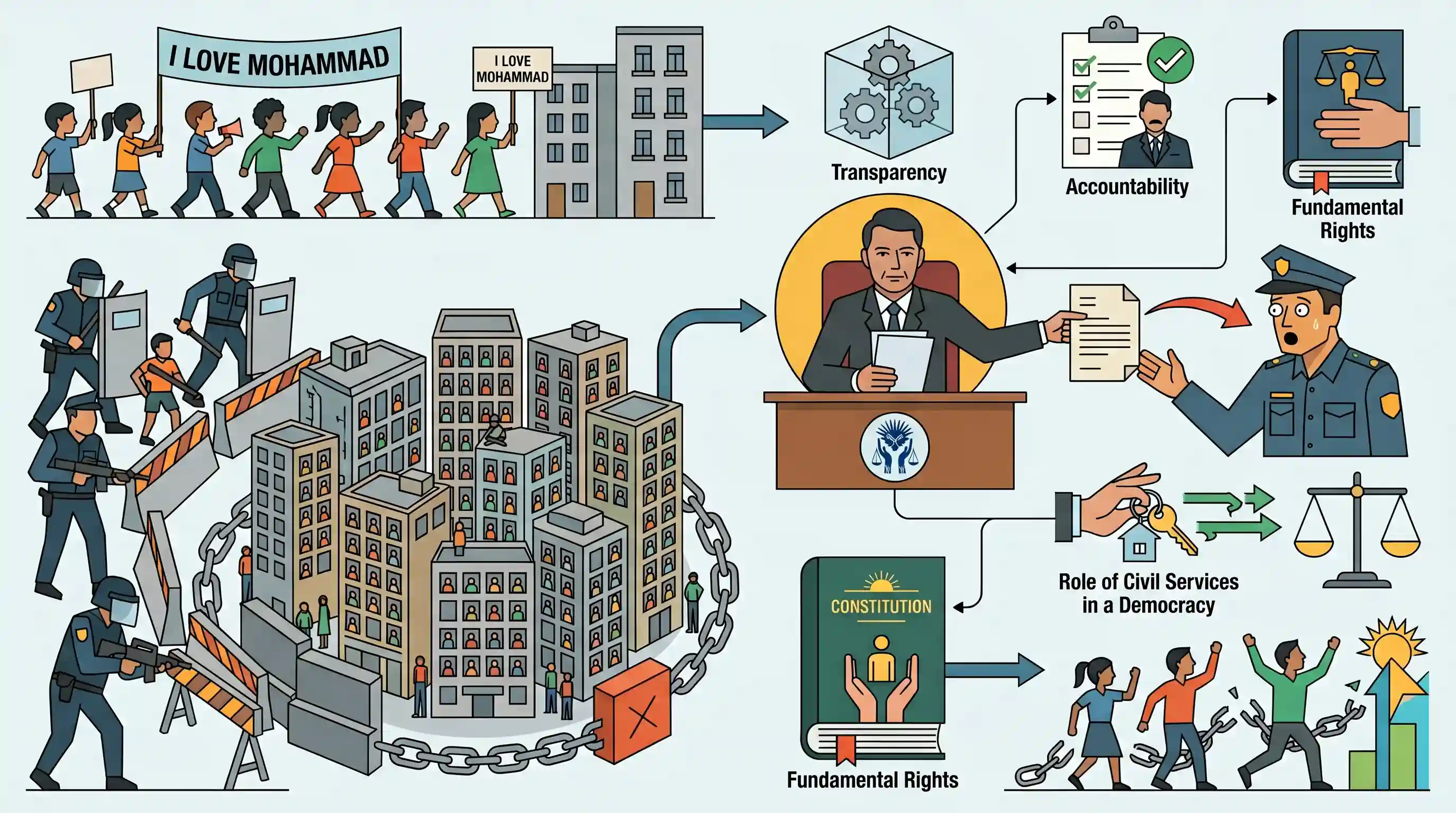
The National Human Rights Commission (NHRC) has sought an action taken report from Uttarakhand authorities following allegations that nearly 20,000 residents in Kashipur were placed under illegal house arrest. The sweeping police crackdown in the Allikhana locality occurred after a children's march carrying "I Love Mohammad" posters was allegedly linked to a separate police assault. The NHRC's intervention highlights grave concerns regarding human rights violations, police excesses, and arbitrary detention without due process.
Key Points
- The NHRC has demanded an Action Taken Report (ATR) from Uttarakhand authorities over the alleged illegal house arrest of around 20,000 residents in Kashipur.
- The incident stems from a sweeping police crackdown in the Allikhana locality following a September 2025 children's march carrying 'I Love Mohammad' posters.
- A complaint filed by an advocate alleges police excesses, physical assault, undeclared curfews, and municipal demolitions without due process.
- The intervention underscores concerns surrounding state accountability, the right to personal liberty, and protections against arbitrary detention under the Constitution.
Important Terms
National Human Rights Commission (NHRC)

A statutory body established in 1993 to protect and promote human rights. It investigates violations by public servants and acts as a 'watchdog' for life, liberty, and dignity.
UPSC context
GS Paper II: Statutory Bodies. Tests understanding of quasi-judicial mechanisms and executive accountability in human rights protection.
Action Taken Report (ATR)
A formal document submitted by government authorities to the NHRC detailing measures implemented to address a specific grievance or comply with recommendations.
UPSC context
GS Paper II: Governance. Relevant for topics on transparency, administrative accountability, and the effectiveness of statutory bodies.
Protection of Human Rights (PHR) Act, 1993
The legislation providing for the creation of the NHRC and State Commissions. It defines human rights as those enforceable by Indian courts or embodied in international covenants.
UPSC context
GS Paper II: Important Acts. Essential for understanding the legal framework governing human rights institutions in India.
House Arrest
The detention of an individual in their own residence instead of a jail. While used for preventive measures, it becomes 'illegal' if conducted without due legal process.
UPSC context
GS Paper II: Fundamental Rights. Crucial for discussions on personal liberty versus state security and preventive detention laws.
Arbitrary Detention
The arrest or detention of an individual in a case where there is no likelihood of a crime or no legal basis, violating constitutional safeguards.
UPSC context
GS Paper II: Fundamental Rights. Tests knowledge of Article 22 and judicial precedents like D.K. Basu v. State of West Bengal.
Article 21
The fundamental right guaranteeing that no person shall be deprived of their life or personal liberty except according to procedure established by law.
UPSC context
GS Paper II: Fundamental Rights. The bedrock of individual liberty; frequently tested in contexts of police excesses and judicial activism.
Suo Motu
The power of a body (like NHRC or courts) to take notice of a matter on its own motion, without a formal petition or complaint.
UPSC context
GS Paper II: Quasi-judicial Bodies. Important for understanding the proactive role of commissions in protecting civil liberties.
Prelims Trap
The NHRC has the authority to directly penalize erring state officials and enforce binding orders.
The NHRC is a statutory body with strictly recommendatory powers. It can investigate and recommend prosecution or compensation, but it cannot directly punish officials or enforce its findings.
Static Concepts Connected
What are the primary statutory limitations on the NHRC's investigative powers?
- Recommendatory nature: Its recommendations are not binding on the government, and it relies heavily on Action Taken Reports from the very state machinery it investigates.
- One-year limitation: The Commission cannot inquire into any human rights violation if more than one year has elapsed since the date of the alleged incident.
- Armed forces restriction: It has limited jurisdiction and cannot independently investigate allegations of human rights violations committed by the armed forces.
How do administrative punitive demolitions violate constitutional safeguards?
- Article 21 violation: Demolitions without due process deprive individuals of shelter, violating the right to life and personal liberty which strictly requires a 'procedure established by law'.
- Separation of powers: The executive bypasses the judiciary by unilaterally determining guilt and administering punishment, directly attacking the Rule of Law.
- Natural justice deficit: Such actions typically lack mandatory show-cause notices and fair hearings, violating the foundational principle of audi alteram partem.
Cross-Topic Patterns
NHRC limits & Prakash Singh directives
NHRC's reliance on state ATRs underlines the urgency of establishing independent State Police Complaints Authorities (SPCAs) to objectively investigate police excesses.
Punitive demolitions & Executive overreach
The trend of blending municipal demolitions with police crackdowns is a major GS-2 theme, questioning executive overreach, natural justice, and the state's adherence to the Rule of Law.

Expect a 2026 Prelims question testing the precise statutory limits of NHRC's powers mapped against Article 21 and arbitrary detention.
Linked PYQs · 3
Linked PYQs · 3
- 2014MainsGS2
National Human Rights Commission (NHRC) in India can be most effective when its tasks are adequately supported by other mechanisms that ensure the accountability of a government. In light of the above observation assess the role of NHRC as an effective complement to the judiciary and other institutions in promoting and protecting human rights standards.
- 2021MainsGS2
Though the Human Rights Commissions have contributed immensely to the protection of human rights in India, yet they have failed to assert themselves against the mighty and powerful. Analyzing their structural and practical limitations, suggest remedial measures.
- 2017MainsGS2
Examine the scope of Fundamental Rights in the light of the latest judgement of the Supreme Court on Right to Privacy.
