NHAI Uses AI to Preserve Institutional Knowledge Amid Transfers
Source:The Hindu ↗
हे का महत्त्वाचे आहे
It highlights a critical administrative challenge in India's bureaucracy—loss of institutional knowledge due to frequent transfers—and demonstrates an innovative technological fix using AI and open-source tools to improve e-governance and public administration.
सारांश
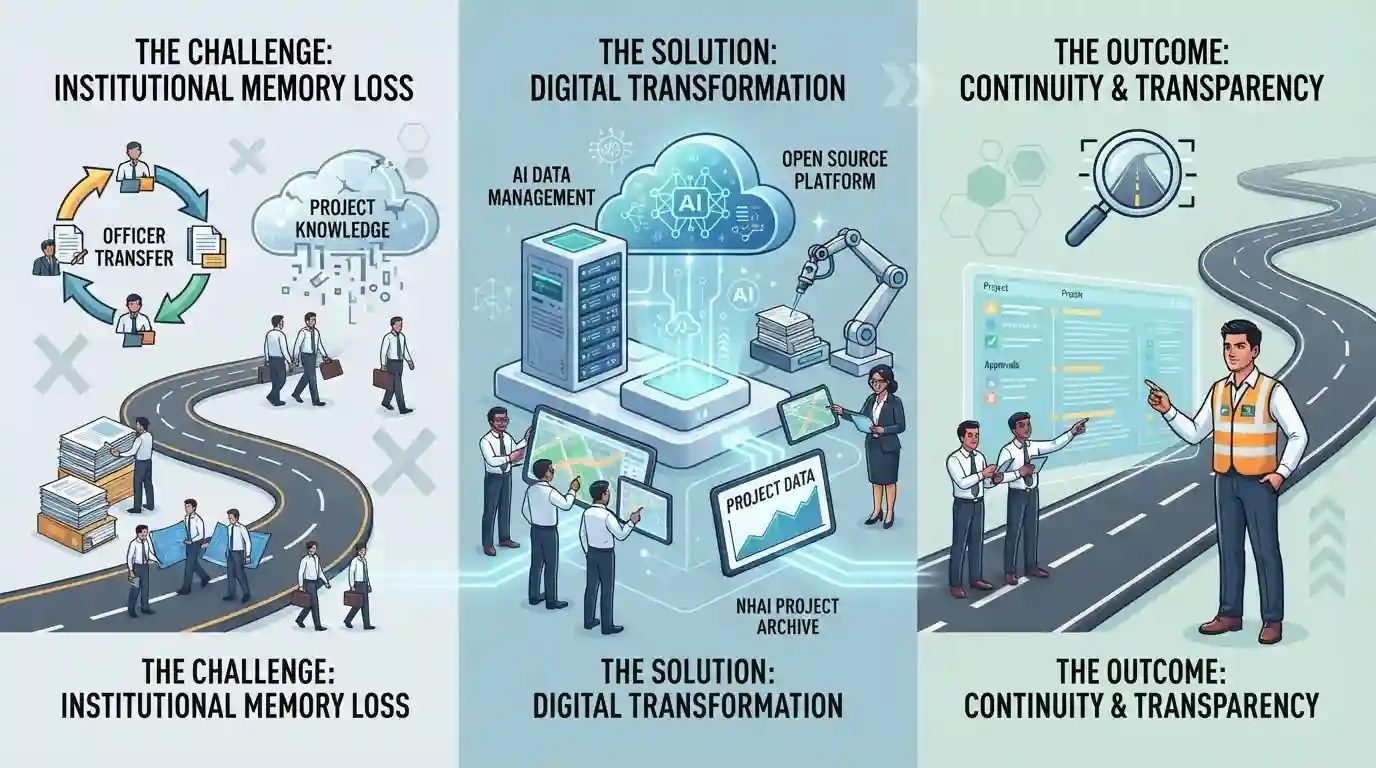
The National Highways Authority of India (NHAI) is turning to artificial intelligence and open-source technologies to tackle the loss of institutional memory caused by routine officer transfers, ensuring project continuity and transparency in infrastructure management.
मुख्य मुद्दे
- NHAI is leveraging artificial intelligence (AI) and open-source technology to preserve institutional knowledge that is frequently lost due to routine officer transfers.
- Frequent bureaucratic reshuffles and officer transfers often result in a loss of continuity, context, and institutional memory in critical infrastructure projects.
- The integration of AI-driven systems helps document, index, and retrieve project data, decisions, and historical context seamlessly, mitigating governance bottlenecks.
- Open-source frameworks ensure cost-effectiveness, data security, and adaptability to specific public sector administrative requirements without vendor lock-in.
महत्त्वाच्या संज्ञा
National Highways Authority of India (NHAI)

An autonomous statutory body under the Ministry of Road Transport and Highways responsible for the development, maintenance, and management of national highways in India.
UPSC context
UPSC GS Paper III (Infrastructure: Roads) and GS Paper II (Statutory Bodies); tests institutional governance and transport infrastructure.
पूर्वपरीक्षा सापळा
Open-source frameworks inherently risk data security compromises due to public domain exposure in critical infrastructure.
Aspirants might assume open-source implies a public cloud exposed to external vendors, whereas NHAI uses closed-loop architectures trained on internal standards.
संबंधित स्थिर संकल्पना
What are the major structural challenges and reform recommendations concerning civil service transfers in India?
- Minimum Tenure: Civil Services Board (CSB) recommendations to fix minimum tenure for officers to insulate them from political pressures.
- Knowledge Loss: Institutional memory loss due to frequent reshuffles hampers long-term policy formulation and execution.
- Second ARC Focus: Second ARC recommendations emphasize performance-based appraisal and domain expertise over generalist rotations.
आंतर-विषय नमुने
Bureaucratic Transfers and Infrastructure Continuity
NHAI's administrative bottlenecks mirror systemic civil service inertia where frequent transfers disrupt long-term infrastructure planning and accountability.
E-Governance Frameworks and Open-Source Sovereignty
Deploying public sector AI platforms highlights the balance between open-source agility and sovereign data security frameworks in e-governance.

NHAI's AI deployment for institutional memory addresses classic civil service reform challenges and e-governance applications in mains.
संबंधित PYQ · 3
संबंधित PYQ · 3
- 2025MainsGS2
e-governance projects have a built-in bias towards technology and back-end integration than user-centric designs. Examine.
- 2024MainsGS2
e-governance is not just about the routine application of digital technology in service delivery process. It is as much about multifarious interactions for ensuring transparency and accountability. In this context evaluate the role of the 'Interactive Service Model' of e-governance.
- 2023MainsGS2
e-governance, as a critical tool of governance, has ushered in effectiveness, transparency and accountability in governments. What inadequacies hamper the enhancement of these features ?
