Lucknow Kanpur Expressway Damage and Quality Control Probe
Source:hindustan-times ↗
Why It Matters
This incident highlights the crucial gap between the adoption of advanced construction technologies and the actual delivery of durable public infrastructure, underscoring the ongoing challenges of accountability and quality assurance in India's rapid highway expansion.
Summary
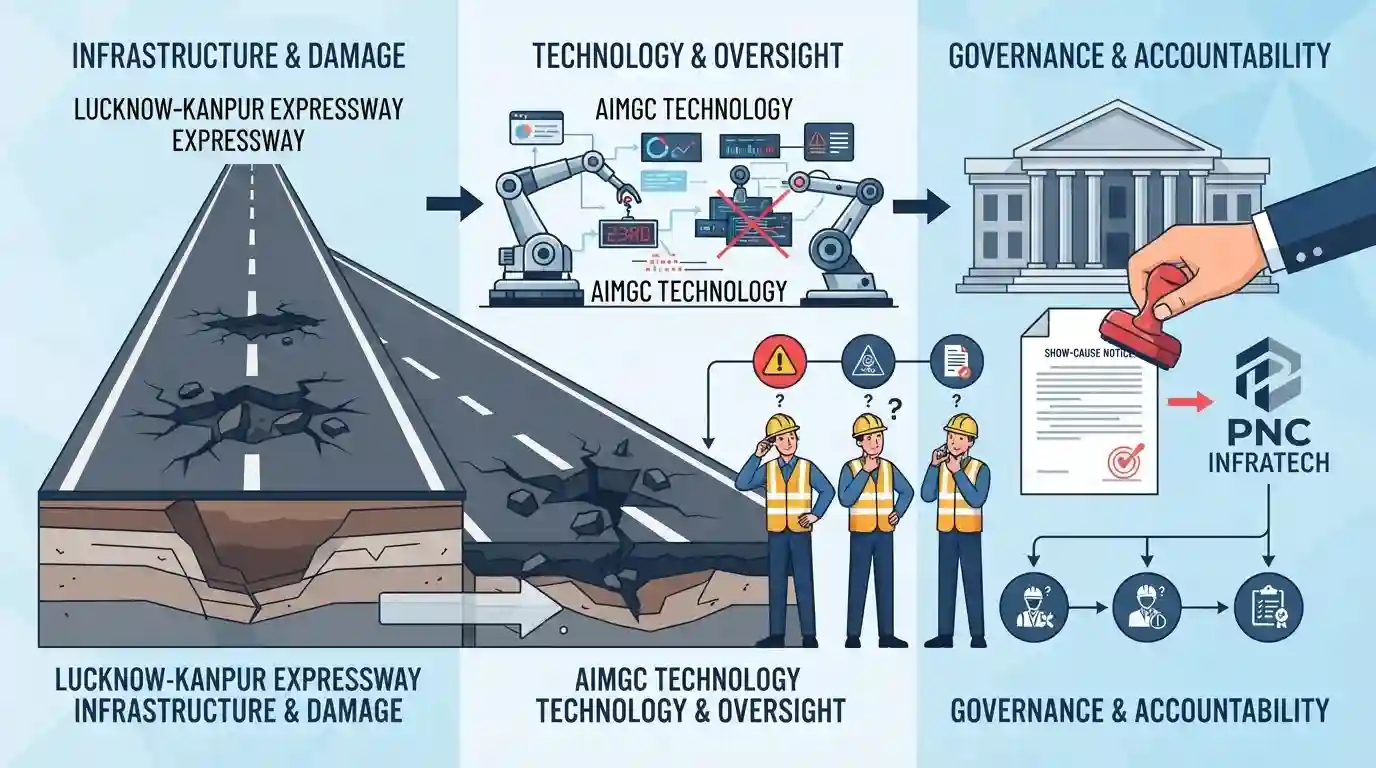
The National Highways Authority of India (NHAI) has initiated a probe and taken disciplinary action against three engineers after severe surface damage was discovered on the newly built Lucknow-Kanpur Expressway. A show-cause notice has been issued to the construction firm, PNC Infratech. Despite utilizing advanced Automated Intelligence Machine Guided Construction (AIMGC) technology aimed at precision and durability, the rapid appearance of potholes highlights significant lapses in quality control, project execution, and governance in major infrastructure developments.
Key Points
- The NHAI has ordered a formal probe and banned three engineers following the emergence of fresh potholes and craters on the newly inaugurated Lucknow-Kanpur Expressway.
- A show-cause notice was issued to PNC Infratech, the private construction agency responsible for building the expressway.
- The project uniquely utilized Automated Intelligence Machine Guided Construction (AIMGC) technology, which was intended to guarantee high precision and quality, raising concerns over its execution.
- The rapid degradation of the road surface underscores systemic issues in quality control and accountability in state-led infrastructure projects.
Important Terms
Automated Intelligence Machine Guided Construction (AIMGC)

A road construction technology utilizing GPS-enabled machinery synced with 3D design models. It enables precise material usage and real-time monitoring of soil compaction and density, recently introduced in India to enhance infrastructure quality.
UPSC context
Relevant to GS Paper 3 (Infrastructure & Technology). Tests awareness of AI/automation applications in public infrastructure and quality control.
Lucknow-Kanpur Expressway
A 63-km, six-lane access-controlled greenfield and brownfield corridor in Uttar Pradesh, designated as National Expressway 6. It is India's first highway utilizing AIMGC technology, aimed at reducing travel time and boosting regional industrial connectivity.
UPSC context
Essential for GS Paper 3 (Infrastructure). Tests knowledge of modern smart highways, economic corridors, and regional development initiatives.
National Highways Authority of India (NHAI)
A statutory body under the Ministry of Road Transport and Highways, established by the NHAI Act, 1988. It serves as the nodal agency responsible for the development, maintenance, and management of India's national highways network.
UPSC context
Important for GS Paper 2 (Statutory Bodies) and GS Paper 3 (Infrastructure). Covers governance, accountability, and the execution of major public works.
PNC Infratech
An Indian private infrastructure development company that executes large-scale engineering, procurement, and construction (EPC) projects, including highways and expressways, often partnering with government agencies under various public-private partnership models.
UPSC context
Relates to GS Paper 3 (Infrastructure/Investment Models). Highlights the role and accountability of private EPC contractors in public infrastructure development.
Prelims Trap
NHAI acquires land for highway projects using the powers granted under the National Highways Authority of India Act, 1988.
While NHAI is an autonomous body created under the NHAI Act of 1988, the actual land acquisition for national highways is governed by the older National Highways Act, 1956.
Static Concepts Connected
What is the statutory framework governing the National Highways Authority of India (NHAI)?
- Statutory Origin: It was constituted as an autonomous statutory body under the National Highways Authority of India Act, 1988, functioning under the Ministry of Road Transport and Highways.
- Land Acquisition: Land acquisition for national highway projects entrusted to NHAI is legally executed under Section 3 of the National Highways Act, 1956.
How does Multi-Lane Free Flow (MLFF) electronic toll collection function?
- RFID Technology: FASTag relies on Radio Frequency Identification (RFID) technology to facilitate direct, contactless toll deductions from a linked prepaid or bank account.
- ANPR Integration: Advanced MLFF systems eliminate toll barriers entirely by integrating RFID data with Automatic Number Plate Recognition (ANPR) cameras to track and charge vehicles in motion.
Cross-Topic Patterns
MLFF Tolling + Data Privacy
Integrating ANPR cameras and RFID for barrier-less tolling creates continuous vehicle tracking capabilities, intersecting with digital surveillance and DPDP Act compliance.
Infrastructure Corridors + Geography Mapping
The East-West (Porbandar-Silchar) and North-South (Srinagar-Kanyakumari) corridors, which intersect at Jhansi in UP, remain high-yield UPSC geography mapping touchpoints.

Expect a prelims statement mixing NHAI's 1988 origin with the 1956 Act's land acquisition powers, alongside RFID-based MLFF tolling tech.
Linked PYQs · 2
Linked PYQs · 2
- 2023UPPSC_PRELIMSGS1
Which of the following Scheme/Programme is not the Central Government Programme and it is Uttar Pradesh Government's Programme?
- 2013UPPSC_PRELIMSGS1
The North-South and East West corridors of the National Highway Development Project meet at
