NHAI Hikes Toll Rates on Major Jaipur Highways
Source:theshillongtimes ↗
Why It Matters
Road infrastructure and transportation networks are fundamental to Rajasthan's economic development. Changes in toll rates directly influence logistics costs, trade efficiency, and the overall cost of doing business, making it a critical topic for state-level economy and infrastructure discussions.
Summary
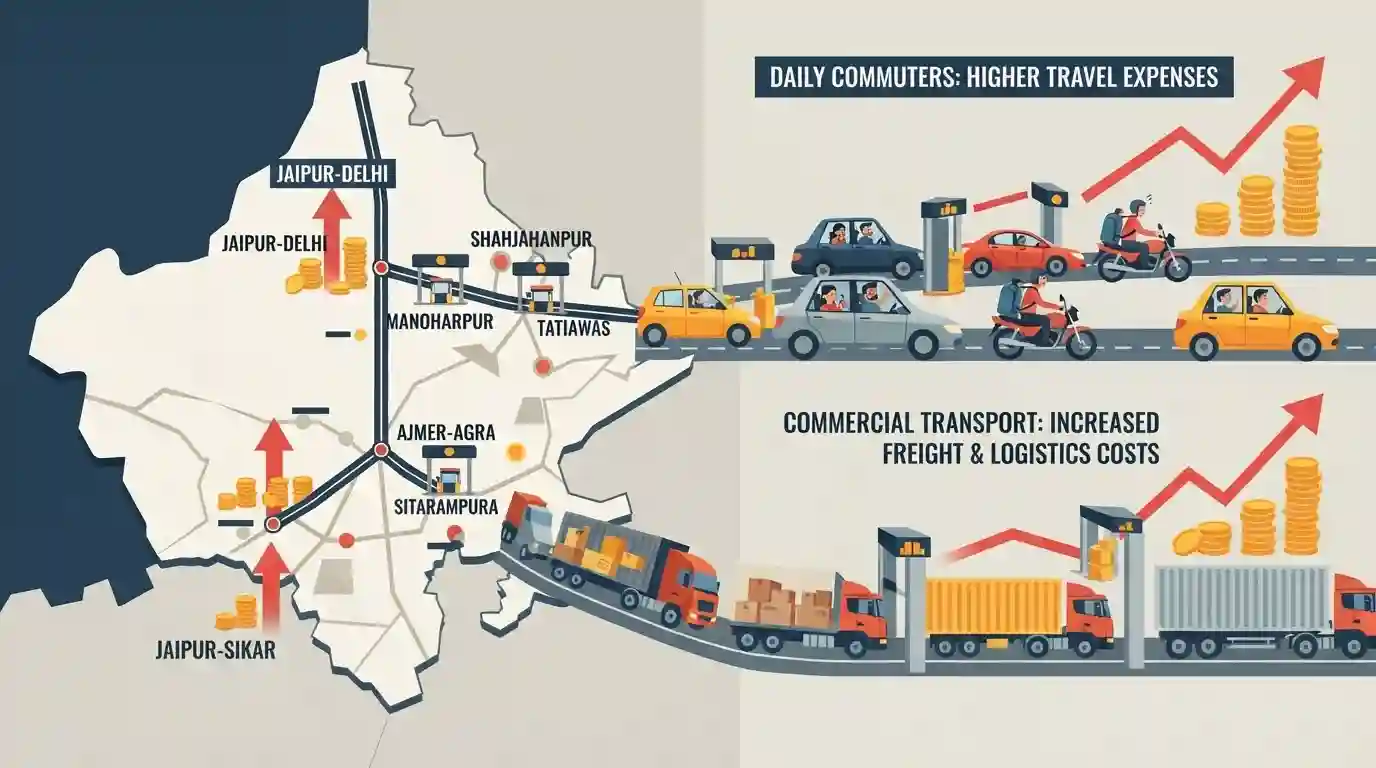
The National Highways Authority of India (NHAI) has increased toll tax rates across key national highways passing through Jaipur, impacting major routes such as the Jaipur-Delhi highway (Old NH-48), the Ajmer-Agra Ring Road, and the Jaipur-Sikar bypass. Toll plazas at Manoharpur, Shahjahanpur, Sitarampura, and Tatiawas will implement the revised rates, leading to higher travel expenses for daily commuters and increased freight and logistics costs for commercial transport within and beyond Rajasthan.
Key Points
- The National Highways Authority of India (NHAI) has raised toll tax rates on major national highways passing through Jaipur.
- The toll rate hike affects critical routes, including the Jaipur-Delhi highway (Old NH-48), with increased fees at the Manoharpur and Shahjahanpur toll plazas.
- Toll rates have also been increased at the Sitarampura toll plaza on the Ajmer-Agra Ring Road and the Tatiawas toll plaza on the Jaipur-Sikar bypass.
- The increase in toll charges is expected to elevate travel and logistics costs for both private commuters and commercial freight operations across the region.
Important Terms
National Highways Authority of India (NHAI)

A statutory body under the Ministry of Road Transport and Highways, established in 1988. It is responsible for the development, maintenance, and management of India's national highway network.
UPSC context
GS Paper 3 (Infrastructure). Tests knowledge of agencies executing highway projects, toll collections, and programs like Bharatmala Pariyojana.
National Highways Fee Rules, 2008
The statutory framework governing the calculation, annual escalation, and collection of user fees (tolls) on India's national highways to recover construction and maintenance costs.
UPSC context
GS Paper 3 (Infrastructure financing). Important for understanding road asset monetization, InvITs, BOT models, and tolling transparency issues.
NH-48
A major national highway spanning from Delhi to Chennai. Forming a crucial section of the Golden Quadrilateral, it was previously known as NH-8 in its northern segment.
UPSC context
GS Paper 1 (Geography). Tests map-based knowledge of India's major transport, freight, and economic corridors.
Logistics Costs
The overall expenses incurred in transporting, storing, and delivering goods. Highway toll hikes directly increase these overheads for commercial freight, impacting final retail prices.
UPSC context
GS Paper 3 (Economy). Central to evaluating India's National Logistics Policy which aims to reduce these costs for better export competitiveness.
FASTag
An RFID-based electronic toll collection system deployed across national highway toll plazas by the NHAI, enabling automatic, cashless deduction of user fees to reduce congestion.
UPSC context
GS Paper 3 (Technology in Governance). Tests digital integration in transport systems, efficiency improvements, and revenue leakage prevention.
Prelims Trap
"The National Logistics Policy (NLP) 2022 mandates the elimination of toll taxes on commercial freight by 2030."
The NLP aims to reduce overall logistics costs to a single digit (around 8% of GDP) via efficiency and multi-modal integration, not by outright eliminating highway tolls.
Static Concepts Connected
What are the primary asset monetization models used by NHAI?
- Toll-Operate-Transfer (TOT): Private players pay an upfront fee for the right to collect tolls and maintain a publicly-funded, operational highway for 15-30 years.
- NHAI InvITs: Pooled investment vehicles that enable retail and institutional investors to invest directly in a portfolio of operational highway assets, providing regular yield.
- SPV Financing: Creation of distinct Special Purpose Vehicles (SPVs) for specific greenfield corridors to raise debt independently of NHAI's balance sheet.
What are the core targets of the National Logistics Policy (NLP) 2022?
- Cost Reduction: Lower India's logistics costs from the current estimate of 13-14% of GDP to a single-digit percentage by 2030 to boost export competitiveness.
- LPI Ranking: Improve India’s standing in the World Bank's Logistics Performance Index (LPI) to rank among the top 25 nations by 2030.
- Digital Integration: Implement a Unified Logistics Interface Platform (ULIP) to bring all digital services of the transportation sector into a single portal.
Cross-Topic Patterns
Highway tolls, freight & core inflation
Higher freight costs from toll hikes directly cascade into core inflation. This complicates the RBI's monetary policy, linking micro-level infrastructure pricing to macroeconomic stability.
GNSS Tolling & Right to Privacy
The transition from physical plazas and FASTag to satellite-based (GNSS) tolling involves continuous vehicle tracking, bridging infrastructure policy with constitutional Right to Privacy (Puttaswamy) debates.

Expect a 2026 prelims question differentiating NHAI's TOT model from InvITs, or evaluating the upcoming GNSS tolling system's mechanics.
Linked PYQs · 2
Linked PYQs · 2
- 2023RPSC_PRELIMSGS1
The Rajasthan State Highway Development Program-II project, which includes the upgrading of 11 highways with a length of 801 km, is financed by which agency?
- 2024RPSC_PRELIMSGS1
In Rajasthan's Gross Fixed Capital Formation of 2022-23, what is the order in which sectors are arranged from highest to lowest share? A. Construction B. Transport C. Agriculture D. Manufacturing
