NHAI Integrates Wildlife Mitigation in Highway Design
Source:timesofindia ↗
Why It Matters
The article highlights the critical policy debate between linear infrastructure development and ecological conservation in environmentally sensitive areas. This is particularly relevant to Uttarakhand, where infrastructure projects regularly intersect with vital wildlife corridors (like those near Rajaji National Park) and elephant migratory routes, testing the implementation of the Supreme Court's landmark Mudumalai elephant corridor guidelines.
Summary
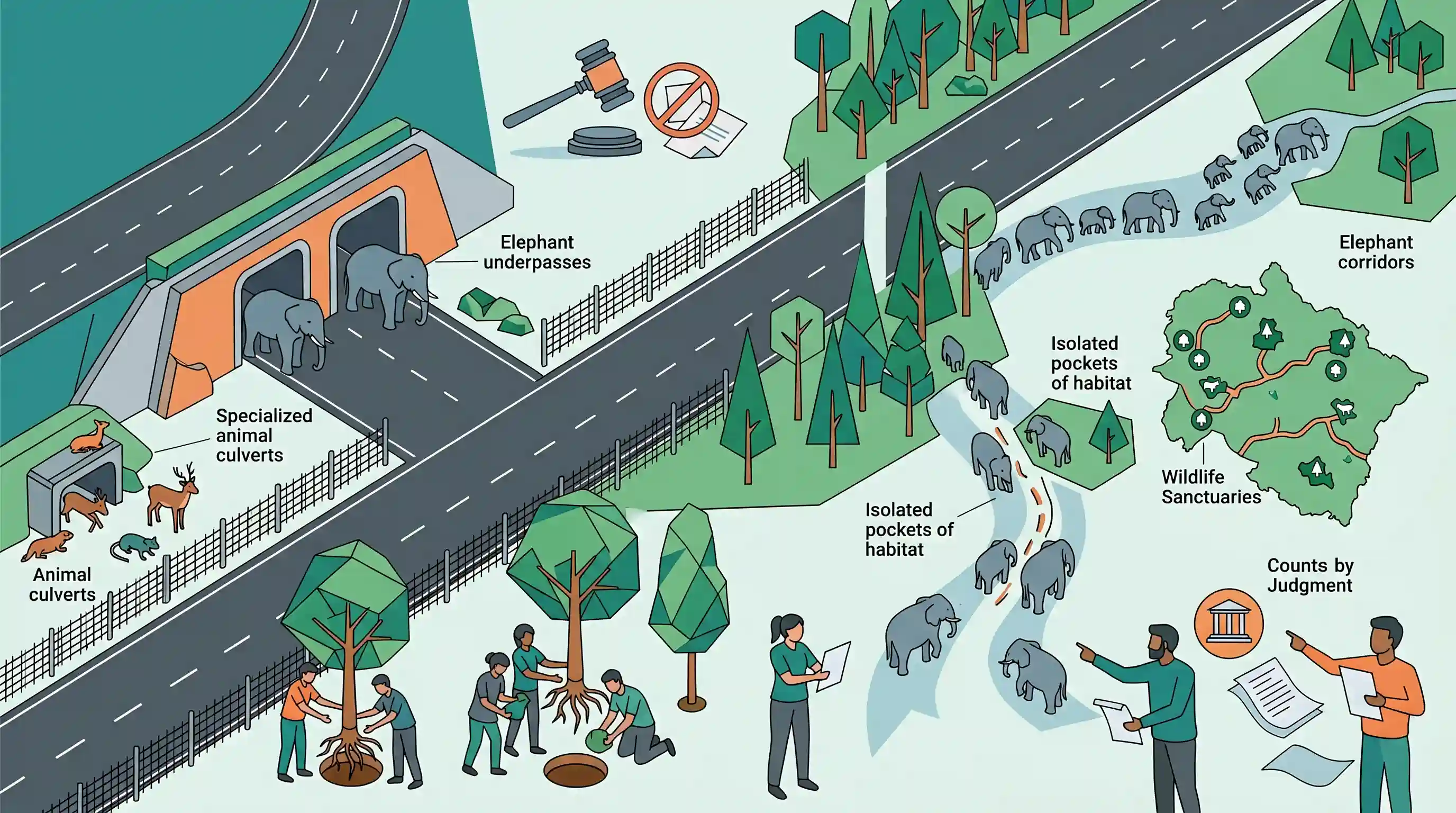
The National Highways Authority of India (NHAI) has defended the controversial Bhaniyawala-Jollygrant-Rishikesh highway expansion project, claiming that extensive ecological and wildlife mitigation safeguards have been integrated into its design in consultation with the Wildlife Institute of India (WII) and WWF-India. Features include elevated elephant underpasses, specialized animal culverts, reduced forest Right of Way, and scientific tree transplantation managed by the Forest Research Institute (FRI). Despite a High Court dismissal of a contempt petition against the project, environmentalists intend to appeal to the Supreme Court, citing the fragmentation of critical elephant corridors in violation of the landmark Mudumalai judgment.
Key Points
- The National Highways Authority of India (NHAI) defended the proposed four/six-lane expansion of the Bhaniyawala-Jollygrant-Rishikesh highway corridor, which has faced opposition from environmentalists and was on hold since January 2026 due to High Court orders.
- To mitigate human-wildlife conflict and maintain ecological connectivity, NHAI has integrated one major bridge-cum-elephant underpass and four dedicated elevated elephant underpasses (approx. 3.5 km long) into the project design.
- For smaller and larger mammals (tigers, leopards, deer, jackals) and reptiles, the project includes six box culverts (5x3m) and 13 pipe culverts (1,200 mm diameter), alongside green guide hedges, sound barriers, and speed-calming measures.
- NHAI reduced the Right of Way (RoW) in the forest zone from 60 meters to 23 meters to limit encroachment and deposited over ₹1.97 crore for compensatory afforestation and over ₹6.04 crore for Wildlife Mitigation and Soil and Water Conservation plans.
- Out of 4,369 affected trees, 754 will be scientifically transplanted under the guidance of the Forest Research Institute (FRI), Dehradun.
- Although the High Court dismissed a contempt petition against the project, local activists represented by advocate Abhijay Negi plan to appeal to the Supreme Court, arguing that the highway fragments two crucial elephant corridors, violating the landmark Mudumalai judgment.
Important Terms
Mudumalai Elephant Corridor Judgment

Landmark 2020 Supreme Court ruling (Hospitality Association of Mudumalai v. In Defence of Environment and Animals) prioritizing the "right of passage" for elephants, declaring them a keystone species, and ordering the closure of illegal commercial resorts.
UPSC context
GS Paper III (Ecology). Tests landmark environmental judgments, wildlife corridors, and balancing conservation with development.
National Highways Authority of India (NHAI)
An autonomous statutory body established under the NHAI Act, 1988, functioning under the Ministry of Road Transport and Highways, responsible for developing, maintaining, and managing India's national highways network.
UPSC context
GS Paper III (Infrastructure). Tests institutional frameworks executing major highway projects and managing environmental-infrastructure trade-offs.
Wildlife Institute of India (WII)
An autonomous institution under the Ministry of Environment, Forest and Climate Change, established in 1982, conducting research and providing advisory services on biodiversity conservation, wildlife policy, and habitat mitigation.
UPSC context
GS Paper III (Biodiversity). Tests awareness of statutory/autonomous bodies advising on wildlife mitigation and ecological impact assessments.
Forest Research Institute (FRI)
A premier institute under the Indian Council of Forestry Research and Education (ICFRE), based in Dehradun, focusing on forestry research, educational training, and scientific applications such as tree transplantation.
UPSC context
GS Paper III (Environment). Tests technical knowledge of institutions working on sustainable forestry, afforestation, and transplantation.
WWF-India
Established in 1969, a leading conservation NGO working as part of the global WWF network to promote biodiversity conservation, reduce human footprint, and assist in eco-friendly planning for development projects.
UPSC context
GS Paper III (Ecology). Tests role of non-governmental organizations in environmental advocacy, wildlife protection, and policy partnerships.
Prelims Trap
Elephant corridors in India are formally defined, designated, and legally protected zones explicitly under the Wildlife (Protection) Act, 1972.
No clause in the WPA, 1972 explicitly defines 'elephant corridors'. Instead, they are secured via eco-sensitive zones, executive state notifications, and judicial directives under general environmental powers.
Static Concepts Connected
What is the legal status of Elephant Corridors in India?
- No statutory definition: The Wildlife (Protection) Act, 1972 does not explicitly define or map 'elephant corridors'; they are protected under general forest conservation laws and Eco-Sensitive Zone rules.
- Judicial backing: The landmark 2020 Mudumalai judgment legally validated state authority to notify corridors and restrict commercial activity using the Public Trust Doctrine.
- Project Elephant: Corridor identification and securement are primary objectives under this centrally sponsored scheme launched in 1992.
What are the key ecological features of Rajaji Tiger Reserve?
- Geographical limit: Represents the absolute north-western limit of the global geographic distribution of both the wild Asian elephant and Bengal tiger.
- Location: Spans the Shivalik foothills across Haridwar, Dehradun, and Pauri Garhwal districts of Uttarakhand.
- Riverine split: The Ganga River bisects the reserve, making artificial wildlife corridors (like underpasses) vital for genetic flow between its segments.
Cross-Topic Patterns
Linear infrastructure vs Eco-Sensitive Zones
Balancing linear development with conservation requires adhering to strict green-infrastructure protocols, shifting focus from mere compensatory afforestation to scientific eco-duct engineering.
Public Trust Doctrine in infrastructure planning
Judicial review of NHAI projects shows how courts leverage the Public Trust Doctrine to prioritize keystone species over ease-of-doing-business land acquisitions.

SC's Mudumalai corridor ruling and green-infrastructure mitigation designs will likely feature in GS-3 environment-vs-growth questions.
Linked PYQs · 3
Linked PYQs · 3
- 2025UKPSC_PRELIMSGS1
Which of the following is incorrectly matched about Central Government Institutes located in Uttarakhand?
- 2011UKPSC_PRELIMSGS1
The Forest Research Institute is situated at
- 2024UKPSC_PRELIMSGS1
Which of the following National Park of Uttarakhand has been included in Project Tiger Scheme in 2015 ?
