Green tribunal directs states to adopt Wetland Mitra model
Source:Indian Express ↗
Why It Matters
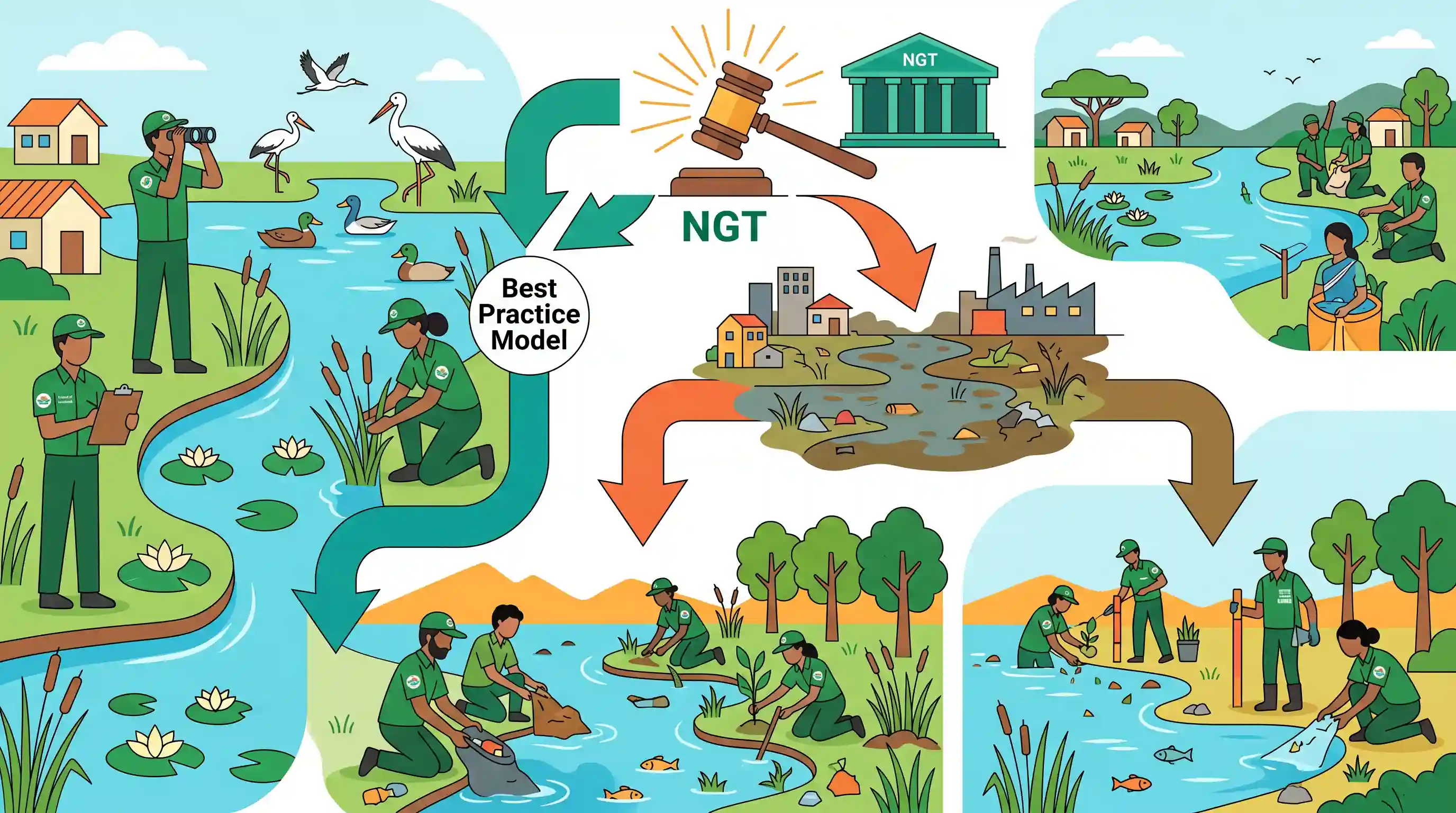
Provides a practical example of a successful community-led conservation model (Wetland Mitra) and illustrates the role of the NGT in promoting inter-state adoption of environmental best practices. This is highly useful for GS3 Environment and GS2 Governance answers.
Summary
The National Green Tribunal (NGT) has directed the states of Madhya Pradesh and Rajasthan to implement Chhattisgarh's 'Wetland Mitra' model to combat the encroachment and degradation of local water bodies. The initiative emphasizes community participation by designating locals as 'friends of wetlands' to monitor, protect, and help revive these critical ecosystems. This approach underscores the growing recognition of decentralized, participatory environmental governance and inter-state adoption of ecological best practices to ensure water security and biodiversity conservation.
Key Points
- The National Green Tribunal (NGT) has issued directives urging Madhya Pradesh and Rajasthan to adopt Chhattisgarh’s "Wetland Mitra" model.
- The model aims to protect and revive dying water bodies by involving local community members as "friends of wetlands" in conservation efforts.
- This judicial intervention seeks to address the severe issue of illegal encroachment and degradation of water bodies in these states.
- The 'Wetland Mitra' approach demonstrates the effectiveness of decentralized, participatory environmental governance in safeguarding critical ecological assets.
Important Terms
Wetland Mitra model

A community-led initiative designating local volunteers as "friends" to monitor, protect, and report on the status of wetlands to prevent encroachment and pollution.
UPSC context
GS Paper III (Conservation) and GS Paper II (Governance); tests understanding of participatory environmental management and community-based conservation.
National Green Tribunal (NGT)
A specialized statutory judicial body established under the NGT Act 2010 for the effective and expeditious disposal of cases relating to environmental protection and forest conservation.
UPSC context
GS Paper II (Statutory Bodies) and GS Paper III (Environmental Governance); frequently tested for its jurisdiction and judicial powers.
Wetlands (Conservation and Management) Rules, 2017
The primary regulatory framework in India for protecting wetlands, decentralizing management to State/UT Wetland Authorities and emphasizing the principle of 'wise use'.
UPSC context
GS Paper III (Environment and Pollution); tests knowledge of specific environmental legislation and decentralization of power.
Wise Use Principle
A guiding principle of the Ramsar Convention and Indian law, defined as the sustainable utilization of wetlands in a way compatible with ecosystem maintenance.
UPSC context
GS Paper III (Conservation and Sustainable Development); crucial for understanding the balance between ecology and livelihood.
State Wetland Authority (SWA)
A state-level statutory body responsible for identifying, notifying, and managing wetlands within its jurisdiction as per the 2017 Rules.
UPSC context
GS Paper II (Executive and Statutory Bodies); tests knowledge of the institutional framework for environmental management.
Prelims Trap
"Wetland Mitras are statutory posts created under the Wetlands (Conservation and Management) Rules, 2017."
Wetland Mitra is an informal, community-stewardship model originally from Chhattisgarh. It is not a statutory post or body defined within the 2017 Wetlands Rules.
Static Concepts Connected
What are the key features of the Wetlands (Conservation and Management) Rules, 2017?
- Decentralization: Replaced the 2010 rules by decentralizing power, establishing State Wetland Authorities (SWAs) as the primary nodal agencies.
- Wise Use Principle: Management is strictly based on the "wise use" principle, balancing ecological character with sustainable socio-economic usage.
- Prohibitions: Strictly prohibits encroachment, solid waste dumping, setting up of industries, and discharge of untreated waste into wetlands.
What is the jurisdiction and mandate of the National Green Tribunal (NGT)?
- Statutory Nature: A specialized statutory body established under the NGT Act 2010 for the effective and expeditious disposal of cases relating to environmental protection.
- Guiding Principles: Not bound by the Code of Civil Procedure; it is guided by natural justice, the precautionary principle, and the polluter pays principle.
- Jurisdiction: Hears civil cases arising out of seven specific environmental enactments, including the Water Act, Forest Act, and Environment (Protection) Act, 1986.
Cross-Topic Patterns
Inter-state adoption via judicial push
The NGT is acting as a catalyst for horizontal federalism by legally nudging states (MP, Rajasthan) to replicate another state's (Chhattisgarh) successful ecological governance model.
Community Stewardship & Amrit Dharohar
Grassroots 'Wetland Mitra' initiatives complement the Union's Amrit Dharohar scheme, which aims to promote the optimal use of Ramsar Sites through local community participation and eco-tourism.

Expect a multi-statement Prelims question mixing the statutory powers of State Wetland Authorities under the 2017 Rules with community initiatives like Wetland Mitra.
Linked PYQs · 3
Linked PYQs · 3
- 2023MainsGS3
Comment on the National Wetland Conservation Programme initiated by the Government of India and name a few India's wetlands of international importance included in the Ramsar Sites.
- 2018MainsGS3
What is wetland? Explain the Ramsar concept of 'wise use' in the context of wetland conservation. Cite two examples of Ramsar sites from India.
- 2019PrelimsGS1
Consider the following statements: 1. Under Ramsar Convention, it is mandatory on the part of the Government of India to protect and conserve all the wetlands in the territory of India. 2. The Wetlands (Conservation and Management) Rules, 2010 were framed by the Government of India based on the recommendations of Ramsar Convention. 3. The Wetlands (Conservation and Management) Rules, 2010 also encompass the drainage area or catchment regions of the wetlands as determined by the authority. Which of the statements given above is/are correct?
