National Green Tribunal Directives on Municipal Waste Incineration
Source:Indian Express ↗
Why It Matters
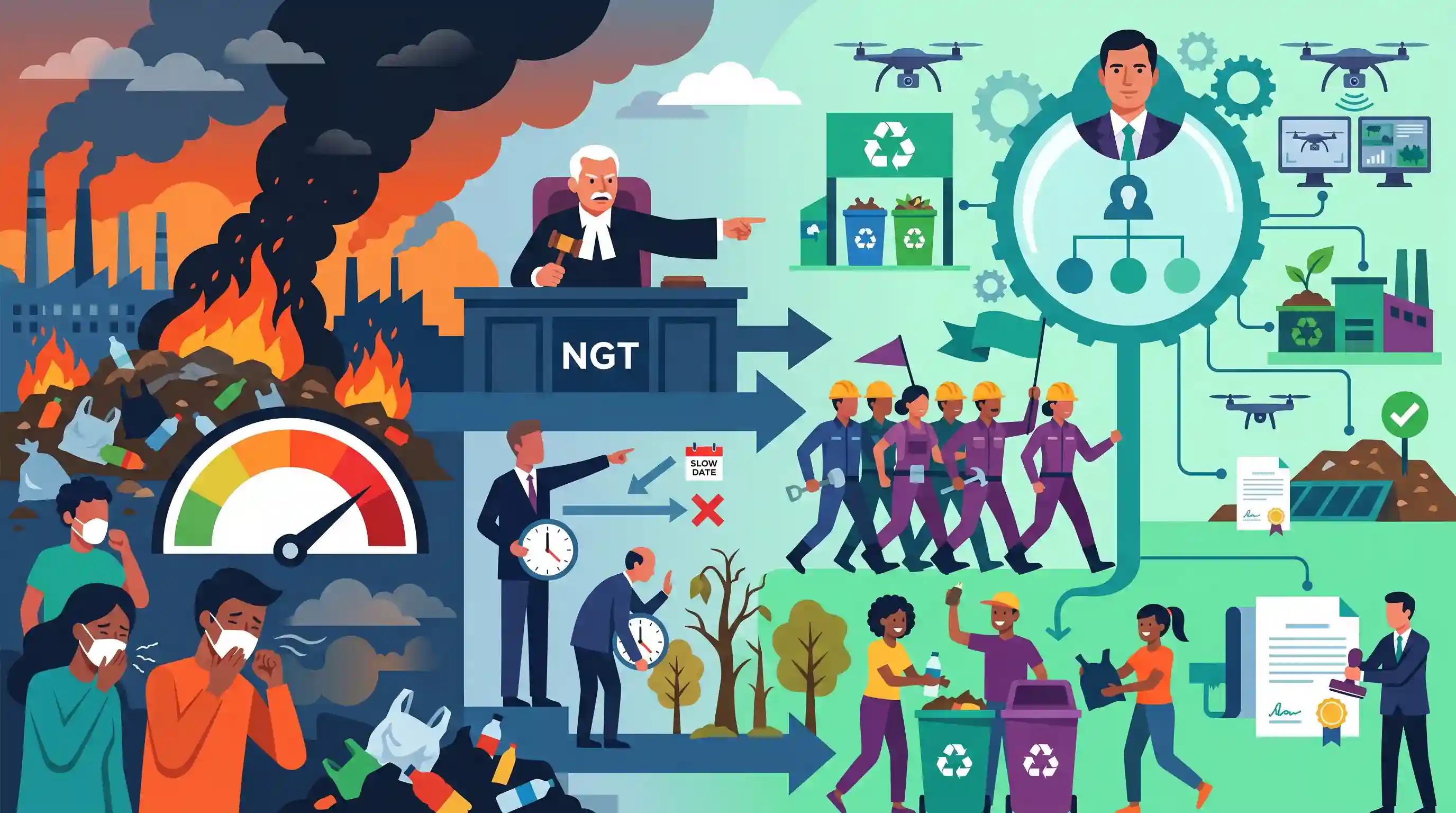
Open burning of municipal solid waste leading to high AQI indicates a significant governance failure and non-compliance with the Solid Waste Management Rules, 2016. The NGT's intervention highlights the necessity for continuous monitoring, community involvement, and centralized mission-mode management for sustainable environmental compliance, serving as a critical case study for environment and governance topics in UPSC Mains.
Summary
The National Green Tribunal (NGT) heavily criticized authorities in Bhopal for systemic failures in waste management following an incident of open burning of municipal solid waste that spiked the Air Quality Index (AQI) to a hazardous 315. Denouncing the tendency to seek long compliance dates, the NGT emphasized that administrative delays indicate a lack of concern for environmental governance. The tribunal stressed the need to shift from isolated responses to a "mission mode" approach, proposing a centralized state-level single-window mechanism headed by an Additional Chief Secretary to oversee waste management. It also underscored the importance of continuous monitoring, community involvement to alleviate administrative burdens, and strict adherence to the Solid Waste Management Rules, 2016, and the Environment (Protection) Act, 1986.
Key Points
- The NGT condemned the open burning of solid waste in Bhopal which drove the AQI to 315, attributing it to a systemic failure in waste governance.
- The tribunal criticized authorities for requesting long compliance dates, emphasizing that administrative delays indicate a lack of concern for environmental protection.
- NGT recommended adopting a "mission mode" approach, including the creation of a state-level centralized single-window mechanism headed by an Additional Chief Secretary for waste management.
- The bench called for greater community involvement to lessen financial and administrative burdens on municipal authorities.
- Emphasized continuous monitoring and strict adherence to the Solid Waste Management Rules, 2016, and the Air Act, 1981, highlighting the inadequacy of isolated, reactionary measures.
Important Terms
National Green Tribunal (NGT)

A statutory judicial body established under the NGT Act 2010 for the specialized and expeditious disposal of cases relating to environmental protection and conservation of forests.
UPSC context
GS-III: Environmental Governance; tests knowledge of statutory bodies and their role in upholding the 'Polluter Pays' and 'Precautionary' principles.
Solid Waste Management Rules, 2016
Legislation enacted by the MoEF&CC that mandates waste segregation at source into biodegradable, dry, and domestic hazardous streams, applying to both urban and non-urban areas.
UPSC context
GS-III: Waste Management; essential for questions on urban governance, sanitation, and the Extended Producer Responsibility (EPR) framework.
Environment (Protection) Act, 1986
India’s landmark 'umbrella' legislation passed post-Bhopal Gas Tragedy, empowering the Central Government to coordinate actions, set emission standards, and regulate hazardous substances nationwide.
UPSC context
GS-III: Environmental Legislation; a core act for understanding the constitutional and legal hierarchy of environmental protection in India.
Air (Prevention and Control of Pollution) Act, 1981
A legal framework enacted to prevent and control air pollution, which established the CPCB/SPCBs and was later amended in 1987 to include noise as a pollutant.
UPSC context
GS-III: Pollution; relevant for understanding the regulatory mechanisms and institutional powers used to manage hazardous air quality levels.
Air Quality Index (AQI)
A composite index that transforms complex air quality data of various pollutants into a single number to communicate health risks to the public effectively.
UPSC context
GS-III: Environmental Pollution; frequently tested in Prelims and Mains regarding health standards and the National Clean Air Programme (NCAP).
Prelims Trap
"NGT has appellate jurisdiction over all environmental laws including the Wildlife (Protection) Act, 1972."
The NGT deals with civil cases under 7 specific laws (like EPA 1986, Air Act 1981). It explicitly lacks jurisdiction over the Wildlife (Protection) Act, 1972, and the Indian Forest Act, 1927.
Static Concepts Connected
What are the key mandates of the Solid Waste Management Rules, 2016?
- Source Segregation: Mandates waste generators to segregate waste into three streams: Biodegradables, Dry (Plastic, Paper, Metal, Wood), and Domestic Hazardous waste.
- Extended Producer Responsibility: Manufacturers of non-biodegradable packaging must collect back the waste generated by their products, shifting the financial burden.
- Bulk Generators: Hotels, RWAs, and large institutions must ensure on-site composting or biomethanation of their biodegradable waste.
What are the foundational powers and characteristics of the NGT?
- Statutory Body: Established under the NGT Act 2010 to expedite cases relating to environmental protection and conservation of forests.
- Natural Justice: Not bound by the Code of Civil Procedure, 1908; it is guided by the principles of natural justice.
- Suo Motu Powers: The Supreme Court has affirmed that the NGT holds suo motu powers to initiate proceedings based on letters, representations, or media reports.
Cross-Topic Patterns
NGT directives vs Local Body Autonomy
NGT's push for a state-level centralized single-window mechanism shifts power upward, highlighting the tension between environmental emergency measures and the decentralized autonomy of Urban Local Bodies (74th Amendment).
Open burning & Short-Lived Climate Pollutants
Open burning of municipal solid waste releases dioxins and black carbon, linking local AQI governance directly to global mitigation of Short-Lived Climate Pollutants (SLCPs).

Expect a GS3 Mains question evaluating the role of NGT vs local municipalities (ULBs) in enforcing Solid Waste Management Rules 2016.
Linked PYQs · 5
Linked PYQs · 5
- 2018MainsGS3
What are the impediments in disposing the huge quantities of discarded solid wastes which are continuously being generated? How do we remove safely the toxic wastes that have been accumulating in our habitable environment?
- 2021MainsGS3
Describe the key points of the revised Global Air Quality Guidelines (AQGs) recently released by the World Health Organisation (WHO). How are these different from its last update in 2005? What changes in India's National Clean Air Programme are required to achieve these revised standards?
- 2022MainsGS2
“The most significant achievement of modern law in India is the constitutionalization of environmental problems by the Supreme Court.” Discuss this statement with the help of relevant case laws.
- 2019PrelimsGS1
As per the Solid Waste Management Rules, 2016 in India, which one of the following statements is correct?
- 2019PrelimsGS1
Consider the following statements : The Environment Protection Act, 1986 empowers the Government of India to 1. state the requirement of public participation in the process of environmental protection, and the procedure and manner in which it is sought 2. lay down the standards for emission or discharge of environmental pollutants from various sources Which of the statements given above is/are correct?
