NGT Seeks Response on Ecological Degradation of Kabartal Wetland
Source:etvbharat ↗
Why It Matters
Kanwar Lake (Kabartal) is Bihar's only Ramsar site and Asia's largest oxbow lake, making its environmental protection, geographic formation (Burhi Gandak), and administrative challenges a high-frequency topic for BPSC Prelims and Mains exams.
Summary
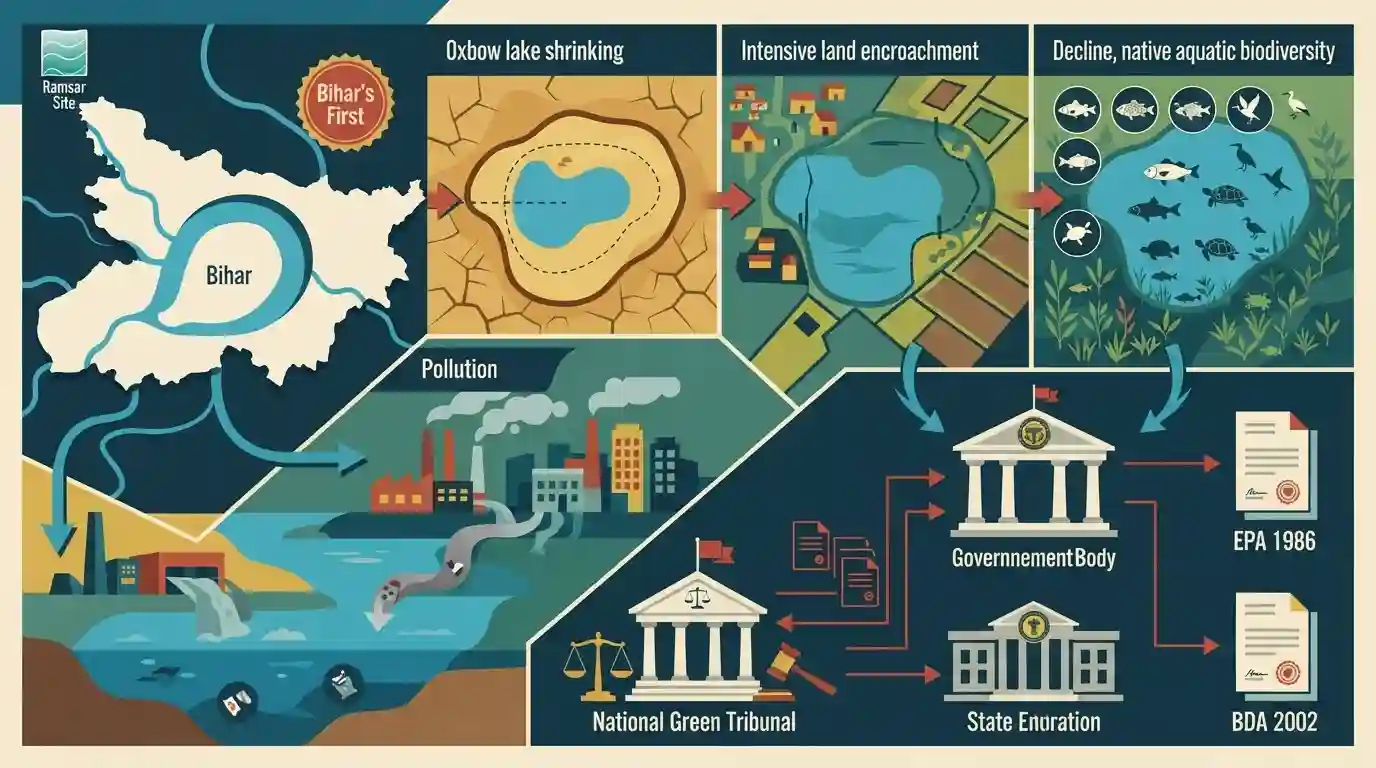
The National Green Tribunal (NGT) has taken suo motu cognisance of the severe ecological degradation of Kabartal Wetland (Kanwar Lake) in Bihar's Begusarai district. As Asia's largest freshwater oxbow lake and Bihar's first designated Ramsar site, the wetland is facing rapid shrinkage, intensive land encroachment, decline in native aquatic biodiversity, and pollution. The NGT has issued notices to key central and state environmental bodies for failing to protect the wetland under the Environment (Protection) Act 1986 and Biological Diversity Act 2002.
Key Points
- The National Green Tribunal (NGT) took suo motu cognisance of the deteriorating ecological condition of Kabartal Wetland (Kanwar Lake) in Bihar's Begusarai district.
- Kabartal Wetland is recognized as Asia's largest freshwater oxbow lake and was designated as Bihar's first Ramsar site in August 2020.
- The lake was formed due to the meandering of the Burhi Gandak River, a major tributary of the Ganges in North Bihar.
- The tribunal noted serious environmental threats, including shrinking water-spread area, heavy encroachment, sewage discharge, chemical pollution, and a severe decline in native fish species like Rohu, Puthi, Garah, and Singhi.
- The NGT issued notices to the Union Ministry of Environment, Forest and Climate Change (MoEFCC), CPCB, National Biodiversity Authority (NBA), and local Bihar state authorities, seeking action reports on compliance with environmental protection and biodiversity laws.
Important Terms
National Green Tribunal (NGT)

A specialized statutory body established in 2010 to expedite cases involving environmental protection, forest conservation, and legal rights, operating under principles of natural justice.
UPSC context
GS Paper 2 & 3. Tests knowledge of environmental governance, dispute resolution, and statutory bodies.
Ramsar Convention
A 1971 international treaty adopted in Iran for the conservation and wise use of wetlands, aiming to protect their ecological character, biodiversity, and hydrological functions.
UPSC context
GS Paper 3. Essential for environment and ecology questions regarding wetland conservation and internationally recognized protected sites.
Environment (Protection) Act, 1986
India's umbrella environmental law enacted post-Bhopal Gas Tragedy, empowering the Central Government to protect ecosystems, regulate hazardous substances, and enforce strict pollution standards.
UPSC context
GS Paper 2 & 3. Crucial for understanding government powers, EIA regulations, and statutory environmental protections.
Biological Diversity Act, 2002
Legislation fulfilling India's obligations under the Convention on Biological Diversity, focusing on conserving biological resources, promoting sustainable use, and ensuring equitable benefit-sharing with local communities.
UPSC context
GS Paper 3. Key for biodiversity topics, the National Biodiversity Authority, and preventing bio-piracy.
Central Pollution Control Board (CPCB)
An apex statutory organization established under the Water Act, 1974, responsible for monitoring and controlling water and air pollution, and advising the government on environmental quality.
UPSC context
GS Paper 3 (Environment). Tests regulatory frameworks for air/water pollution and the functioning of national environmental authorities.
Prelims Trap
Kanwar Lake was formed by the meandering of the Gandak River, which originates in Nepal.
Kanwar Lake was formed by the Burhi Gandak, not the Gandak. Furthermore, the Burhi Gandak originates entirely in India (Bihar), making it geographically distinct from the Nepal-originating Gandak.
Static Concepts Connected
How are oxbow lakes formed geomorphologically?
- Meander loops: Rivers in their middle/lower courses form highly sinuous meander loops due to lateral erosion on outer banks and deposition on inner banks.
- Neck cutoff: During heavy floods, the river cuts through the narrow neck of the meander to take a straighter, more direct course.
- Residual lake: The abandoned, crescent-shaped loop becomes isolated by alluvial deposition at its ends, forming an oxbow lake (e.g., Kabartal).
Does the National Green Tribunal (NGT) possess suo motu powers?
- Supreme Court ruling: Yes. In the 2021 MCGM v. Ankita Sinha case, the Supreme Court ruled the NGT has inherent suo motu (self-igniting) jurisdiction.
- Article 21 link: The SC held this power is essential for the NGT to effectively discharge its mandate to protect the Right to Life under Article 21.
- Statutory interpretation: The power is interpreted purposively from the NGT Act, 2010, despite the absence of an explicit "suo motu" clause in the legislation.
Cross-Topic Patterns
Fluvial Geomorphology + Ramsar Sites
UPSC frequently links wetland ecology with physical geography. Kabartal's identity as an oxbow lake connects its ecological fate directly to the fluvial dynamics of the Burhi Gandak river system.
NGT Judicial Activism + Article 21
NGT's suo motu interventions are increasingly grounded in constitutional rights, highlighting the evolution of statutory environmental tribunals enforcing the Right to Life under Article 21.

Expect a 'River vs. Ramsar Site' match-the-following in Prelims 2026, pairing Kabartal with Burhi Gandak and Wular with Jhelum.
Linked PYQs · 2
Linked PYQs · 2
- 2022BPSC_PRELIMSGS1
Which is the first Ramsar Site in Bihar?
- 2023BPSC_PRELIMSGS1
The other name of river Gandak is
