NGT Reprimands West Bengal Over Waste Management Delays
Source:etv-bharat ↗
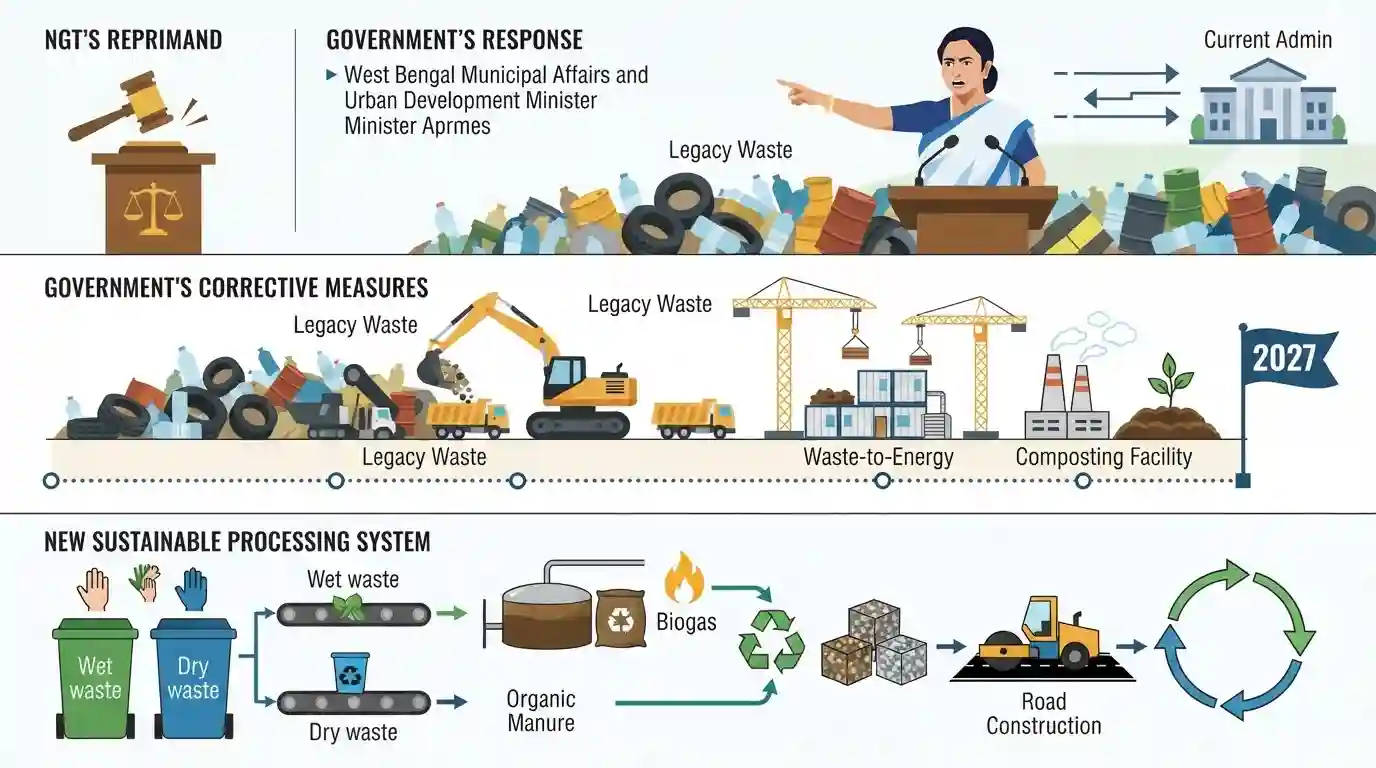
Why It Matters
This highlights the regulatory oversight of the National Green Tribunal (NGT) regarding environmental compliance by state governments. It provides insights into West Bengal's current waste management policies, specifically the target of clearing legacy waste by 2027 and adopting a circular economy approach by producing biogas and reusing plastics. Such state-specific environmental and governance issues are highly relevant for WBCS Prelims.
Summary
The National Green Tribunal (NGT) recently reprimanded the West Bengal government over persistent delays in solid and liquid waste management. In response, West Bengal Municipal Affairs and Urban Development Minister Agnimitra Paul cited legacy issues inherited from previous governments but emphasized that the current administration is taking prompt corrective measures. The government has launched tendering processes to expedite waste-management infrastructure and set a goal to eliminate all legacy waste by 2027. Going forward, waste will be strictly segregated at the source into wet and dry categories, which will be subsequently recycled or converted into organic manure, biogas, and materials for road construction, reflecting a shift towards sustainable waste processing.
Key Points
- The National Green Tribunal (NGT) has strongly criticized the West Bengal government for its sluggish progress in managing solid and liquid waste.
- West Bengal Municipal Affairs and Urban Development Minister Agnimitra Paul attributed the delays to the alleged negligence of previous administrations over the last 13 years.
- The state government has initiated tendering processes to fast-track waste-management projects and has set a target to clear all "legacy waste" by 2027.
- A new protocol involving source segregation of waste into dry and wet categories is being enforced, which will be processed into organic manure, biogas, and plastic material for road construction.
Important Terms
National Green Tribunal (NGT)

A specialized statutory body established under the NGT Act (2010) for the effective and expeditious disposal of cases relating to environmental protection, forest conservation, and enforcement of ecological rights.
UPSC context
Essential for WBCS Paper IV (Environment) and Paper V (Polity), testing knowledge of environmental governance and dispute resolution bodies.
West Bengal Municipal Affairs and Urban Development Department
The state government department responsible for overseeing urban local bodies, town planning, and civic infrastructure, including strict implementation of municipal solid and liquid waste management across West Bengal.
UPSC context
Important for WBCS Paper V (State Administration), testing understanding of local governance and urban civic responsibilities in Bengal.
Legacy Waste
Massive volumes of old, untreated garbage that have accumulated in landfills over years. It requires scientific clearing methods like biomining and bioremediation to prevent severe land and air pollution.
UPSC context
Highly relevant for WBCS Paper IV (Environment/Ecology), frequently tested under waste management, urbanization issues, and pollution control policies.
Solid and Liquid Waste Management (SLWM)
The systematic segregation, collection, treatment, and recycling of dry/wet solid refuse and wastewater. It aims to convert waste into resources like biogas or manure, minimizing environmental impact.
UPSC context
Central to WBCS Paper IV (Environmental Science) and Paper VI (Government Schemes), testing knowledge of sustainable urban planning.
Prelims Trap
"The NGT derives its powers and was established under the Environment (Protection) Act, 1986."
The NGT is a statutory body established specifically under the National Green Tribunal Act, 2010, not the EPA 1986.
Static Concepts Connected
What is the statutory framework and jurisdiction of the NGT?
- Statutory Origin: Established under the NGT Act, 2010 for the expeditious disposal of cases relating to environmental protection and conservation of forests.
- Applicable Laws: Hears civil cases under 7 specific laws, including the Water Act, Air Act, and Environment (Protection) Act.
- Notable Exclusions: Crucially lacks jurisdiction over the Wildlife (Protection) Act, 1972 and the Indian Forest Act, 1927.
What are the core mandates of the Solid Waste Management Rules, 2016?
- Source Segregation: Mandates generators to separate waste at the source into three distinct streams: wet (biodegradable), dry (plastic/paper), and domestic hazardous.
- Producer Responsibility: Manufacturers of non-biodegradable packaging are made responsible for collecting back the packaging waste generated.
- User Fees & Fines: Empowers local bodies to levy user fees for waste collection and impose spot fines for littering.
Cross-Topic Patterns
Circular economy & SATAT initiative
Processing wet waste into biogas bridges urban waste governance with national alternative fuel initiatives like SATAT (compressed biogas) and the broader transition towards a circular economy.
Plastic waste in infrastructure
Using sorted plastic for road construction aligns with Indian Road Congress guidelines, a theme frequently tested in Mains under sustainable infrastructure and waste-to-wealth technologies.

Expect multi-statement questions in Paper IV comparing NGT's statutory powers with CPCB, alongside the Solid Waste Management Rules 2016.
Linked PYQs · 2
Linked PYQs · 2
- 2013WBCS_PRELIMSGS1
The National Green Tribunal was established in India in
- 2023WBCS_PRELIMSGS1
Financial instruments that generate proceeds for investment in environmentally sustainable projects are called
