National Green Tribunal Orders Probe into Bhopal E Waste Disposal
Source:the-print ↗
Why It Matters
This article is highly relevant for MPPSC Prelims as it deals with environmental administration in Madhya Pradesh (MPPCB & NGT Central Zone Bench in Bhopal), state-specific e-waste generation statistics, and the public health impacts of heavy metals, which are frequent areas of questioning in state exams.
Summary
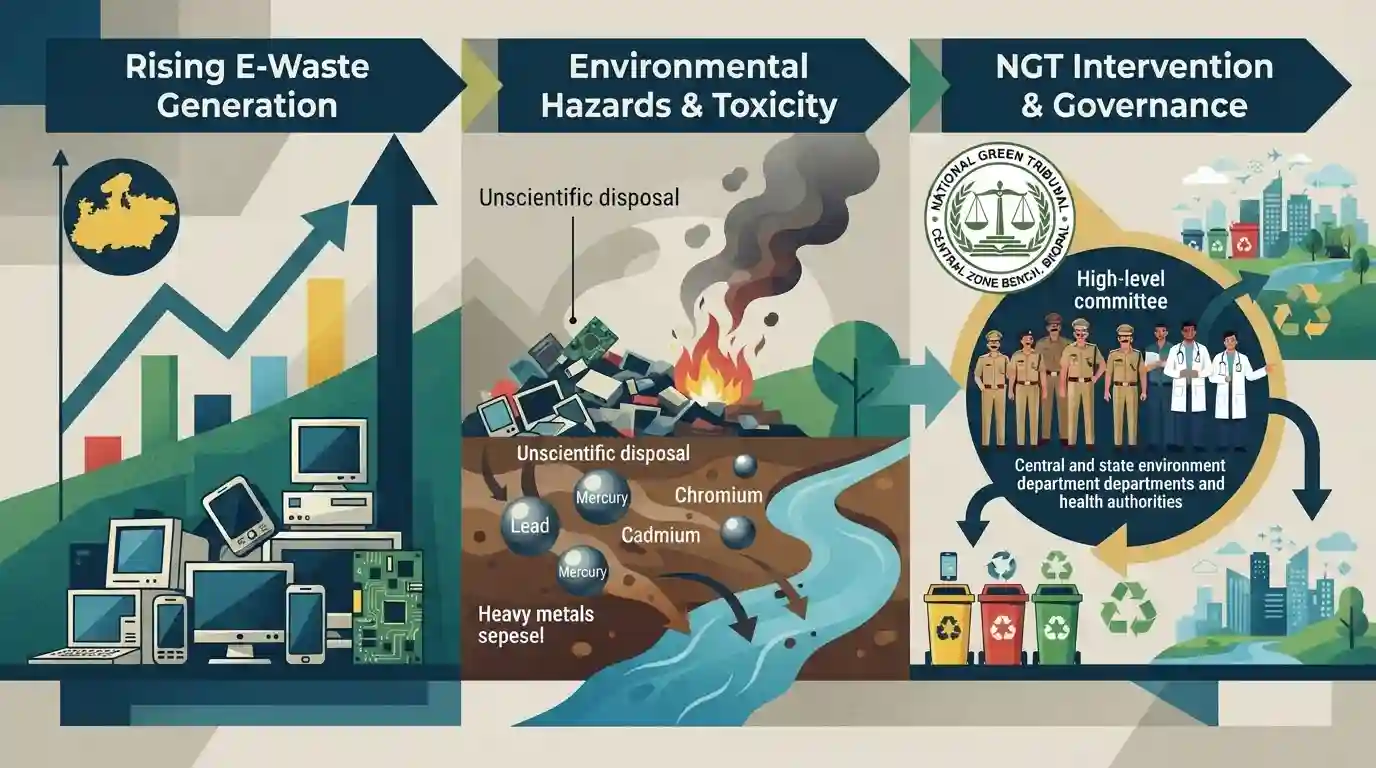
The National Green Tribunal's (NGT) Central Zone Bench in Bhopal has formed a high-level committee consisting of central and state environment and health departments to investigate unauthorized e-waste handling and open burning in Bhopal. The plea highlighted a ten-fold increase in e-waste generation in Madhya Pradesh since 2019, touching 5,000 tonnes annually, warning of severe heavy metal pollution (lead, mercury, cadmium, chromium) resulting from unscientific disposal methods.
Key Points
- The Central Zone Bench of the National Green Tribunal (NGT) in Bhopal ordered the constitution of a joint committee to probe the unscientific disposal and open burning of electronic waste (e-waste) in Bhopal.
- The order was passed following a plea filed by environmental activist Nitin Saxena, who alleged that a large portion of e-waste in Bhopal is processed at unauthorized scrap units, leading to open burning that releases hazardous pollutants.
- The committee comprises representatives from MoEFCC Regional Office (Bhopal), CPCB, Madhya Pradesh Health Department, Electrical and Electronics Department, and the MPPCB, with MPPCB designated as the nodal agency.
- According to the petition, Madhya Pradesh generates around 5,000 tonnes of e-waste annually, representing a ten-fold rise since 2019.
- Open burning of e-waste releases toxic substances and heavy metals, such as lead, mercury, cadmium, and chromium, which severely pollute air, soil, and water resources and pose critical health hazards (e.g., Itai-Itai disease from cadmium, Minamata from mercury).
Important Terms
National Green Tribunal (NGT)

A specialized statutory body established under the NGT Act, 2010, for the expeditious and effective disposal of judicial cases related to environmental protection and conservation of forests.
UPSC context
GS Paper II (Statutory Bodies) and Paper III (Environment). Tests judicial mechanisms for environmental protection in MP.
Madhya Pradesh Pollution Control Board (MPPCB)
A state-level statutory body established under the Water Act, 1974, responsible for monitoring environmental quality, regulating industrial emissions, and enforcing pollution laws in Madhya Pradesh.
UPSC context
GS Paper III (Environment) and MP Geography. Tests state environmental governance, pollution regulation, and local compliance.
E-Waste (Management) Rules
Rules notified under the Environment (Protection) Act, 1986, implementing a digital, certificate-based Extended Producer Responsibility (EPR) framework to ensure the environmentally sound recycling of discarded electronics.
UPSC context
GS Paper III (Environment/S&T). Tests waste management policies, sustainable development, and pollution control.
Environment (Protection) Act, 1986
An umbrella parliamentary act empowering the Central Government to protect and improve environmental quality, coordinate regulatory authorities, and control environmental pollution across India.
UPSC context
GS Paper II (Legislations) and GS Paper III (Environment). Tests key constitutional and legal frameworks for ecological preservation.
Central Pollution Control Board (CPCB)
India's apex statutory organization established under the Water Act, 1974, responsible for advising the central government, coordinating state boards, and setting national environmental standards.
UPSC context
GS Paper II (Statutory Bodies) and GS Paper III (Environment). Tests national pollution control frameworks and center-state environmental coordination.
Prelims Trap
The MPPCB was established under the Environment (Protection) Act, 1986, to handle waste and pollution mandates.
MPPCB is a statutory body established earlier under the Water (Prevention and Control of Pollution) Act, 1974, not the EPA, 1986.
Static Concepts Connected
What is the statutory origin and mandate of the MP Pollution Control Board (MPPCB)?
- Statutory Origin: Established on September 23, 1974, under Section 4 of the Water (Prevention and Control of Pollution) Act, 1974.
- Name Change: Renamed as MPPCB in 1980 after incorporating mandates under the Air Act and subsequent environmental rules.
- Functional Mandate: Enforces environmental laws, monitors air/water quality, and issues consents to establish/operate industries in MP.
What are the key jurisdictional and structural aspects of the NGT in Madhya Pradesh?
- Central Zone Bench: Bhopal hosts the Central Zone Bench, holding territorial jurisdiction over environmental disputes in MP, Chhattisgarh, and Rajasthan.
- Legal Framework: Established under the NGT Act 2010; it is not bound by the Civil Procedure Code but guided by principles of natural justice.
- Time-bound Redressal: Mandated to make endeavors to dispose of applications or appeals finally within 6 months of filing.
Cross-Topic Patterns
E-waste + Industrial Health Hazards
Connects unregulated scrap industries to occupational health hazards, highlighting heavy metal toxicity like Minamata and Itai-Itai diseases in unorganized sectors.
EPR + Circular Economy
Integrates e-waste management rules with green economics, forcing manufacturers to build recycling channels via digital Extended Producer Responsibility certificates.

Expect a question matching heavy metals (cadmium, mercury) to their specific diseases alongside the statutory origin of MPPCB.
Linked PYQs · 5
Linked PYQs · 5
- 2023MPPSC_PRELIMSGS1
National Green Tribunal's (NGT) headquarters is situated at:
- 2018MPPSC_PRELIMSGS1
What is the full form of NGT?
- 2022MPPSC_PRELIMSGS1
Which pollution causes Itai-Itai disease in human beings?
- 2024MPPSC_PRELIMSGS1
When did the Government of India pass the Water (Prevention and Control of Pollution) Act?
- 2025MPPSC_PRELIMSGS1
The Government of India passed the Environment (Protection) Act to protect and improve the quality of environment in:
