Environmental Violations in Ganga Bridge Construction Project
Source:Indian Express ↗
Why It Matters
The case exemplifies the persistent conflict between rapid state-driven infrastructure development (NHAI) and environmental compliance (NMCG/NGT). It is highly relevant for GS-3 answers discussing the efficacy of EIA, the limitations of post-facto environmental clearances, and the challenges in implementing the Namami Gange objectives amidst large-scale public projects.
Summary
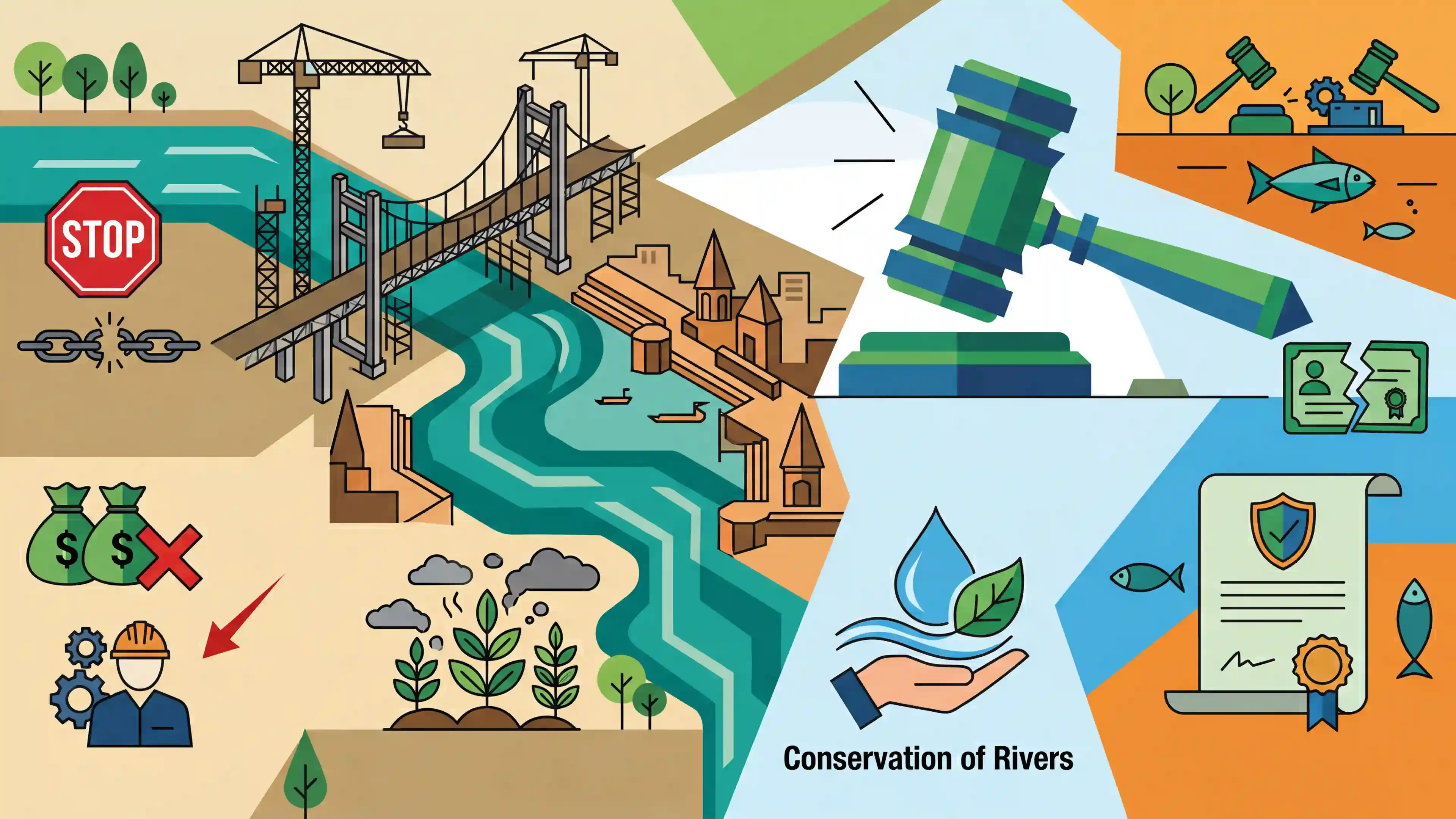
The National Green Tribunal (NGT) reprimanded the National Highways Authority of India (NHAI) for starting the construction of a major bridge over the Ganga in Prayagraj without the requisite advance clearance from the National Mission for Clean Ganga (NMCG). Citing violations of the River Ganga Authorities Order of 2016, the NGT emphasized that prior approval is mandatory for projects affecting river floodplains. Additionally, the Tribunal fined the project contractor Rs 10 lakh for operating plants without valid pollution control board consents, ruling that obtaining post-facto clearance does not retroactively cure initial environmental violations.
Key Points
- The NGT condemned NHAI for starting construction of a Rs 739 crore bridge across the Ganga in Prayagraj without prior approval from the National Mission for Clean Ganga (NMCG).
- Under the River Ganga Authorities Order, 2016, no construction on the Ganga or its tributaries is permitted without prior NMCG clearance to protect the floodplain.
- NHAI completed nearly 9% of the project work before obtaining NMCG approval in February 2024, demonstrating procedural negligence.
- The project contractor was fined Rs 10 lakh by UPPCB, directed by NGT, for operating concrete batching plants without mandatory Consent to Establish (CTE) and Consent to Operate (CTO).
- NGT reaffirmed the legal principle that post-facto environmental clearances do not legitimize initial non-compliance or erase the violations committed at the start of a project.
Important Terms
National Green Tribunal (NGT)

A statutory body established under the NGT Act 2010 for the effective and expeditious disposal of cases relating to environmental protection, forest conservation, and legal rights regarding the environment.
UPSC context
GS Paper II (Statutory Bodies) and Paper III (Environment). Tests knowledge of environmental adjudication and the role of specialized tribunals.
National Mission for Clean Ganga (NMCG)
The implementation arm of the National Ganga Council, functioning under the Ministry of Jal Shakti. It manages the Namami Gange programme to ensure effective pollution abatement and rejuvenation of the river.
UPSC context
GS Paper III (Conservation/Pollution). Relevant for questions on river rejuvenation, federal institutional structures, and water governance.
National Highways Authority of India (NHAI)
An autonomous statutory body under the Ministry of Road Transport and Highways, established by the NHAI Act, 1988, to develop, maintain, and manage the National Highways network.
UPSC context
GS Paper III (Infrastructure). Important for discussing the balance between rapid infrastructure development and environmental compliance.
River Ganga (Rejuvenation, Protection and Management) Authorities Order, 2016
A statutory order issued under the Environment (Protection) Act, 1986, establishing a multi-tier governance structure for Ganga and mandating prior clearance for projects affecting the river's floodplains.
UPSC context
GS Paper III (Environment/Legislation). Tests awareness of specific legal frameworks protecting national rivers and the requirement for prior environmental permissions.
State Pollution Control Board (SPCB)
Statutory bodies at the state level responsible for enforcing the Water (Prevention and Control of Pollution) Act and the Air Act through monitoring and granting industrial consents.
UPSC context
GS Paper II and III. Relevant for regulatory oversight, federal environmental enforcement, and the 'Polluter Pays Principle.'
Prelims Trap
"NMCG was established under the Water (Prevention and Control of Pollution) Act, 1974."
NMCG was constituted as a regulatory authority under the Environment (Protection) Act, 1986 (via the 2016 Ganga Order), not the Water Act.
Static Concepts Connected
What is the legal framework governing the National Mission for Clean Ganga (NMCG)?
- Statutory Backing: It was registered as a society but constituted as an Authority under the Environment (Protection) Act, 1986.
- Implementation Role: It acts as the implementation arm of the National Ganga Council (headed by the Prime Minister).
- Regulatory Powers: It possesses powers to issue binding directions and prohibit any construction in the Ganga river basin and its floodplains.
What are CTE and CTO in environmental governance?
- Statutory Basis: These are mandatory statutory clearances required under the Water Act, 1974, and Air Act, 1981.
- Consent to Establish (CTE): Prior permission required from the State Pollution Control Board before setting up an industrial plant or polluting infrastructure.
- Consent to Operate (CTO): Second-stage clearance required before the facility actually commences operations, ensuring compliance with established norms.
Cross-Topic Patterns
Infrastructure Push vs EPA 1986
While highway expansions often seek standard EIA exemptions, construction altering major river floodplains triggers specialized scrutiny under the EPA's Ganga Order. State agencies like NHAI are not immune.
The Post-Facto Clearance Debate
NGT's rejection of retrospective clearances echoes multiple Supreme Court rulings holding that post-facto approvals violate the Precautionary Principle of environmental jurisprudence.

Expect a 2026 prelims question pairing NMCG's statutory powers under the EPA 1986 with NGT's enforcement of the precautionary principle.
Linked PYQs · 5
Linked PYQs · 5
- 2015MainsGS3
Discuss the Namami Gange and National Mission for Clean Ganga (NMCG) programmes and causes of mixed results from the previous schemes. What quantum leaps can help preserve the river Ganga better than incremental inputs?
- 2024MainsGS3
Industrial pollution of river water is a significant environmental issue in India. Discuss the various mitigation measures to deal with this problem and also the government's initiatives in this regard.
- 2013MainsGS3
Enumerate the National Water Policy of India. Taking river Ganges as an example, discuss the strategies which may be adopted for river water pollution control and management. What are the legal provisions of management and handling of hazardous wastes in India?
- 2020MainsGS3
How does the draft Environment Impact Assessment (EIA) Notification, 2020 differ from the existing EIA Notification, 2006?
- 2024MainsGS3
What role do environmental NGOs and activists play in influencing Environmental Impact Assessment (EIA) outcomes for major projects in India? Cite four examples with all important details.
