NGT Notice on Environmental Clearance for Singrauli Coal
Source:The Hindu ↗
Why It Matters
Provides a clear case study for GS3 (Environment) regarding the conflict between coal mining operations and ecological conservation (elephant corridors, massive deforestation). It highlights the practical application of Environmental Impact Assessments (EIA), the role of the NGT in scrutinizing clearances, and the regulatory framework surrounding Eco-Sensitive Zones (ESZs).
Summary
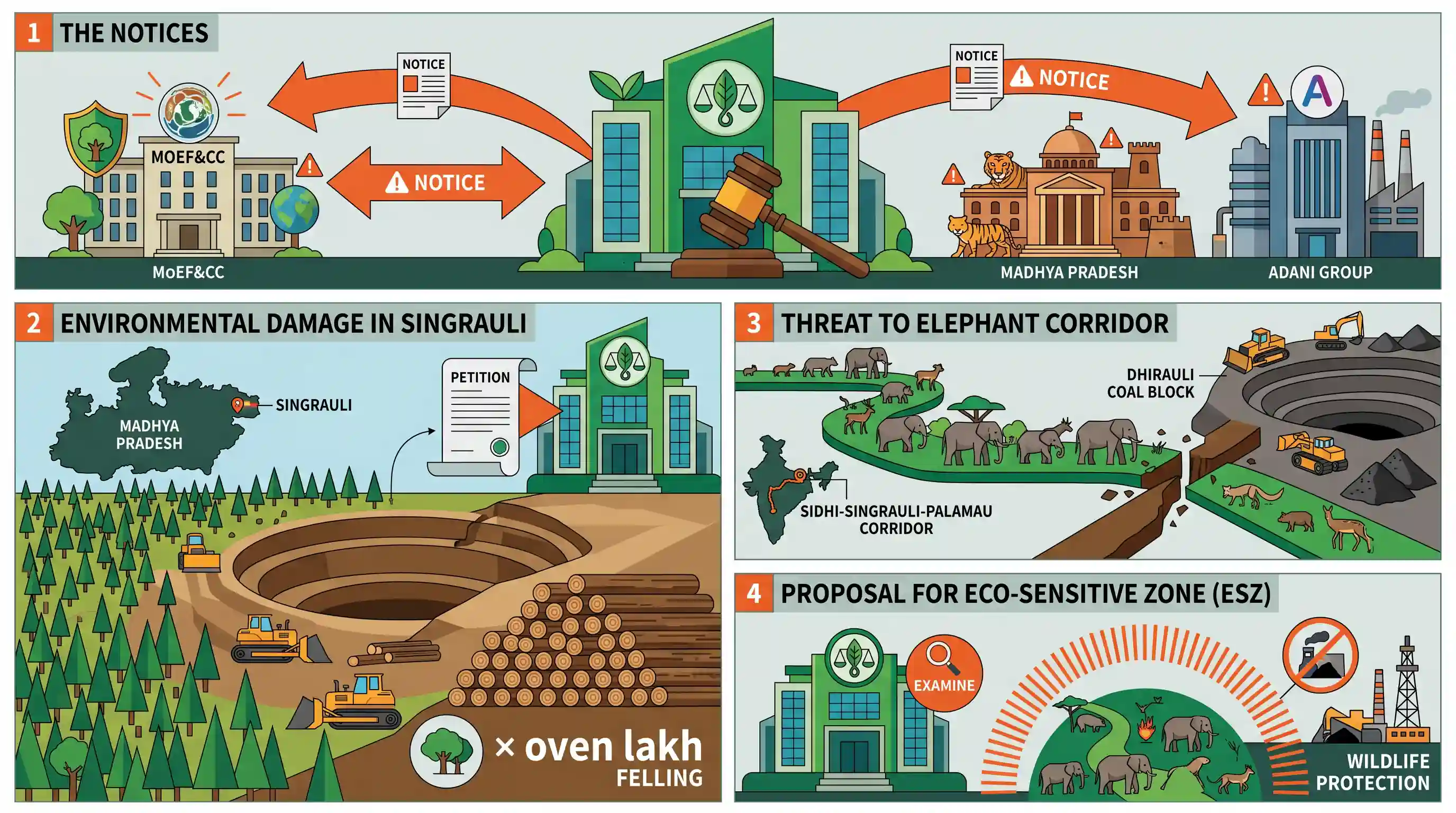
The National Green Tribunal (NGT) has issued notices to the Ministry of Environment, Forest and Climate Change (MoEF&CC), the Madhya Pradesh government, and the Adani Group concerning the environmental and forest clearances granted for the Dhirauli coal block in Singrauli. The notices were prompted by a petition citing massive ecological damage, including the felling of over five lakh trees. Additionally, the coal block intersects with the proposed Sidhi-Singrauli-Palamau elephant corridor. Highlighting the need for wildlife protection, the NGT has called for an examination into declaring elephant corridors as Eco-Sensitive Zones (ESZ) to mitigate developmental impacts on sensitive habitats.
Key Points
- The NGT has issued notices to the Union and Madhya Pradesh governments regarding the forest and environmental clearances granted for the Adani Group's Dhirauli coal block in Singrauli.
- Petitions allege that the coal project will entail felling of over five lakh trees and negatively impact the region's ecology.
- The proposed Sidhi-Singrauli-Palamau elephant corridor passes through the project area, raising concerns about wildlife displacement.
- The NGT has suggested exploring the possibility of declaring elephant corridors as Eco-Sensitive Zones (ESZ) to offer them statutory protection.
Important Terms
National Green Tribunal (NGT)

A specialized statutory body established under the NGT Act (2010) for the effective and expeditious disposal of cases relating to environmental protection and forest conservation.
UPSC context
GS-II (Statutory Bodies) and GS-III (Environment); tests knowledge of environmental jurisprudence and the tribunal's role in enforcing ecological rights.
Eco-Sensitive Zones (ESZ)
Fragile areas notified by the MoEF&CC around protected areas to act as 'shock absorbers,' regulating human activities to minimize the impact on the core ecosystem.
UPSC context
GS-III (Environment/Conservation); relevant for understanding buffer management, man-animal conflict, and balancing development with ecological safety.
Elephant Corridor
Narrow linear strips of habitat that facilitate the movement of elephants between larger forest patches, essential for genetic diversity and reducing human-wildlife conflict.
UPSC context
GS-III (Biodiversity/Conservation); tests understanding of habitat fragmentation, Project Elephant, and wildlife connectivity strategies.
Environment Protection Act, 1986
An umbrella legislation enacted under Article 253, empowering the Central Government to protect environmental quality and coordinate regulatory authorities across India.
UPSC context
GS-III (Environment); fundamental for understanding the legal basis for Environmental Impact Assessments (EIA) and pollution standards.
Wildlife Protection Act, 1972
A comprehensive legal framework for the protection of wild animals, birds, and plants, establishing protected areas and regulating trade in wildlife products.
UPSC context
GS-III (Conservation); crucial for questions on National Parks, Wildlife Sanctuaries, and the varying degrees of species protection (Schedules).
Ministry of Environment, Forest and Climate Change (MoEF&CC)
The nodal administrative agency of the Central Government for planning, promoting, and coordinating environmental, forestry, and climate change policies and clearances.
UPSC context
GS-II (Government Policies); essential for understanding the executive's role in environmental governance and regulatory frameworks.
Prelims Trap
The term 'Eco-Sensitive Zone' is explicitly defined and mentioned in the Environment (Protection) Act, 1986.
The term 'Eco-Sensitive Zone' is NOT mentioned in the EPA 1986. The MoEFCC notifies ESZs using Section 3 of the Act, which empowers the Centre to restrict industries in specific areas.
Static Concepts Connected
How are Eco-Sensitive Zones (ESZs) notified and regulated?
- Statutory Backing: Notified by MoEFCC under Section 3 of the Environment (Protection) Act, 1986, though the exact term is absent from the Act.
- Prohibited Activities: Commercial mining, polluting industries, major hydroelectric projects, and sawmills are strictly banned within these zones.
- Regulated Activities: Felling of trees, establishment of hotels, and drastic changes in agriculture systems are not banned but require regulatory permission.
How can Elephant Corridors be legally protected in India?
- Current Status: Most elephant corridors currently lack strict legal protection unless explicitly notified under specific wildlife or forest categories.
- WPA 1972 Route: They can be granted statutory protection by declaring them as 'Conservation Reserves' or 'Community Reserves' under the Wildlife (Protection) Act, 1972.
- ESZ Route: As suggested by NGT, notifying them as ESZs under the EPA 1986 would automatically ban detrimental developmental activities like commercial mining.
Cross-Topic Patterns
Energy security vs. Flagship species habitats
The tension between India's reliance on domestic coal (Singrauli) and the fragmented habitats of wide-ranging species like elephants frequently features in Mains GS3 environment vs. development debates.
NGT's role in statutory interpretation
NGT's directive to explore ESZ status for elephant corridors bridges two distinct frameworks: the EPA 1986 (restricting industrial zoning) and the WPA 1972 (protecting wildlife habitats).

Expect a multi-statement Prelims question mixing ESZ notification rules under EPA 1986 with legal protections for Elephant Corridors.
Linked PYQs · 4
Linked PYQs · 4
- 2018PrelimsGS1
How is the National Green Tribunal (NGT) different from the Central Pollution Control Board (CPCB)? 1. The NGT has been established by an Act whereas the CPCB has been created by an executive order of the Government. 2. The NGT provides environmental justice and helps reduce the burden of litigation in the higher courts whereas the CPCB promotes cleanliness of streams and wells, and aims to improve the quality of air in the country. Which of the statements given above is/are correct?
- 2014PrelimsGS1
With reference to 'Eco-Sensitive Zones', which of the following statements is/are correct? 1. Eco-Sensitive Zones are the areas that are declared under the Wildlife (Protection) Act, 1972. 2. The purpose of the declaration of Eco-Sensitive Zones is to prohibit all kinds of human activities in those zones except agriculture. Select the correct answer using the code given below.
- 2025MainsGS3
Mineral resources are fundamental to the country's economy and these are exploited by mining. Why is mining considered an environmental hazard? Explain the remedial measures required to reduce the environmental hazard due to mining.
- 2014MainsGS3
Environmental Impact Assessment studies are increasingly undertaken before a project is cleared by the Government. Discuss the environmental impacts of coal-fired thermal plants located at coal pitheads.
