NGT issues notice over Yamuna pollution in Mathura and Vrindavan
Source:downtoearth-org ↗
Why It Matters
Crucial for UPPSC aspirants studying state-specific environmental degradation, river pollution management (Yamuna), and the judicial/quasi-judicial role of bodies like the National Green Tribunal (NGT) in Uttar Pradesh.
Summary
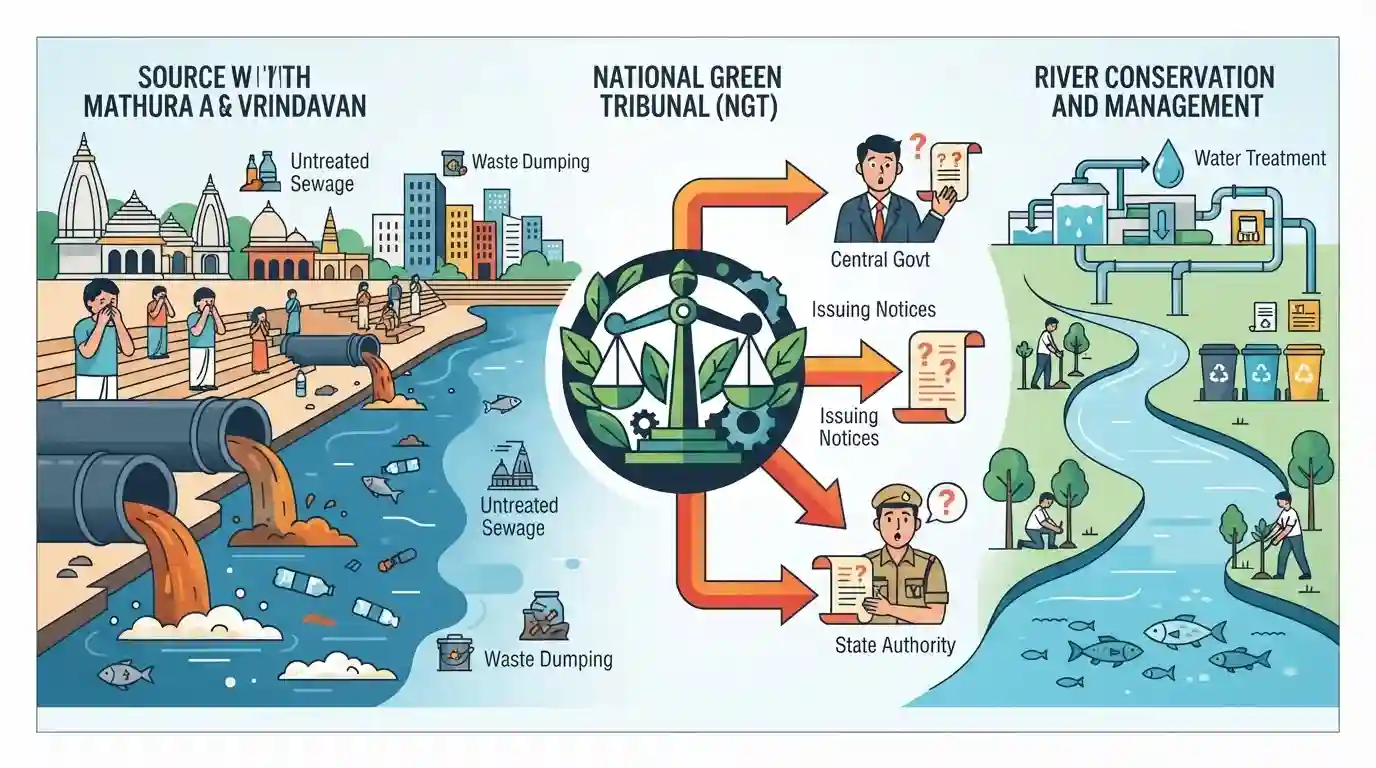
The National Green Tribunal (NGT) has stepped in over alarming levels of Yamuna River pollution in the religious and urban centres of Mathura and Vrindavan in Uttar Pradesh, issuing notices to central and state authorities to address untreated sewage and waste management failures.
Key Points
- The National Green Tribunal (NGT) has issued notices to the Centre and the Uttar Pradesh government over severe pollution of the Yamuna River in Mathura and Vrindavan.
- The case highlights the continuous discharge of untreated sewage, municipal waste, and industrial effluents into the river, violating environmental regulations.
- River Yamuna in Uttar Pradesh faces grave ecological challenges, earning designations like 'biological disaster' in specific stretches due to zero dissolved oxygen and high pollutant loads.
- The tribunal's intervention underscores accountability regarding sewage treatment plants (STPs) and solid waste management infrastructure in sacred and urban pilgrimage towns.
Important Terms
National Green Tribunal (NGT)

A specialized judicial body established under the National Green Tribunal Act, 2010, for effective and expeditious disposal of cases relating to environmental protection and conservation of forests and other natural resources.
UPSC context
UPPSC General Studies Paper III (Environment, Disaster Management). Tests statutory environmental bodies and judicial enforcement of pollution norms.
National Green Tribunal Act, 2010
Legislation enacted in 2010 by Parliament to operationalize the National Green Tribunal, providing a dedicated green court to handle civil cases concerning environmental laws and damage compensation.
UPSC context
UPPSC General Studies Paper II/III (Polity and Environment). Tests statutory frameworks for environmental governance and judicial review.
Central Pollution Control Board (CPCB)
An apex statutory organization established in 1974 under the Water (Prevention and Control of Pollution) Act to promote cleanliness of streams and wells and coordinate state board activities.
UPSC context
UPPSC General Studies Paper III (Environmental Pollution and Degradation). Important for regulatory frameworks, pollution monitoring, and statutory bodies.
Uttar Pradesh Pollution Control Board
State-level statutory body responsible for implementing environmental legislation, monitoring pollution levels, and regulating industrial and municipal discharges within Uttar Pradesh.
UPSC context
UPPSC General Studies Paper V (Uttar Pradesh Specific-Environment and Governance). Tests state administrative apparatus for pollution control.
Prelims Trap
The NGT has jurisdiction over the Wildlife Protection Act, 1972.
The NGT has jurisdiction over civil cases under several environmental acts, but the Wildlife (Protection) Act, 1972 and the Scheduled Tribes and Other Traditional Forest Dwellers (Recognition of Forest Rights) Act, 2006 are notably excluded from its direct statutory jurisdiction.
Static Concepts Connected
What are the core mandate, powers, and legal standing of the National Green Tribunal (NGT)?
- Statutory Basis: Established in 2010 under the National Green Tribunal Act for effective and expeditious disposal of environmental cases.
- Procedure: It is not bound by the Code of Civil Procedure, 1908, but guided by principles of natural justice.
- Enforceability: Orders are binding; penalty for non-compliance includes imprisonment up to 3 years or fine up to Rs. 10 crore.
Cross-Topic Patterns
Yamuna Pollution + Urban Local Governance
River pollution notices in Mathura-Vrindavan highlight gaps in Namami Gange convergence and urban local body finances under the 74th Constitutional Amendment.

NGT statutory powers, composition, and Yamuna pollution status are high-yield for UPPSC Prelims statement-based questions.
Linked PYQs · 2
Linked PYQs · 2
- 2018UPPSC_PRELIMSGS1
Which of the following rivers of Uttar Pradesh has been declared a 'Biological Disaster' due to environmental pollution?
- 2020UPPSC_PRELIMSGS1
Consider the following tributaries of River Yamuna and arrange them from West to East : 1. Betwa 2. Ken 3. Sindh 4. Chambal Select the correct answer from the codes given below.
