National Green Tribunal questions Yamuna pollution in Mathura
Source:downtoearth-org ↗
Why It Matters
Crucial for UPPSC aspirants tracking environmental governance, pollution of major rivers in UP like the Yamuna, and the judicial enforcement roles of bodies like the National Green Tribunal.
Summary
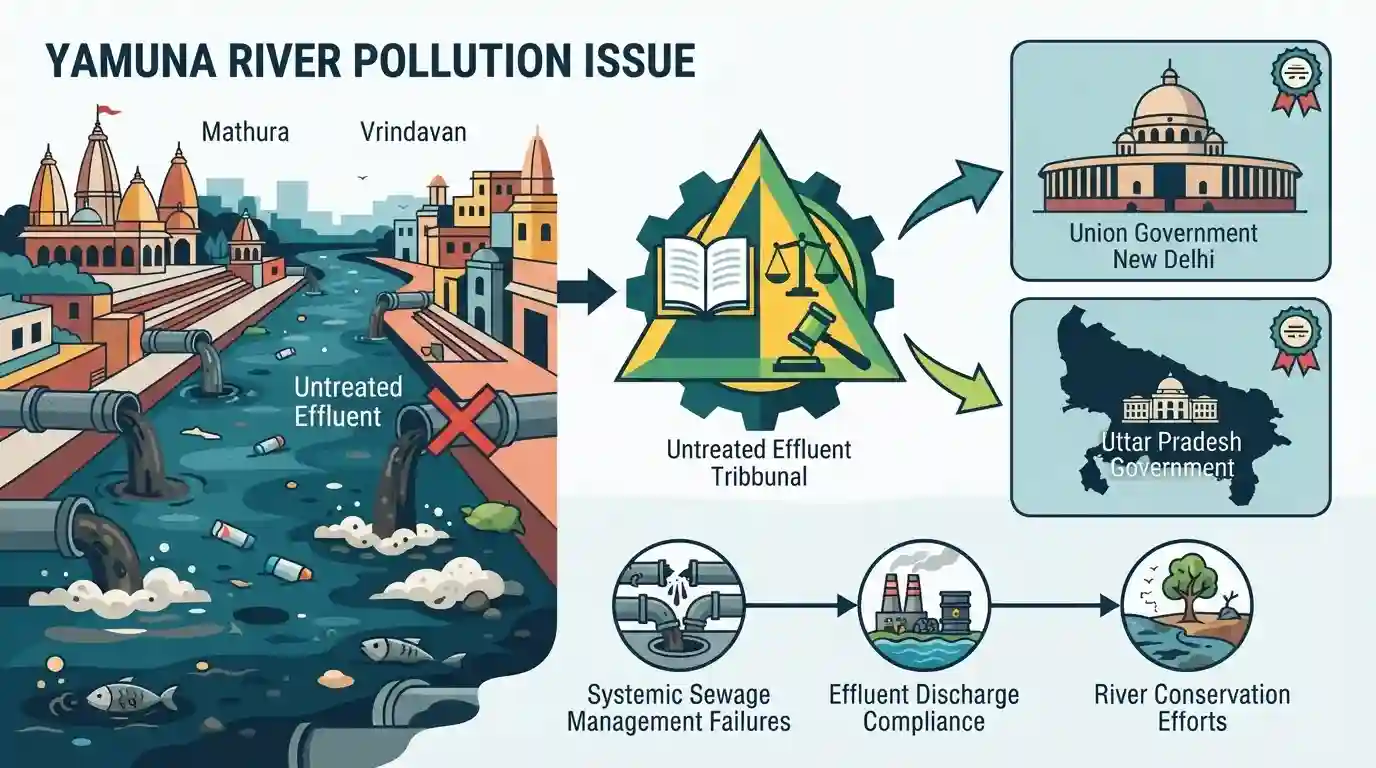
The National Green Tribunal (NGT) has taken suo motu or petition-based cognizance, issuing notices to the Union government and the Uttar Pradesh government over alarming levels of pollution in the Yamuna River across the religious towns of Mathura and Vrindavan. The case highlights systemic failures in sewage management, effluent discharge compliance, and river conservation efforts in Uttar Pradesh.
Key Points
- The National Green Tribunal (NGT) has issued notices to the Centre, Uttar Pradesh government, and local authorities over severe pollution in the Yamuna River in Mathura and Vrindavan.
- The intervention focuses on the discharge of untreated sewage, municipal waste, and industrial effluents directly into the river, violating environmental laws.
- Mathura-Vrindavan stretch represents one of the critically polluted segments of the Yamuna, impacting ecological health and religious-cultural heritage.
- The NGT's action highlights the accountability of statutory bodies and state agencies in implementing effective sewage treatment plants (STPs) and waste management systems.
Important Terms
National Green Tribunal (NGT)

A specialized statutory judicial body established in 2010 under the National Green Tribunal Act for effective and expeditious disposal of cases relating to environmental protection and conservation of forests and other natural resources.
UPSC context
UPSC Prelims/Mains (GS Paper II/III) - Tests knowledge of environmental statutory bodies, judicial activism, and pollution governance in India.
National Mission for Clean Ganga (NMCG)
The apex planning and financing implementation wing under the Ministry of Jal Shakti, coordinating the Namami Gange programme for the rejuvenation, protection, and abatement of pollution in the Ganga river basin and its tributaries.
UPSC context
UPSC Prelims/Mains (GS Paper III) - Important for questions on river conservation frameworks, government schemes, and basin management.
Central Pollution Control Board (CPCB)
A statutory apex organization established in 1974 under the Water (Prevention and Control of Pollution) Act to promote cleanliness of streams and wells and to coordinate state boards.
UPSC context
UPSC Prelims - Frequently asked regarding statutory underpinnings, environmental standards, and pollution monitoring mechanisms.
Uttar Pradesh Pollution Control Board (UPPCB)
A state-level regulatory body operating under the Water and Air Acts to monitor environmental compliance, regulate industrial effluent discharge, and implement pollution control strategies across Uttar Pradesh.
UPSC context
UPPSC Prelims & Mains (UP-Specific GS Papers) - Crucial for state environmental governance, industrial regulation, and river health monitoring in Uttar Pradesh.
Prelims Trap
The National Green Tribunal only issues advisory recommendations to state governments on environmental pollution without binding enforcement powers.
Aspirants often confuse NGT's binding civil court powers with advisory bodies; NGT decisions are legally binding and enforceable as civil decrees.
Static Concepts Connected
What are the key statutory powers and composition of the National Green Tribunal (NGT) under the NGT Act, 2010?
- Statutory Origin: Established in 2010 under the NGT Act to handle expeditious disposal of cases relating to environmental protection and conservation.
- Legal Procedure: Not bound by Code of Civil Procedure, 1908; guided by principles of natural justice.
- Timeframe: Mandated to dispose of applications or appeals finally within 6 months of filing.
Cross-Topic Patterns
Yamuna pollution vs Braj heritage tourism planning
NGT enforcement orders in Mathura-Vrindavan intersect with heritage tourism planning under the UP Braj Teerth Vikas Parishad Act, linking environmental law with state development administration.
Namami Gange framework and UP municipal accountability
Failure of Sewage Treatment Plants (STPs) in UP mirrors persistent implementation gaps under the Namami Gange / NMCG framework across Ganga basin states.

Expect assertion-reasoning questions on NGT's statutory powers under the 2010 Act versus executive bodies like NMCG and UPPCB.
Linked PYQs · 1
Linked PYQs · 1
- 2018UPPSC_PRELIMSGS1
Which of the following rivers of Uttar Pradesh has been declared a 'Biological Disaster' due to environmental pollution?
