Arsenic and Fluoride Contamination in Indian Groundwater
Source:Indian Express ↗
Why It Matters
Groundwater contamination is a severe environmental and public health crisis in India affecting millions. Understanding the roles of statutory bodies like the NGT and CGWA, the geographic distribution of heavy metal pollutants, and the mitigation strategies (like the Jal Jeevan Mission) is crucial for UPSC candidates preparing for Environment, Geography, and Governance sections.
Summary
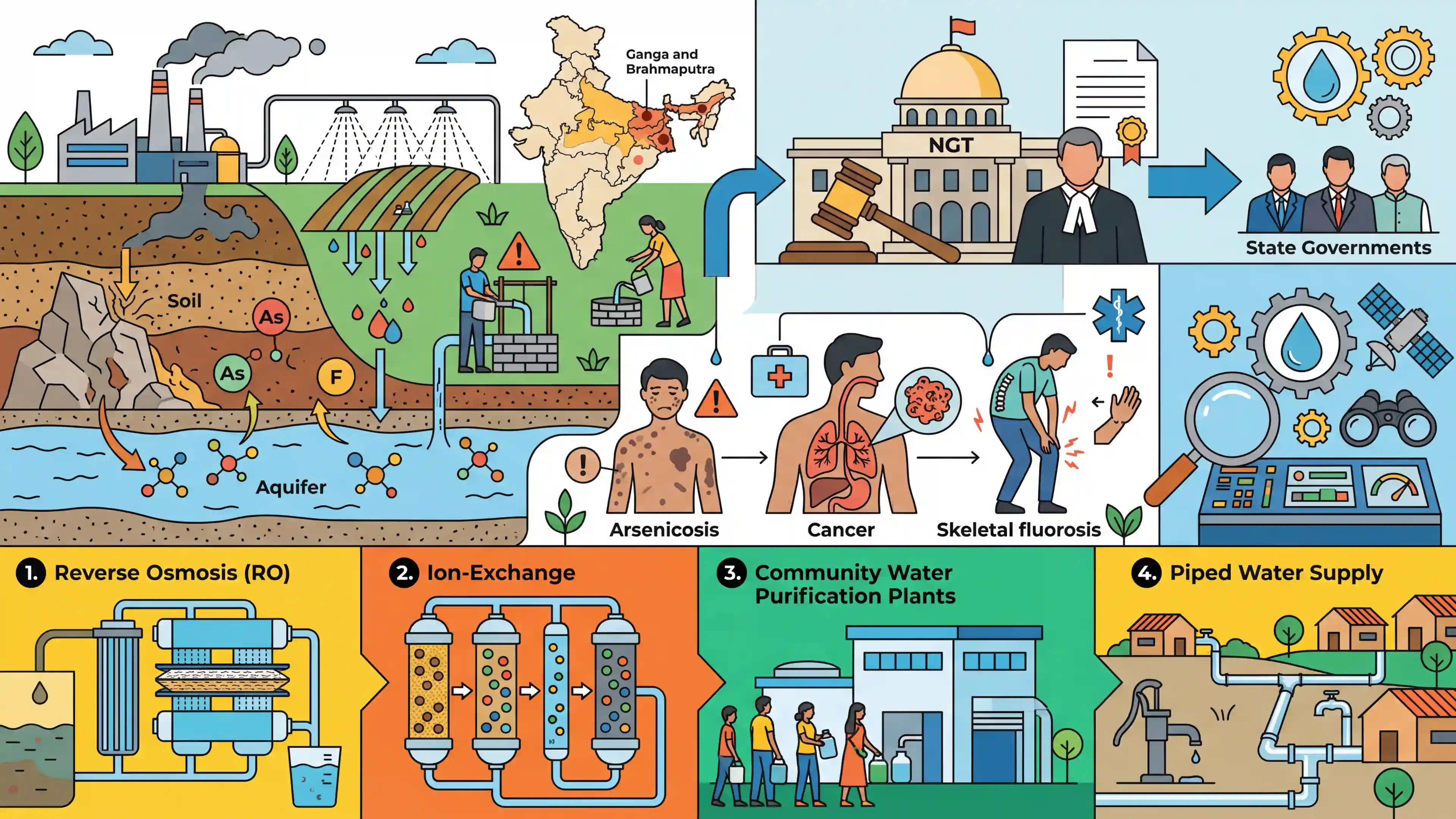
The National Green Tribunal (NGT) has ordered state governments to urgently address arsenic and fluoride contamination in groundwater, designating the Central Ground Water Authority (CGWA) to monitor mitigation efforts across the country. The contamination, widespread in eastern and central India—particularly in the alluvial formations of the Ganga and Brahmaputra basins—stems from a combination of natural rock weathering, industrial pollution, and the use of agricultural chemicals. This severe water quality crisis poses major public health risks, including arsenicosis, cancer, and skeletal fluorosis. To combat the issue, the CGWA and state governments are implementing remedial measures such as reverse osmosis, ion-exchange processes, community water purification plants, and the expansion of piped water supply through the Jal Jeevan Mission.
Key Points
- The National Green Tribunal (NGT) has directed state governments to mitigate arsenic and fluoride contamination in groundwater, with the CGWA tasked to monitor these efforts.
- Groundwater contamination is driven by both natural processes like rock weathering (especially in the alluvial formations of the Ganga and Brahmaputra basins) and anthropogenic factors like industrial pollution and agrochemical use.
- Chronic exposure to arsenic causes arsenicosis and cancer, while fluoride exposure adversely affects bone and teeth health.
- Eastern states like Bihar, West Bengal, UP, and Assam show high arsenic levels, while fluoride contamination is prevalent in central, eastern, and parts of southern and western India.
- Recommended remedial measures include water filtration plants, reverse osmosis, community purification plants, and leveraging the Jal Jeevan Mission for piped water supply.
Important Terms
National Green Tribunal (NGT)

Statutory body established under the NGT Act, 2010 for effective and expeditious disposal of cases relating to environmental protection, conservation of forests, and other natural resources.
UPSC context
GS2: Statutory bodies; GS3: Environment. Tests knowledge of environmental jurisprudence and specialized judicial mechanisms for ecological protection.
Jal Jeevan Mission (JJM)
Flagship initiative launched in 2019 aiming to provide safe, adequate piped drinking water (55 litres per capita per day) to all rural households by 2024.
UPSC context
GS2: Government policies; GS3: Water management. Evaluates understanding of social welfare schemes and Sustainable Development Goal 6 (Clean Water).
Central Ground Water Authority (CGWA)
Statutory body constituted under the Environment (Protection) Act, 1986, to regulate and control groundwater development and management across India.
UPSC context
GS3: Environment. Essential for understanding the regulatory and legal framework governing groundwater extraction and environmental protection.
Central Ground Water Board (CGWB)
Apex scientific organization under the Ministry of Jal Shakti responsible for monitoring, assessing, and providing scientific inputs for India's groundwater resource management.
UPSC context
GS3: Water Conservation. Tests knowledge of technical bodies involved in the assessment and mapping of groundwater resources.
Arsenicosis
Chronic health condition resulting from long-term ingestion of arsenic-contaminated water, characterized by skin lesions, pigmentation changes, and increased risk of cancer.
UPSC context
GS3: Public Health/Pollution. Tests awareness of the health impacts of chemical pollutants in groundwater basins.
Skeletal Fluorosis
Bone disease caused by excessive accumulation of fluoride in bones, leading to joint pain, stiffening, and physical deformities like knock-knees.
UPSC context
GS3: Environment/Health. Relevant for understanding the biological impact of geogenic and anthropogenic water contamination.
Prelims Trap
"The Central Ground Water Authority (CGWA) was established under the Water (Prevention and Control of Pollution) Act, 1974."
CGWA was actually constituted under Section 3(3) of the Environment (Protection) Act, 1986, specifically to regulate and control groundwater development, not the Water Act.
Static Concepts Connected
What are the common water pollutants and their associated health diseases?
- Arsenic: Causes Black-foot disease, skin lesions, and cancers due to chronic exposure (geogenic in Ganga-Brahmaputra basins).
- Fluoride: Excess levels (beyond 1.5 mg/L) cause dental (mottled enamel) and crippling skeletal fluorosis (bone deformities).
- Nitrates: Contamination from agricultural runoff causes Methemoglobinemia or 'Blue Baby Syndrome' in infants.
How does the NGT differ from the Central Ground Water Authority (CGWA)?
- NGT: A statutory tribunal established under the NGT Act 2010 to handle civil environmental disputes and appeals.
- CGWA Origin: An authority constituted under Section 3(3) of the Environment (Protection) Act, 1986.
- Mandate: CGWA specifically regulates and manages groundwater development, while NGT exercises broad environmental appellate jurisdiction.
Cross-Topic Patterns
Paddy cultivation + Geogenic contamination
Groundwater over-extraction for water-intensive crops like paddy lowers the water table, oxidizing aquifers and accelerating the release of geogenic arsenic into water supplies.
Jal Jeevan Mission + Source Sustainability
JJM isn't just about pipe infrastructure; its core mandate includes shifting rural dependence from contaminated groundwater to treated surface water sources to prevent chronic diseases.

Expect a Prelims question pairing CGWA's mandate under the EPA 1986 with geogenic groundwater pollutants (Arsenic, Fluoride, Uranium).
Linked PYQs · 5
Linked PYQs · 5
- 2025MainsGS3
Examine the factors responsible for depleting groundwater in India. What are the steps taken by the government to mitigate such depletion of groundwater?
- 2024MainsGS3
Industrial pollution of river water is a significant environmental issue in India. Discuss the various mitigation measures to deal with this problem and also the government's initiatives in this regard.
- 2020PrelimsGS1
Consider the following statements: 1. 36% of India's districts are classified as "overexploited" or "critical" by the Central Ground Water Authority (CGWA). 2. CGWA was formed under the Environment (Protection) Act. 3. India has the largest area under groundwater irrigation in the world. Which of the statements given above is/are correct?
- 2022PrelimsGS1
Which one of the following has been constituted under the Environment (Protection) Act, 1986?
- 2018PrelimsGS1
How is the National Green Tribunal (NGT) different from the Central Pollution Control Board (CPCB)? 1. The NGT has been established by an Act whereas the CPCB has been created by an executive order of the Government. 2. The NGT provides environmental justice and helps reduce the burden of litigation in the higher courts whereas the CPCB promotes cleanliness of streams and wells, and aims to improve the quality of air in the country. Which of the statements given above is/are correct?
