National Green Tribunal Action on Chaki River Illegal Mining
Source:Indian Express ↗
Why It Matters
Illegal sand and stone mining in riverbeds is a major environmental crisis in India, frequently resulting in ecological degradation and water scarcity. This topic is directly relevant to UPSC's focus on environmental conservation, sustainable development, and the role of statutory bodies like the NGT in enforcing ecological governance.
Summary
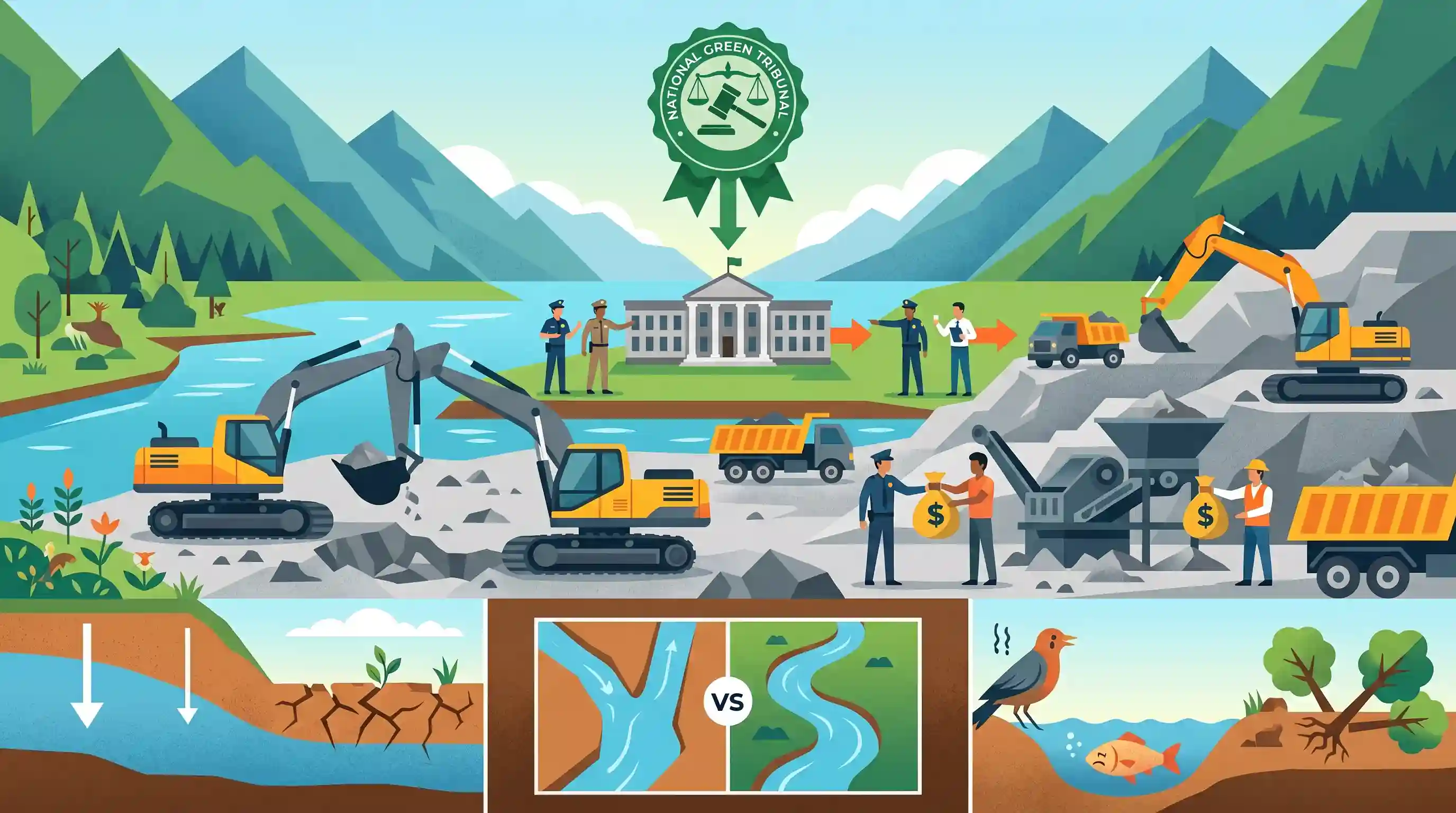
The National Green Tribunal (NGT) has ordered a crackdown on illegal riverbed mining in Himachal Pradesh, prompting the state government to impose heavy fines on stone crushers in the Kangra district for unauthorized extraction from the Chaki river. This strict enforcement highlights the severe ecological threats posed by unchecked riverbed mining, such as groundwater depletion, river channel alteration, and habitat destruction. It also underscores the crucial role of the NGT in holding state authorities accountable for environmental conservation and regulating the extraction of natural resources.
Key Points
- The National Green Tribunal (NGT) directed the Himachal Pradesh government to penalize stone crushers for illegal mining activities in the Chaki river bed.
- Heavy fines amounting to lakhs were imposed on violators in Kangra district, reflecting strict enforcement against unauthorized riverbed extraction.
- Illegal extraction of sand and stones severely damages river ecosystems, alters the natural flow of rivers, and leads to the depletion of the local groundwater table.
- The incident underscores the NGT's critical role as an environmental watchdog ensuring state compliance with conservation norms and sustainable mining practices.
Important Terms
National Green Tribunal (NGT)

A statutory body established under the National Green Tribunal Act 2010 for the effective and expeditious disposal of cases relating to environmental protection and forest conservation.
UPSC context
GS II/III: Statutory bodies and environmental governance; tests understanding of specialized judicial mechanisms in India.
Riverbed Mining
The extraction of sand and gravel from river channels, which if unregulated leads to bank erosion, groundwater depletion, and destruction of aquatic habitats like those of Gharials.
UPSC context
GS III: Environmental degradation and resource management; tests knowledge of ecological impacts of industrial activities.
Minor Minerals
Minerals like sand, gravel, and building stone defined under the MMDR Act, 1957; regulatory and administrative powers for these minerals are delegated to State Governments.
UPSC context
GS II/III: Federalism and mineral regulation; tests understanding of the division of power between Union and States.
Polluter Pays Principle
An environmental law principle requiring that those responsible for pollution bear the costs of managing it and restoring the environment to its original state.
UPSC context
GS III: Environmental ethics and law; one of the core principles applied by the NGT in adjudicating disputes.
Chaki River
A major tributary of the Beas River flowing through Himachal Pradesh and Punjab, originating in the Dhauladhar mountains and frequently impacted by unregulated mining.
UPSC context
GS I: Indian Geography; focuses on Himalayan river systems and their ecological challenges.
Prelims Trap
The NGT has the authority to adjudicate matters relating to the Wildlife (Protection) Act, 1972 and the Forest Rights Act, 2006.
The NGT's civil jurisdiction covers seven specific environmental laws, but explicitly excludes the Wildlife (Protection) Act, 1972, the Indian Forest Act, 1927, and the Forest Rights Act, 2006.
Static Concepts Connected
What are the guiding principles and legislative jurisdiction of the National Green Tribunal?
- Guiding Principles: The NGT is not bound by the Code of Civil Procedure but operates on the principles of natural justice, polluter pays, and precautionary principle.
- Included Laws: It enforces 7 key acts, including the Water Act, Air Act, Forest (Conservation) Act, Environment Protection Act, and Biological Diversity Act.
- Excluded Laws: It lacks jurisdiction over the Wildlife (Protection) Act 1972, Indian Forest Act 1927, and Forest Rights Act 2006.
What are the major ecological consequences of unregulated riverbed sand mining?
- Groundwater Depletion: Removing sand compromises the riverbed's capacity to hold water, leading to a direct lowering of the local groundwater table.
- Channel Alteration: Mining deep pits alters natural channels, increasing stream velocity, exacerbating bank erosion, and heightening downstream flood risks.
- Biodiversity Loss: It destroys benthic habitats, severely affecting the spawning grounds for fish, turtles, and diverse aquatic flora.
Cross-Topic Patterns
State vs. Center on Minor Minerals
While sand is a "minor mineral" regulated by states under the MMDR Act, environmental clearances and NGT oversight frequently overlap, creating federal tension over enforcement and compliance.
Himalayan Drainage System Mapping
The Chaki River is a tributary of the Beas originating in the Dhauladhar range. UPSC frequently tests the origins and specific tributaries of the Indus river system.

Expect a multi-statement Prelims question mixing NGT's excluded jurisdiction (WPA/FRA) with the ecological impacts of river sand mining.
Linked PYQs · 4
Linked PYQs · 4
- 2018PrelimsGS1
Which of the following is/are the possible consequence/s of heavy sand mining in riverbeds? 1. Decreased salinity in the river 2. Pollution of groundwater 3. Lowering of the water-table Select the correct answer using the code given below:
- 2019MainsGS3
Coastal sand mining, whether legal or illegal, poses one of the biggest threats to our environment. Analyze the impact of sand mining along the Indian coasts, citing specific examples.
- 2025MainsGS3
Mineral resources are fundamental to the country's economy and these are exploited by mining. Why is mining considered an environmental hazard? Explain the remedial measures required to reduce the environmental hazard due to mining.
- 2013MainsGS3
What are the consequences of Illegal mining ? Discuss the Ministry of Environment and Forests' concept of GO AND NO GO zones for coal mining sector.
