NGT Orders Study on Industrial Pollution and Heavy Metals
Source:The Hindu ↗
Why It Matters
Lignite mining and associated thermal power generation are critical for energy security but present severe challenges like heavy metal (mercury) toxicity and ground/surface water contamination. This article illustrates the operational dynamics of environmental governance in India—demonstrating the role of the NGT in initiating suo motu proceedings, the challenges of conflicting regulatory and private lab data, and the importance of deploying elite academic institutions (like IITs) to undertake objective, scientific source-apportionment studies.
Summary
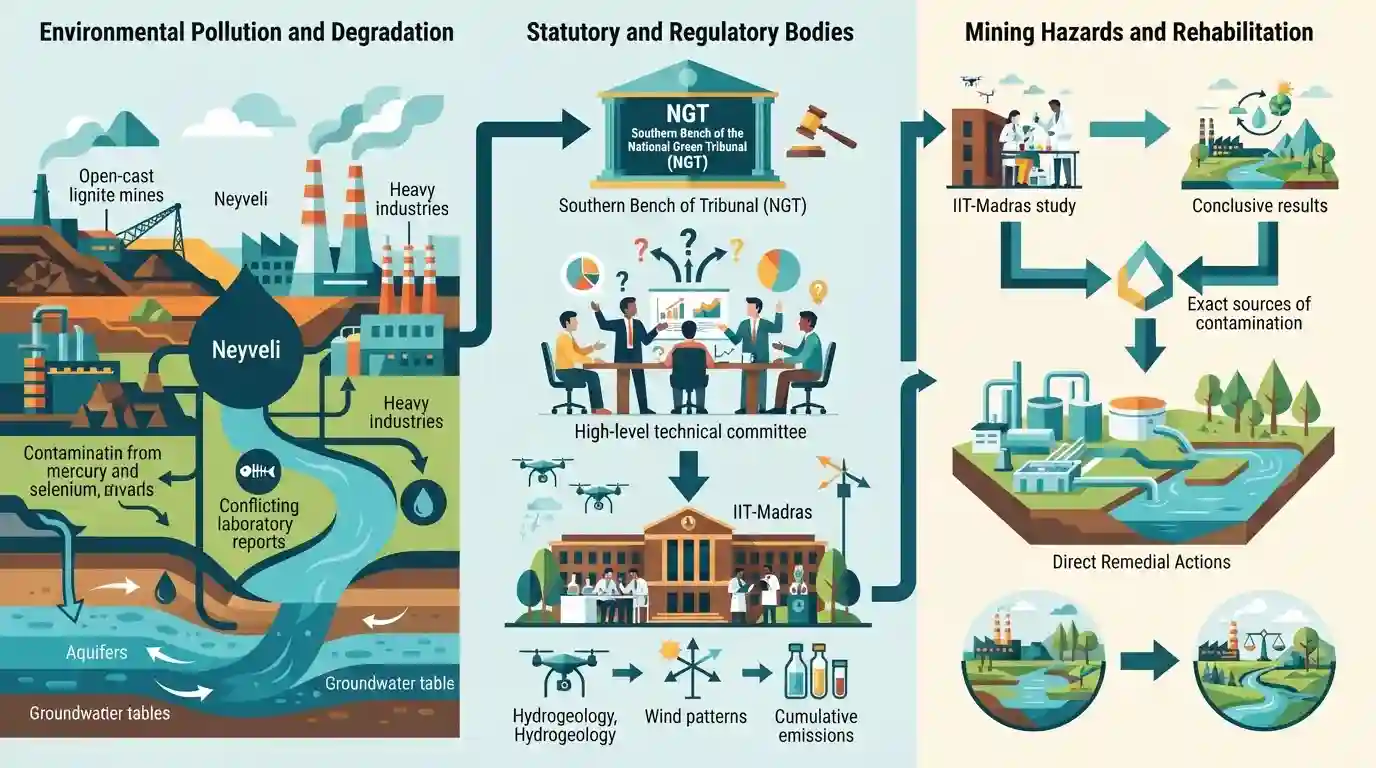
The Southern Bench of the National Green Tribunal (NGT) has ordered the Tamil Nadu Pollution Control Board (TNPCB) to finalize the Terms of Reference and a timeline for a comprehensive scientific study by IIT-Madras on regional environmental pollution. This directive comes after a high-level technical committee could not reach a consensus on the exact source of mercury and selenium contamination in surface waters around Neyveli, where the Neyveli Lignite Corporation (NLC) and other heavy industries operate. The study will conduct deep-dive analyses into regional hydrogeology, wind patterns, and cumulative industrial emissions to resolve conflicting laboratory reports and direct remedial actions.
Key Points
- The Southern Bench of the National Green Tribunal (NGT) directed the Tamil Nadu Pollution Control Board (TNPCB) to issue Terms of Reference (ToR) and set a strict timeline for a comprehensive study by IIT-Madras.
- The case involves two suo motu applications concerning industrial pollution and the suspected presence of toxic heavy metals, specifically mercury and selenium, in the surface waters around Neyveli.
- Diverging scientific findings had emerged; private laboratories reported mercury levels below the limit of quantification, while the TNPCB's internal lab detected mercury in 6 out of 19 surface water samples (ranging between 0.01 mg/l and 0.027 mg/l).
- A technical expert committee constituted earlier failed to submit a unified report due to internal differences, highlighting the complexity of attributing pollution to a specific industrial source.
- The upcoming comprehensive study by IIT-Madras is designed to examine broader regional factors, including local hydrogeology, wind dispersion patterns, and the cumulative impact of nearby industries (including NLC, TAQA, and IL&FS).
Important Terms
National Green Tribunal (NGT)

A specialized statutory, quasi-judicial body established in 2010 to expedite environmental cases, forestry conservation disputes, and to award compensation for ecological damage.
UPSC context
GS Paper III (Environment); tests institutional bodies for environmental governance and fast-track adjudication of ecological disputes.
National Green Tribunal Act, 2010
The parliamentary legislation enacted under Article 253 that established the NGT, incorporating international principles like "polluter pays," "precautionary principle," and "sustainable development."
UPSC context
GS Paper II (Legislations) & GS III; tests statutory provisions of environmental frameworks and legislative mechanisms.
Water (Prevention and Control of Pollution) Act, 1974
India's foundational environmental law enacted to prevent and control water pollution, restore wholesomeness of water, and establish pollution control boards to set effluent standards.
UPSC context
GS Paper III (Environmental Degradation); tests regulatory mechanisms, environmental standards, and the powers of pollution control boards.
Tamil Nadu Pollution Control Board (TNPCB)
A statutory state-level regulatory body established to enforce pollution laws, monitor environmental quality, and grant Consent to Operate (CTO) for industries in Tamil Nadu.
UPSC context
GS Paper III (Statutory Bodies); tests decentralized environmental governance and enforcement of environmental safety norms.
Neyveli Lignite Corporation (NLC) India
A Navratna public sector enterprise under the Ministry of Coal involved in lignite mining and thermal power generation, central to regional fly-ash and heavy-metal contamination disputes.
UPSC context
GS Paper III (Infrastructure & Mining); tests coal extraction hazards, public sector environmental responsibilities, and fly-ash management.
Prelims Trap
The NGT Act, 2010 explicitly grants the Tribunal suo motu powers to take cognizance of environmental matters.
The Act lacks an explicit suo motu provision. The Supreme Court read this power into the NGT's mandate in 2021 to effectively safeguard the Right to Life (Article 21).
Static Concepts Connected
What are the key characteristics and distribution of Lignite coal in India?
- Brown Coal: It is the lowest rank of coal with low carbon concentration (40–55%) and very high moisture content (over 35%).
- Major Reserves: Tamil Nadu holds nearly 79% of India's geological reserves and about 50% of national production, primarily centered around Neyveli.
- Mining Hazards: Requires 'strata depressurization'—heavy groundwater pumping to prevent high-pressure artesian aquifers from bursting the mine floor, causing water depletion.
What are the environmental impacts and regulations regarding Mercury and Selenium?
- Primary Source: Coal and lignite-fired thermal power plants are the largest anthropogenic point sources of mercury emissions in India (70-80%).
- Minamata Convention: A global treaty ratified by India in 2018 to curb mercury pollution and protect human health and the environment.
- Selenium Toxicity: A volatile metalloid in coal that concentrates in fly ash, bioaccumulating rapidly in aquatic food webs and causing reproductive failure in fauna.
Cross-Topic Patterns
NGT Jurisdiction + Article 21 jurisprudence
The Supreme Court affirmed NGT's suo motu powers despite statutory silence, linking procedural environmental law directly to the fundamental Right to Life under Article 21.
Thermal power + aquatic bioaccumulation
Links energy generation to aquatic ecology. Fly ash from lignite combustion concentrates volatile metalloids like Selenium, which rapidly bioaccumulate and disrupt aquatic food webs even at trace levels.

Expect a multi-statement question combining lignite characteristics, thermal plant emissions (mercury/selenium), and Minamata Convention.
Linked PYQs · 4
Linked PYQs · 4
- 2023PrelimsGS1
Consider the following statements regarding mercury pollution: 1. Gold mining activity is a source of mercury pollution in the world. 2. Coal-based thermal power plants cause mercury pollution. 3. There is no known safe level of exposure to mercury. How many of the above statements are correct?
- 2018PrelimsGS1
How is the National Green Tribunal (NGT) different from the Central Pollution Control Board (CPCB)? 1. The NGT has been established by an Act whereas the CPCB has been created by an executive order of the Government. 2. The NGT provides environmental justice and helps reduce the burden of litigation in the higher courts whereas the CPCB promotes cleanliness of streams and wells, and aims to improve the quality of air in the country. Which of the statements given above is/are correct?
- 2025MainsGS3
Mineral resources are fundamental to the country's economy and these are exploited by mining. Why is mining considered an environmental hazard? Explain the remedial measures required to reduce the environmental hazard due to mining.
- 2014MainsGS3
Environmental Impact Assessment studies are increasingly undertaken before a project is cleared by the Government. Discuss the environmental impacts of coal-fired thermal plants located at coal pitheads.
