NGT directs penalising local bodies for Ganga pollution
Source:theprint ↗
Why It Matters
Important for BPSC aspirants tracking environmental governance, pollution control mechanisms in Bihar, and the role of statutory bodies like NGT and BSPCB.
Summary
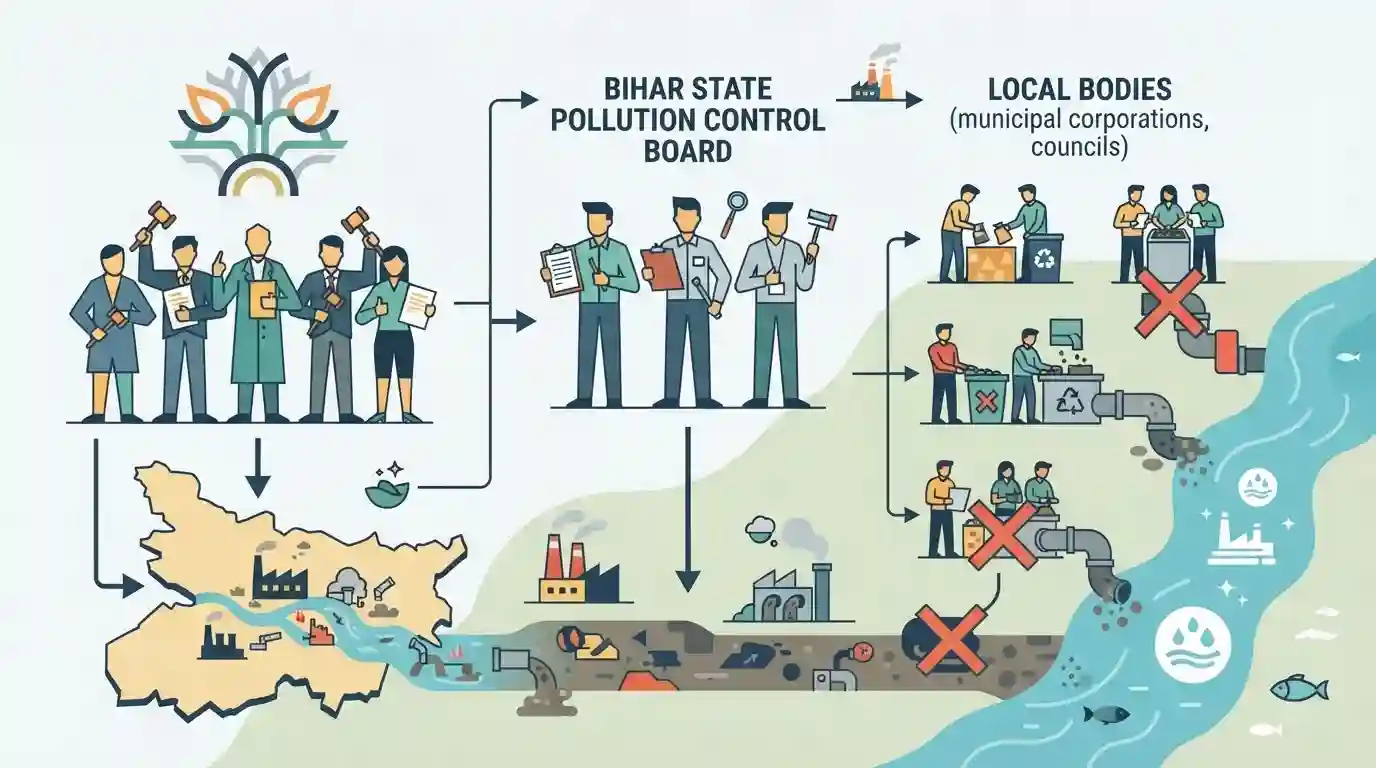
The National Green Tribunal (NGT) directed the Bihar State Pollution Control Board to take strict punitive action, including penalising local bodies, for failing to curb pollution in the River Ganga, underscoring local governance accountability in environmental management.
Key Points
- The National Green Tribunal (NGT) has directed the Bihar State Pollution Control Board (BSPCB) to impose penalties on local bodies responsible for polluting the River Ganga.
- The directive emphasizes strict accountability of municipal bodies and local authorities for untreated sewage and waste discharge into the river system.
- It highlights enforcement challenges and regulatory measures regarding environmental compliance and river conservation in Bihar.
Important Terms
National Green Tribunal (NGT)

A specialized judicial body established in 2010 under the National Green Tribunal Act for effective and expeditious disposal of cases relating to environmental protection and conservation of forests.
UPSC context
Important for BPSC General Studies (Paper II - Polity/Environment); tests statutory tribunals, judicial powers, and environmental governance in Bihar.
Bihar State Pollution Control Board (BSPCB)
A statutory body constituted under the Water (Prevention and Control of Pollution) Act, 1974, responsible for implementing environmental laws and monitoring pollution levels across Bihar.
UPSC context
Crucial for BPSC Bihar-specific governance and environmental degradation topics; tests state-level regulatory mechanisms and pollution control.
Prelims Trap
The National Green Tribunal is a constitutional body established under executive resolution of the Union Government.
Aspirants often assume the NGT is a constitutional body or functions directly under the Ministry of Environment through executive orders, missing its specialized statutory nature.
Static Concepts Connected
What are the key structural and jurisdiction features of the National Green Tribunal (NGT)?
- Statutory Origin: Established under the National Green Tribunal Act, 2010, for expeditious disposal of environmental protection cases.
- Legal Procedure: Not bound by the procedure under the Code of Civil Procedure, 1908, but guided by principles of natural justice.
- Timeframe: Mandates that cases be disposed of finally within 6 months of filing.
What is the role and constitutional basis of State Pollution Control Boards in India?
- Statutory Mandate: Constituted under the Water (Prevention and Control of Pollution) Act, 1974, and later empowered under the Air Act and EPA.
- Key Functions: Responsible for implementing environmental laws, monitoring industrial pollution, and issuing consent to establish/operate.
Cross-Topic Patterns
NGT Orders + Urban Local Body Accountability
The NGT's punitive directive on urban bodies links closely to the enforcement gaps under the 74th Constitutional Amendment regarding municipal sanitation and waste management.
Namami Gange + Statutory Pollution Control Boards
River Ganga conservation mandates connect directly to centrally sponsored schemes like Namami Gange and municipal sewage treatment targets under national water frameworks.

NGT powers, statutory status under 2010 Act, and BSPCB enforcement roles will be tested in a multi-statement BPSC prelims question.
Linked PYQs · 3
Linked PYQs · 3
- 2024-IBPSC_PRELIMSGS1
Which river is known as the ‘Sorrow of Bihar’?
- 2020BPSC_PRELIMSGS1
Which of the following rivers flowing in Bihar is a north flowing river?
- 2022BPSC_PRELIMSGS1
The confluence of the rivers Son and Ganga is located in which district of Bihar?
