NGT Directs Penalties for Untreated Sewage Discharge into Bihar Rivers
Source:theprint ↗
Why It Matters
Highlights the ongoing environmental crisis of river pollution in Bihar and the regulatory mechanisms (NGT and State Pollution Control Boards) used to hold local bodies accountable for ecological degradation.
Summary
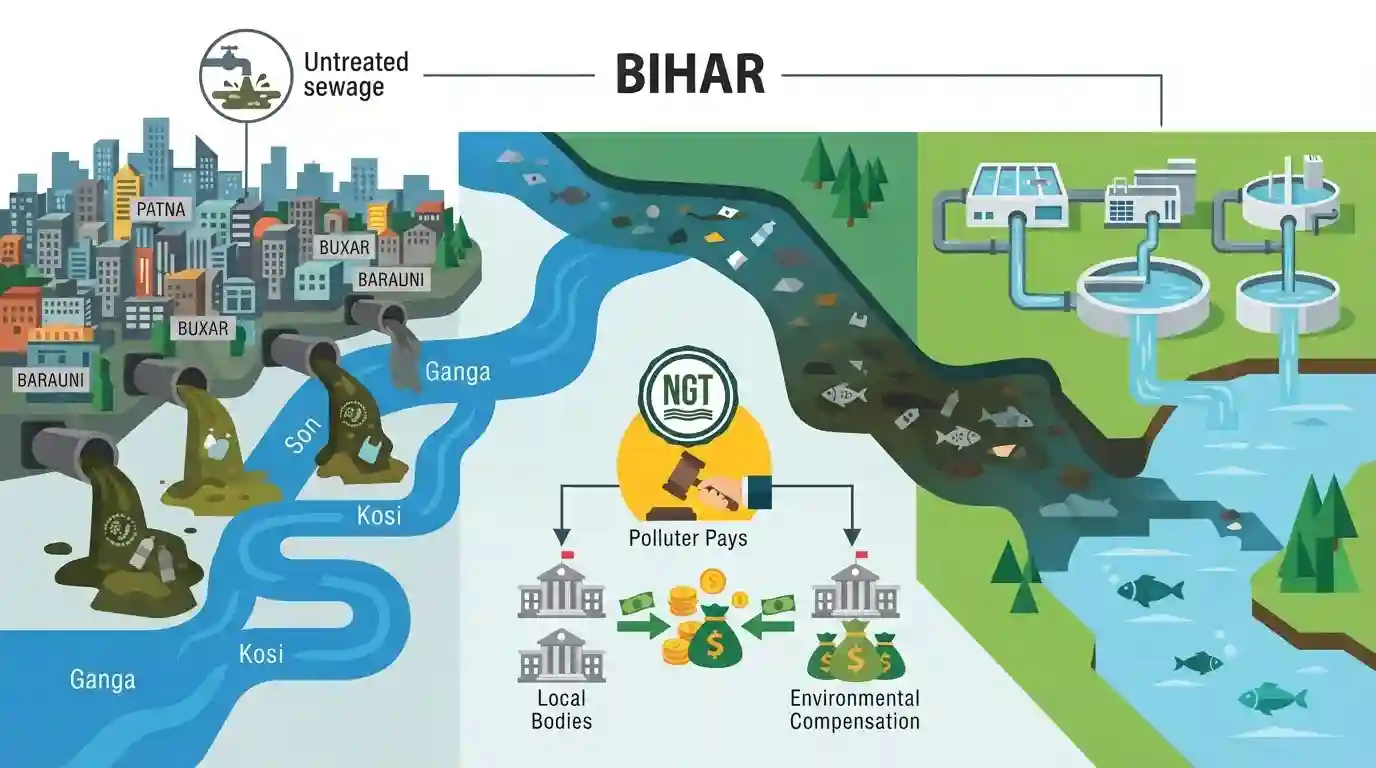
The National Green Tribunal (NGT) has directed the Bihar State Pollution Control Board (BSPCB) to impose environmental compensation on urban local bodies responsible for discharging untreated sewage into the Ganga and other major rivers like the Son, Kosi, and Bagmati. Taking suo motu cognisance of reports indicating severe pollution and high faecal coliform levels making the rivers unsafe for bathing, the NGT emphasized the "polluter pays" principle. The tribunal noted that a massive volume of untreated sewage from untapped drains in cities including Patna, Buxar, and Barauni flows directly into the rivers, and called for the urgent completion and operation of Sewage Treatment Plants (STPs) in the state.
Key Points
- The National Green Tribunal (NGT) ordered the Bihar State Pollution Control Board to penalize urban local bodies for discharging untreated sewage into the Ganga and other rivers.
- A suo motu case highlighted that the Ganga, Son, Kosi, and Bagmati rivers are unsafe even for bathing due to high faecal coliform levels across 27 districts.
- Huge amounts of untreated sewage flow into the Ganga daily from untapped drains in major urban centers like Patna, Buxar, Ara, Jamalpur, and Barauni.
- The NGT stressed the urgent need to operationalize existing Sewage Treatment Plants (STPs) and complete ongoing projects to halt river pollution.
Important Terms
National Green Tribunal (NGT)

A statutory, specialized judicial body established under the NGT Act, 2010, for the effective and expeditious disposal of cases relating to environmental protection, forest conservation, and enforcement of environmental legal rights.
UPSC context
GS Paper II (Statutory Bodies) and GS Paper III (Environment); tests understanding of environmental governance, judicial activism, and dispute resolution.
Bihar State Pollution Control Board (BSPCB)
A state-level statutory body constituted in 1974 under the Water (Prevention and Control of Pollution) Act, 1974, responsible for enforcing environmental standards and regulating pollution within Bihar.
UPSC context
GS Paper II (Statutory Bodies) and GS Paper III (Pollution); tests federal environmental governance and implementation of central pollution acts at the state level.
Polluter Pays Principle
A global environmental law doctrine dictating that the entity responsible for causing pollution must bear the complete financial costs of managing waste, preventing further degradation, and restoring the damaged ecosystem.
UPSC context
GS Paper III (Ecology and Environment); tests understanding of environmental liability, sustainable development, and regulatory mechanisms like Extended Producer Responsibility.
Faecal Coliform
A subgroup of coliform bacteria originating from the intestinal tracts of warm-blooded organisms, serving as a critical biological indicator of sewage contamination and potential pathogens in water bodies.
UPSC context
GS Paper III (Environment & Science); tests knowledge of water quality standards, biological indicators of pollution, and public health risks.
Prelims Trap
State Pollution Control Boards (SPCBs) are statutory bodies established under the Environment (Protection) Act of 1986.
SPCBs were established under the Water (Prevention and Control of Pollution) Act, 1974, not the umbrella Environment (Protection) Act, 1986.
Static Concepts Connected
What is the statutory jurisdiction of the National Green Tribunal (NGT)?
- Origin: Established under the National Green Tribunal Act, 2010, for expediting environmental protection cases.
- Guiding Principles: Bound by principles of natural justice, 'Polluter Pays', and sustainable development, not Code of Civil Procedure.
- Jurisdiction: Possesses original, appellate, and suo motu powers over civil cases involving seven specific environmental laws.
How do BOD and Faecal Coliform measure water quality?
- BOD Definition: Measures oxygen needed by aerobic organisms to decompose organic waste; higher BOD indicates lower dissolved oxygen levels.
- Faecal Coliform: Gram-negative bacteria indicating human/animal fecal contamination; serves as a primary biological indicator of untreated domestic sewage.
Cross-Topic Patterns
Judicial Environmentalism and Local Governance
NGT penalizing Urban Local Bodies (ULBs) highlights the structural governance gap between environmental mandates and the weak financial autonomy of municipal bodies under the 74th Amendment.
River Pollution and Aquatic Biodiversity
Severe untreated sewage discharge in the Ganga directly threatens the eco-tourism potential and vulnerable habitat of the National Aquatic Animal, the Gangetic Dolphin, in Bihar's Vikramshila sanctuary.

Questions may test NGT's suo motu powers alongside the distinct regulatory mandates of SPCBs under the Water Act 1974.
Linked PYQs · 3
Linked PYQs · 3
- 2019BPSC_PRELIMSGS1
The district of Bihar which has a longer length of Ganga river is
- 2024-EBPSC_PRELIMSGS1
Which of the following drainage systems drains the lands of Bihar?
- 2024-IBPSC_PRELIMSGS1
Which river is known as the ‘Sorrow of Bihar’?
