Great Nicobar Infrastructure Project and Ecological Clearance Review
Source:The Hindu ↗
Why It Matters
This issue is a textbook example of the 'Environment vs. Development' debate, highlighting the complexities of executing strategic infrastructure in ecologically fragile hotspots. It integrates concepts from Environmental Impact Assessments (EIA), protection of PVTGs, Coastal Regulation Zone (CRZ) rules, and maritime security, making it highly relevant for GS1 (Geography/Society), GS2 (Tribal Rights), and GS3 (Environment/Infrastructure).
Summary
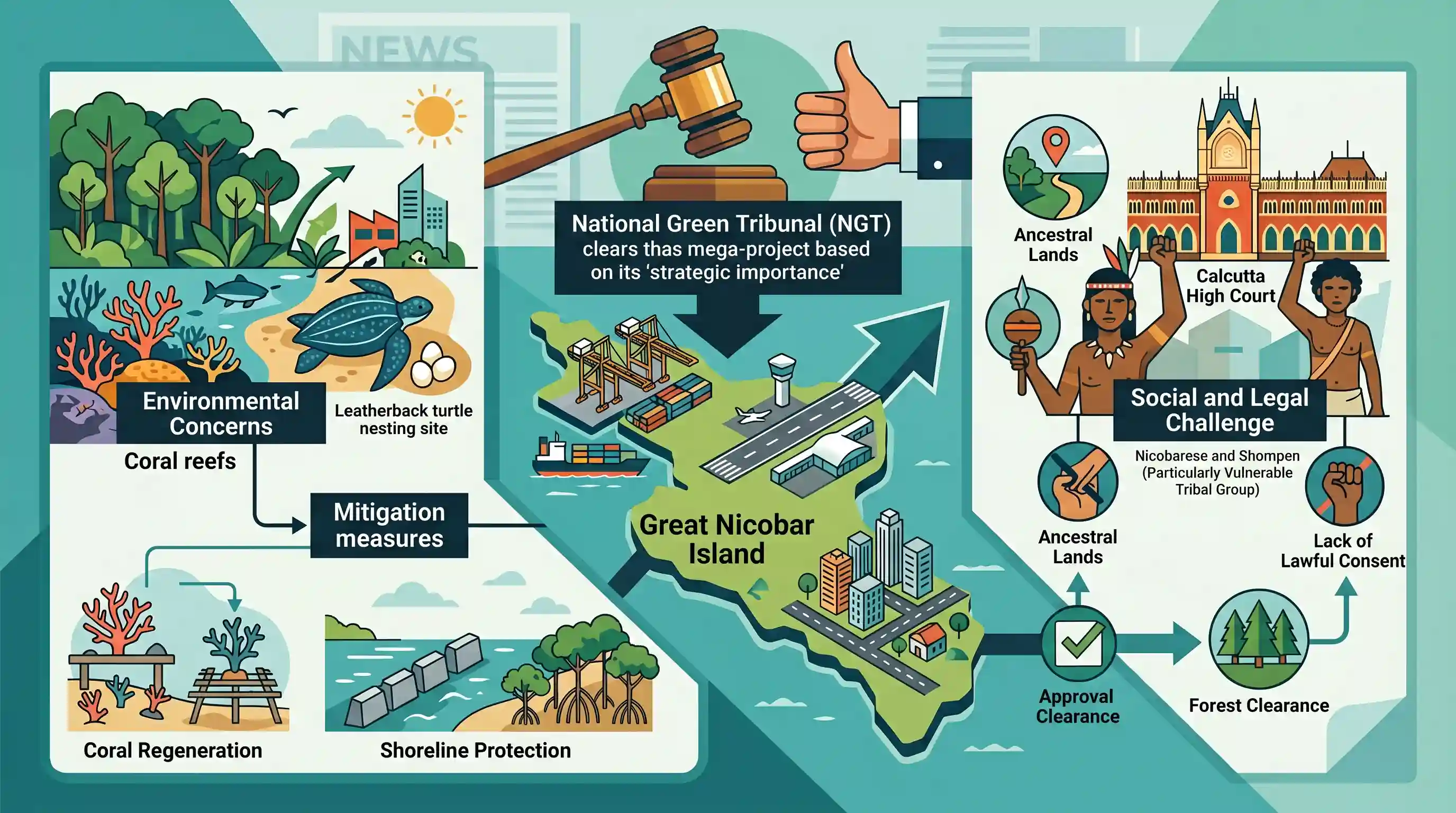
The National Green Tribunal (NGT) has cleared the ₹92,000-crore Great Nicobar Island mega-infrastructure project, validating the Environment Ministry’s 2022 Environmental Clearance (EC) by citing the project's 'strategic importance'. The massive development includes a transshipment port, airport, and township. Environmentalists had raised red flags regarding the project's impact on rich biodiversity, including coral reefs, leatherback turtle nesting sites, and Coastal Regulation Zone-1A (CRZ-1A) areas. To mitigate impacts, the NGT has mandated proactive measures such as coral regeneration and shoreline protection. Concurrently, indigenous communities—the Nicobarese and the Shompen (a Particularly Vulnerable Tribal Group)—are challenging the project's Forest Clearance in the Calcutta High Court, alleging a lack of lawful consent and the forced surrender of ancestral lands.
Key Points
- The NGT has upheld the Environmental Clearance (EC) for the ₹92,000-crore Great Nicobar Island mega-infrastructure project, emphasizing its strategic and defense significance.
- The NGT formed a High-Powered Committee to review ecological concerns, including threats to coral reefs, leatherback turtles, and ecologically sensitive CRZ-1A zones.
- Mitigation directives mandate the Environment Ministry to undertake coral regeneration and prevent shoreline erosion to protect turtle and bird nesting beaches.
- Despite EC approval, the project's Forest Clearance faces a pending legal challenge at the Calcutta High Court.
- Indigenous groups, including the Nicobarese and the particularly vulnerable Shompen tribe, allege the project violates their rights and proceeds without lawful consent.
Important Terms
National Green Tribunal (NGT)

Statutory body created under the NGT Act 2010 for expeditious disposal of environmental disputes. It balances economic growth with ecological protection, as seen in its 'strategic importance' clearance of the Great Nicobar project.
UPSC context
GS Paper III (Environment). Tests understanding of specialized judicial bodies and the legal framework for balancing development with conservation.
Particularly Vulnerable Tribal Groups (PVTGs)
A government classification for the most vulnerable tribal sub-groups, identified by factors like a declining population, low literacy, and pre-agricultural technology. India has 75 such groups, including the Shompen of Great Nicobar.
UPSC context
GS Paper II (Social Justice). Tests knowledge of welfare policies for marginalized groups and constitutional protections for indigenous communities.
Coastal Regulation Zone (CRZ) Notification
Coastal areas regulated under the Environment (Protection) Act, 1986, to conserve sensitive ecosystems. Categories like CRZ-1A (Ecologically Sensitive Areas) strictly prohibit major construction to maintain the ecological integrity of the coastline.
UPSC context
GS Paper III (Conservation). Important for understanding coastal ecosystem management, environmental zoning, and disaster resilience in maritime states.
Environmental Clearance (EC)
Mandatory approval granted by the Environment Ministry based on an Environmental Impact Assessment (EIA). It specifies mitigation conditions under which a large-scale project may proceed without causing irreversible ecological damage.
UPSC context
GS Paper III (EIA). Tests knowledge of regulatory processes for industrial clearance and the principle of sustainable development.
Forest Clearance (FC)
Official permission required to use forest land for non-forest purposes like ports or townships. Under the Forest (Conservation) Act, 1980, this typically requires compensatory afforestation and tribal rights settlement.
UPSC context
GS Paper III (Governance). Relevant for questions on land-use policy, compensatory afforestation, and the intersection of infrastructure with forest protection laws.
High-Powered Committee (HPC)
An expert group (as ordered by the NGT in 2023) tasked with reviewing a project's environmental and regulatory compliance. It includes representatives from government and research institutes to reassess ecological concerns.
UPSC context
GS Paper II (Executive/Judiciary). Tests the role of expert committees in providing evidence-based oversight for large-scale, controversial government projects.
Shompen
A semi-nomadic, hunter-gatherer PVTG indigenous to the interior rainforests of Great Nicobar. They are central to the debate over tribal displacement and 'habitat rights' under the Forest Rights Act.
UPSC context
GS Paper I (Social Diversity). Tests awareness of India's isolated indigenous populations and the impact of modernization on traditional tribal habitats.
Prelims Trap
Both the Shompen and Nicobarese indigenous communities of Great Nicobar are classified as Particularly Vulnerable Tribal Groups (PVTGs).
Only the Shompen are a PVTG. The Nicobarese are a Scheduled Tribe, but their population and developmental metrics exclude them from PVTG status.
Static Concepts Connected
Which tribes in the Andaman & Nicobar Islands are classified as PVTGs?
- Five PVTGs: Great Andamanese, Jarawa, Onge, Sentinelese (Andaman), and Shompen (Nicobar). Nicobarese are an ST, not a PVTG.
- Ethnic Origin: Andamanese tribes are largely of Negrito descent, while the Shompen and Nicobarese of the Nicobar islands are of Mongoloid descent.
What defines Coastal Regulation Zone-1A (CRZ-IA) under India's coastal rules?
- Ecological Sensitivity: CRZ-IA covers highly fragile, ecologically sensitive systems like mangroves, corals, and turtle nesting grounds (e.g., Galathea Bay).
- Construction Ban: Strictly prohibits large-scale industrial construction, though conditional exemptions exist for defense, strategic projects, and essential pipelines based on detailed EIA.
Cross-Topic Patterns
Malacca Strait + Port Economics
The project's transshipment terminal leverages proximity to the Malacca Strait, connecting maritime geography (IR/Security) with India's Indo-Pacific strategic supply chains and port economics.
UT Legal Jurisdiction vs Clearances
The article highlights the Calcutta High Court hearing the forest clearance case, reinforcing the static polity concept of Union Territories sharing High Court jurisdictions.

Expect a multi-statement Prelims question mixing Shompen PVTG status, Galathea Bay's location, and Calcutta HC's jurisdiction over A&N.
Linked PYQs · 5
Linked PYQs · 5
- 2009PrelimsGS1
In which one of the following places is the Shompen tribe found?
- 2013PrelimsGS1
Under the Scheduled Tribes and Other Traditional Forest Dwellers (Recognition of Forest Rights) Act, 2006, who shall be the authority to initiate the process for determining the nature and extent of individual or community forest rights or both?
- 2018PrelimsGS1
Consider the following statements : 1. Most of the world's coral reefs are in tropical waters. 2. More than one-third of the world's coral reefs are located in the territories of Australia, Indonesia and Philippines. 3. Coral reefs host far more number of animal phyla than those hosted by tropical rainforests. Which of the statements given above is/are correct?
- 2022PrelimsGS1
"Biorock technology" is talked about in which one of the following situations?
- 2014MainsGS3
Environmental Impact Assessment studies are increasingly undertaken before a project is cleared by the Government. Discuss the environmental impacts of coal-fired thermal plants located at coal pitheads.
