NGT Takes Action Over Chromium Contamination of Groundwater in UP
Source:The Hindu ↗
Why It Matters
This article highlights critical environmental challenges in Uttar Pradesh regarding industrial groundwater contamination (such as chromium toxicity) and the judicial-regulatory role of the National Green Tribunal (NGT) in enforcing pollution control norms, making it essential for UPPSC PCS aspirants focusing on state environment and governance issues.
Summary
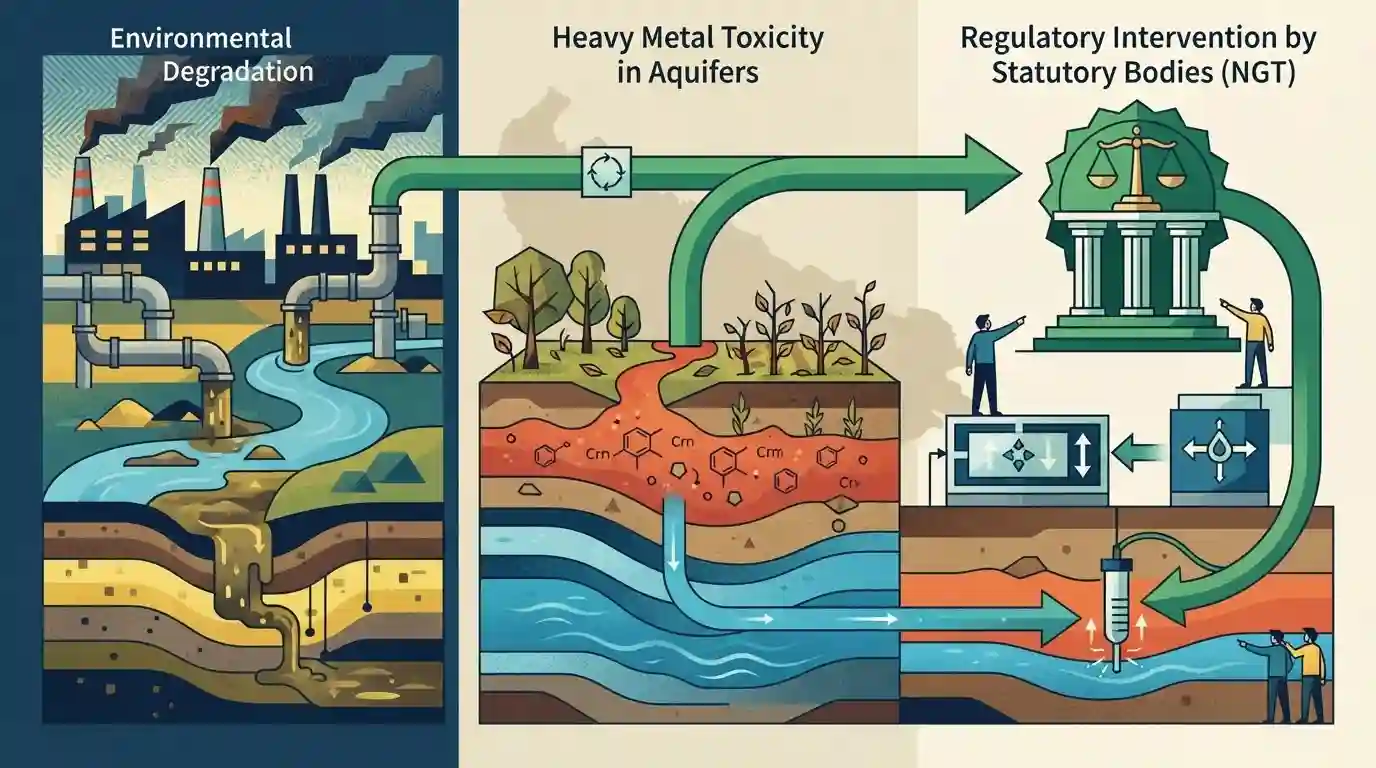
The National Green Tribunal (NGT) has intervened strongly over severe chromium contamination in Uttar Pradesh groundwater caused by industrial pollution. The case highlights environmental degradation, heavy metal toxicity affecting aquifers, and the regulatory role of statutory bodies like the NGT in enforcing compliance and remedial measures across UP.
Key Points
- The National Green Tribunal (NGT) took stringent action regarding severe chromium contamination of groundwater in parts of Uttar Pradesh.
- Industrial effluents, particularly from unscientific disposal of tannery and manufacturing waste, have led to heavy metal toxicity in local aquifers.
- Chromium contamination poses severe health and environmental hazards, affecting drinking water sources and agricultural soil safety in UP.
- The NGT directive emphasizes accountability, remediation, and strict compliance by polluting industries and state regulatory bodies.
Important Terms
National Green Tribunal (NGT)

A specialized statutory body established under the NGT Act, 2010, for effective and expeditious disposal of cases relating to environmental protection, conservation of forests, and enforcement of legal rights concerning the environment.
UPSC context
Important for UPPSC GS Paper III (Environment, Pollution) and statutory bodies, testing the role of judicial/quasi-judicial mechanisms in checking environmental degradation.
National Green Tribunal Act, 2010
An enactment passed by the Indian Parliament in 2010 that provides for the establishment of a specialized tribunal for handling environmental disputes and enforcing key environmental laws.
UPSC context
Relevant for UPPSC GS Paper II and III (Polity and Statutory/Regulatory Frameworks), testing legislative provisions for environmental justice and governance.
Prelims Trap
The National Green Tribunal is an executive body set up by the Ministry of Environment, Forest and Climate Change.
Aspirants often assume the NGT is a constitutional body or functions under the Ministry of Environment through executive orders, when it is a statutory body established via an Act of Parliament.
Static Concepts Connected
What are the key structural and jurisdiction features of the National Green Tribunal (NGT)?
- Statutory Origin: Statutory Basis: Established in 2010 under the National Green Tribunal Act, 2010, drawing inspiration from India's constitutional provision of Article 21.
- Civil Jurisdiction: Jurisdiction: Exercises civil jurisdiction over civil cases involving substantial environmental questions arising from implementation of enactments listed in Schedule I.
- Exclusions: Exclusion: The NGT is explicitly barred from hearing cases under the Wildlife (Protection) Act, 1972, and the Scheduled Tribes and Other Traditional Forest Dwellers Act, 2006.
- Timeframe: Speedy Justice: Mandated to dispose of applications and appeals finally within 6 months of filing.
Cross-Topic Patterns
Hexavalent Chromium & UP Public Health
Groundwater heavy metal toxicity links environmental degradation under GS Paper-III with public health provisioning under state welfare mandates in UP special governance.
Industrial Corridors vs. Environmental Jurisprudence
The Kanpur legacy waste case illustrates the friction between industrial growth (tanneries) and statutory enforcement by green courts like NGT.

NGT jurisdiction, hexavalent chromium toxicity limits (IS 10500), and UP industrial clusters like Kanpur will form a multi-statement match set.
Linked PYQs · 4
Linked PYQs · 4
- 2016UPPSC_PRELIMSGS1
Indiscriminate use of fertilizers have led to
- 2018UPPSC_PRELIMSGS1
Which of the following rivers of Uttar Pradesh has been declared a 'Biological Disaster' due to environmental pollution?
- 2021UPPSC_PRELIMSGS1
Flyash pollution is caused by
- 2022UPPSC_PRELIMSGS1
Dichloro-diphenyl-trichloroethane (DDT) is a
