Chennai Initiative Trains Women SHGs in Urban Gardening
Source:The Hindu ↗
Why It Matters
This article serves as an excellent case study of how mobilizing women's Self Help Groups (SHGs) can simultaneously address urban livelihood generation, women's empowerment, and urban climate resilience (mitigating heat islands). It offers practical examples for Mains answers on gender equity, sustainable urban development, and micro-entrepreneurship.
Summary
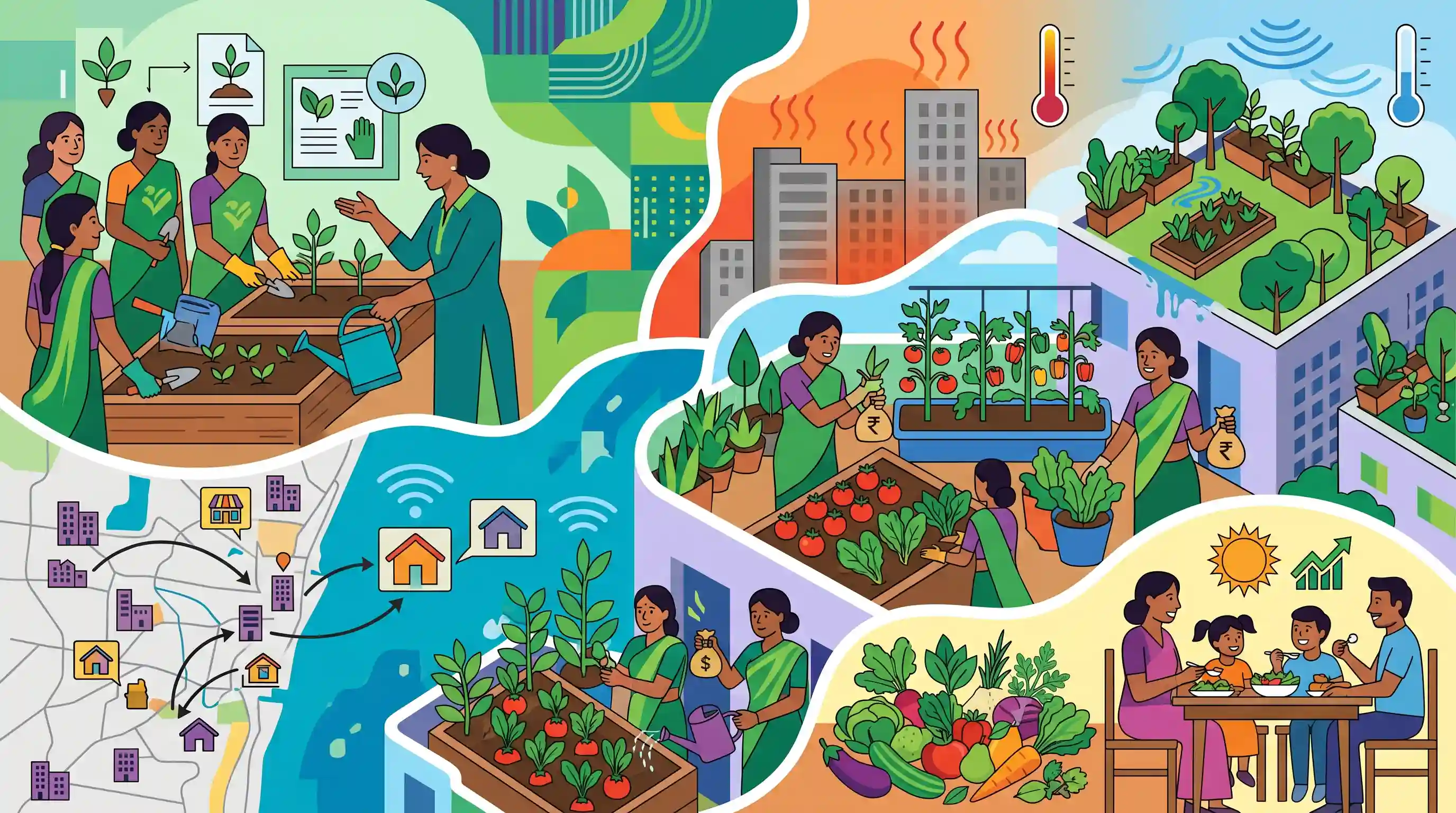
The Chennai Resilience Centre (CRC) has launched the 'Madras Mali' initiative to train 250 women Self Help Group (SHG) members as professional urban gardeners. By collaborating with the Tamil Nadu Urban Livelihoods Mission, the program connects these trained women with households seeking gardening assistance. This effort not only provides viable livelihood and income-generation opportunities for women but also promotes sustainable urban farming. Environmentally, the proliferation of terrace and home gardens helps mitigate the urban heat island effect and bolsters local food security by providing nutritious organic produce.
Key Points
- The 'Madras Mali' initiative trains women SHG members under the Tamil Nadu Urban Livelihoods Mission as professional urban gardeners.
- The program empowers women by providing stable income-generation opportunities, yielding roughly ₹10,000 for a fortnight's work.
- Training covers organic farming, seasonal cropping, and sustainable practices like crafting grow bags from banana sheaths.
- Green terraces and home gardens established through the program help combat the urban heat island effect, potentially reducing indoor temperatures by up to seven degrees Celsius.
- The initiative bolsters urban food security and nutrition, supplying fresh produce to local households, anganwadis, and government schools.
Important Terms
Madras Mali

A Chennai Resilience Centre (CRC) initiative training women Self Help Group (SHG) members as professional urban gardeners to provide maintenance services for households and institutions, creating green livelihoods.
UPSC context
GS Paper I/III: Social Empowerment and Livelihoods. Tests understanding of urban poverty alleviation and women-led social entrepreneurship models.
Tamil Nadu Urban Livelihoods Mission (TNULM)
A state-level initiative, aligned with the National Urban Livelihoods Mission (NULM), aimed at reducing urban poverty through skill development, financial inclusion, and strengthening community institutions like SHGs.
UPSC context
GS Paper II/III: Government Schemes/Poverty. Tests knowledge of state implementations of national urban development missions and livelihood security frameworks.
Chennai Resilience Centre (CRC)
A unit of Care Earth Trust dedicated to building urban resilience in Chennai through programs addressing climate change, food security, and heat mitigation via community-based nature solutions.
UPSC context
GS Paper III: Environment/Disaster Management. Illustrates the role of specialized NGOs in building climate-resilient cities and implementing nature-based solutions.
Chennai Urban Farming Initiative (CUFI)
A flagship program of the CRC that transforms underutilized urban spaces into productive gardens to enhance food security, mitigate urban heat, and generate income for low-income communities.
UPSC context
GS Paper III: Environment/Agriculture. Tests concepts of urban agriculture, climate resilience, and sustainable urban planning to address food insecurity.
Urban Heat Island Effect
A localized climatic phenomenon where urban areas experience significantly higher temperatures than surrounding rural areas due to human activities, dense infrastructure, and lack of vegetation.
UPSC context
GS Paper I/III: Geography/Environment. Core concept for urban climate challenges, heatwave management, and the necessity of urban greening strategies.
Self Help Group (SHG)
A voluntary association of people, typically women, who come together to improve their socio-economic conditions through collective savings, mutual support, and income-generating activities.
UPSC context
GS Paper II: Social Justice/Governance. A fundamental topic regarding rural and urban development, women's empowerment, and grassroots institutional frameworks.
Care Earth Trust
A Chennai-based technical NGO focused on biodiversity conservation and human wellbeing through research and advocacy; it serves as the parent organization for the Chennai Resilience Centre.
UPSC context
GS Paper III: Environment. Example of civil society participation in urban biodiversity and environmental governance.
Prelims Trap
DAY-NULM scheme is implemented by the Ministry of Rural Development.
Aspirants confuse DAY-NULM with DAY-NRLM. NULM (urban) is under the Ministry of Housing and Urban Affairs (MoHUA), while NRLM (rural) is under Rural Development.
Static Concepts Connected
What is the Urban Heat Island (UHI) effect and how is it mitigated?
- Definition: Phenomenon where urban regions experience significantly higher temperatures than surrounding rural areas due to dense infrastructure.
- Primary Causes: Low-albedo concrete absorbing solar radiation, lack of transpiring vegetation, and anthropogenic waste heat from vehicles and ACs.
- Mitigation: Expanding green roofs, terrace gardens, urban forestry, and using reflective materials to increase surface albedo.
What are the core livelihood components of the DAY-NULM scheme?
- Social Mobilization: Organizing urban poor into Self-Help Groups (SHGs) and their federations to build social capital and financial inclusion.
- Skill Training: Providing formal wage employment through targeted Skill Training and Placement (EST&P) to enhance urban livelihood options.
- Micro-enterprises: Offering financial assistance, bank linkages, and interest subvention to set up individual or group micro-enterprises.
Cross-Topic Patterns
SHGs driving urban climate adaptation
Beyond microfinance, SHGs are increasingly deployed for decentralized climate action—like urban greening and waste management—merging GS1 (Society) with GS3 (Environment).
Urban farming as a food inflation buffer
Decentralized home gardening creates local supply chains for perishables, subtly reducing urban vulnerability to supply shocks and volatile vegetable price inflation.

Expect a GS2/GS3 mains question in 2026 linking women's SHGs directly to urban climate resilience and UHI mitigation, beyond microfinance.
Linked PYQs · 4
Linked PYQs · 4
- 2021MainsGS2
Can the vicious cycle of gender inequality, poverty and malnutrition be broken through microfinancing of women SHGs? Explain with examples.
- 2017MainsGS2
The emergence of the Self-Help Groups (SHGs) in contemporary times points to the slow but steady withdrawal of the State from developmental activities." Examine the role of the SHGs in developmental activities and the measures taken by the Government of India to promote the SHGs.
- 2013MainsGS1
Bring out the causes for the formation of heat islands in the urban habitat of the world.
- 2022PrelimsGS1
The "Miyawaki method" is well known for the:
