National Family Health Survey Insights on Malnutrition and Policy
Source:Indian Express ↗
हे का महत्त्वाचे आहे
It addresses a critical social sector challenge—malnutrition as revealed by national health surveys—which directly impacts India's human capital and aligns with Mains syllabus requirements on health and social development.
सारांश
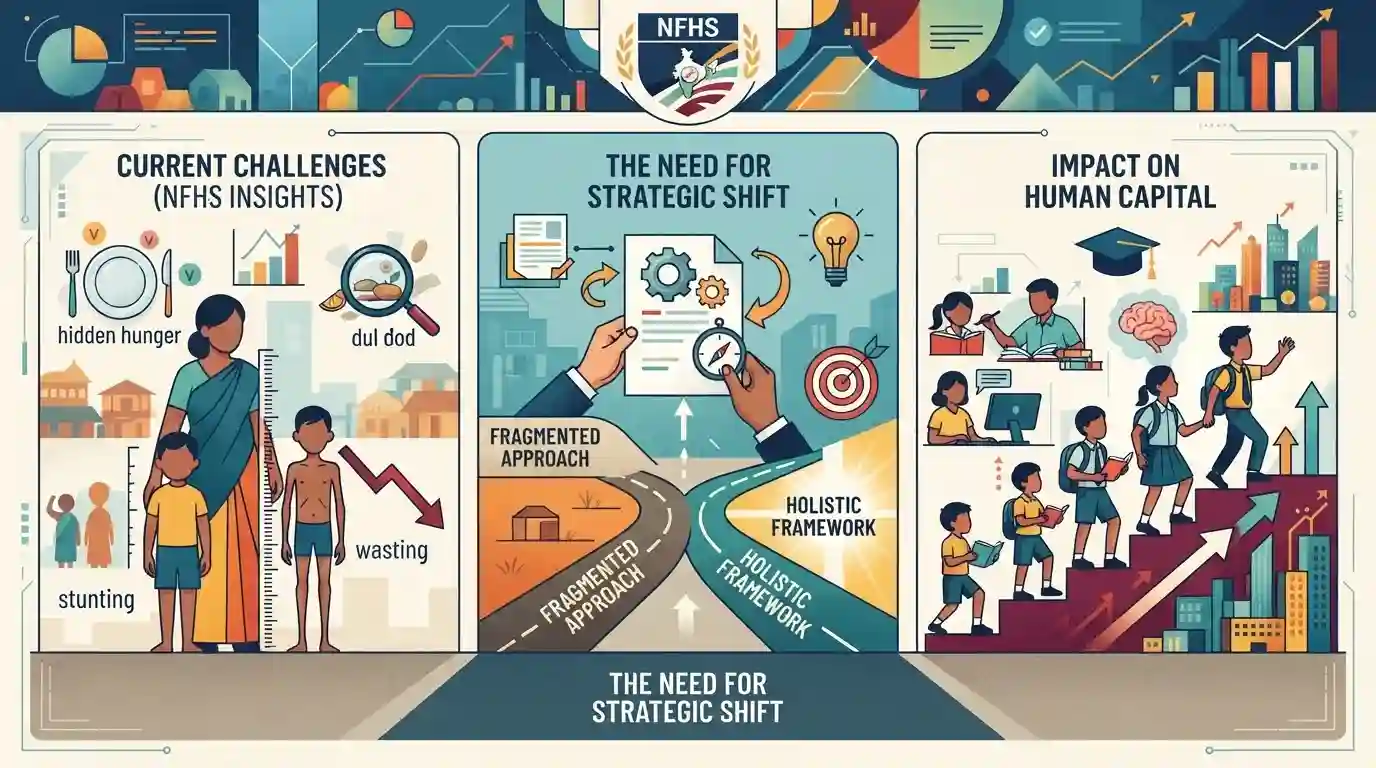
The editorial discusses the insights emerging from the National Family Health Survey (NFHS-VI) regarding nutrition, calling for a strategic shift in India's public health and nutrition policy framework to address chronic challenges like stunting, wasting, and hidden hunger.
मुख्य मुद्दे
- The findings from NFHS-VI necessitate a comprehensive rethink of India's nutrition policies and strategies to combat persistent malnutrition, stunting, and wasting.
- Malnutrition and poverty form a vicious cycle that severely undermines human capital formation and long-term economic growth.
- Current interventions need to move beyond mere calorie sufficiency toward nutritional quality, dietary diversity, and targeted lifecycle approaches.
महत्त्वाच्या संज्ञा
National Family Health Survey (NFHS)

A comprehensive, multi-round cross-sectional survey providing large-scale data on health, fertility, mortality, and nutrition across India.
UPSC context
GS Paper II (Social Justice - Health, Human Resources); tests understanding of welfare indicators, policy design, and public health data in India.
पूर्वपरीक्षा सापळा
improvements in chronic stunting rates indicate a resolution across all forms of child malnutrition, including acute wasting and hidden hunger.
Aspirants often assume a drop in stunting rates means acute malnutrition (wasting) or dietary diversity has similarly improved, missing that wasting and hidden hunger can remain stubbornly high despite declining stunting.
संबंधित स्थिर संकल्पना
What are the core indicators used to measure child malnutrition under the National Family Health Survey (NFHS)?
- Stunting Metric: Stunting represents low height-for-age, indicating chronic or long-term nutritional deprivation and recurrent illness in early childhood.
- Wasting Metric: Wasting measures low weight-for-height, reflecting acute malnutrition, rapid weight loss, or severe food deprivation in recent months.
- Underweight Metric: Underweight tracks low weight-for-age, serving as a composite indicator capturing both chronic and acute undernutrition dimensions.
- Hidden Hunger: Hidden Hunger denotes micronutrient deficiencies (vitamins and minerals) even when caloric intake is seemingly sufficient.
आंतर-विषय नमुने
Malnutrition & Demographic Dividend Constraints
Chronic child malnutrition directly restricts cognitive development and labor productivity, capping demographic dividend benefits despite a youthful population.
Nutritional Security & Agricultural Diversification
Tackling hidden hunger requires diversifying PDS and Mid-Day Meal schemes toward millets and biofortified staples, linking agriculture policy with public health.

NFHS malnutrition metrics + dual burden of disease likely to feature in a multi-statement Prelims question on public health indicators.
संबंधित PYQ · 3
संबंधित PYQ · 3
- 2024MainsGS2
Poverty and malnutrition create a vicious cycle, adversely affecting human capital formation. What steps can be taken to break the cycle ?
- 2020MainsGS2
In order to enhance the prospects of social development, sound and adequate health care policies are needed particularly in the fields of geriatric and maternal health care. Discuss.
- 2022MainsGS3
What are the major challenges of Public Distribution System (PDS) in India ? How can it be made effective and transparent ?
