National Family Health Survey Highlights Persistent Child Malnutrition
Source:The Hindu ↗
Why It Matters
The NFHS data is critical for UPSC aspirants as it serves as the most authoritative source on India's health and demographic metrics. It provides empirical evidence for evaluating the efficacy of government interventions like POSHAN Abhiyaan and NFSA, and is highly relevant for framing answers in GS Paper 2 (Health, Poverty, Hunger) and GS Paper 3 (Food Security).
Summary
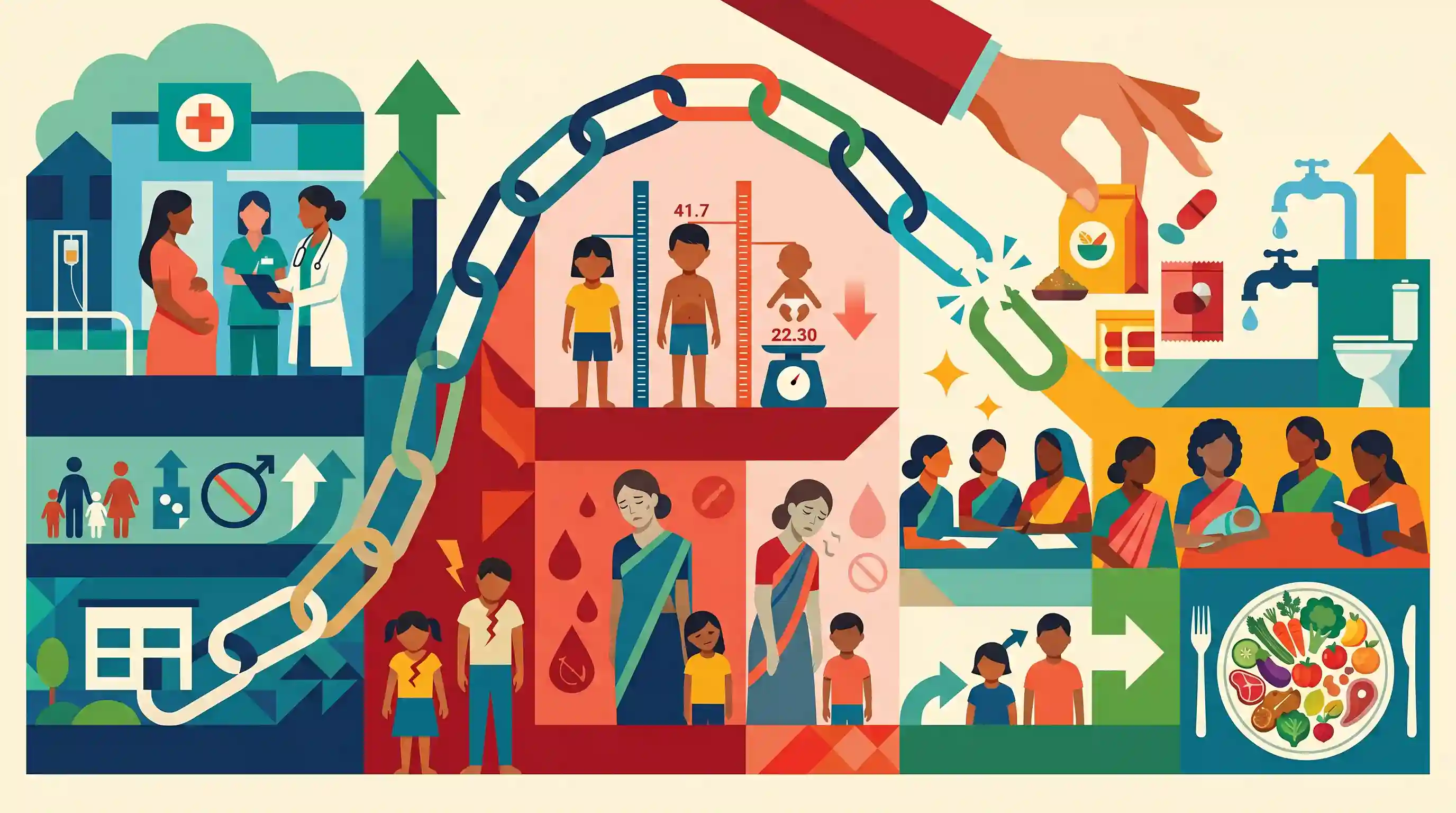
The National Family Health Survey-6 (NFHS-6) reveals a complex picture of India's health and demographic landscape. While the country has made commendable progress in areas such as maternal healthcare access, family planning, and institutional deliveries, significant nutritional challenges persist. The survey brings into sharp focus the enduring burden of child undernutrition—manifested in high rates of stunting and wasting—and the alarming prevalence of anaemia among women and children. These findings underscore that while India has largely achieved food security, nutritional security remains an unfinished agenda. Addressing these multidimensional challenges requires robust implementation of schemes like POSHAN Abhiyaan and Anaemia Mukt Bharat, coupled with improvements in sanitation, women's empowerment, and dietary diversity to break the intergenerational cycle of malnutrition and poverty.
Key Points
- The National Family Health Survey-6 (NFHS-6) highlights notable advancements in India's demographic and health indicators, including increased rates of institutional deliveries and improved maternal healthcare access.
- Despite positive health trends, the data underscores a critical and persistent challenge regarding child malnutrition, with concerning levels of stunting (low height-for-age), wasting (low weight-for-height), and being underweight.
- Widespread prevalence of anaemia among young children, adolescent girls, and women remains a severe public health issue requiring multi-sectoral interventions.
- The findings necessitate a paradigm shift from basic food security (caloric sufficiency) to comprehensive nutritional security, advocating for dietary diversity, micronutrient supplementation, and the promotion of nutri-cereals like millets.
- Emphasizes the need to strengthen existing initiatives such as POSHAN Abhiyaan and Anaemia Mukt Bharat, alongside addressing social determinants of health like sanitation, clean drinking water, and women's education.
Important Terms
National Family Health Survey (NFHS-6)

A large-scale, multi-round survey (2023-24) providing national and district-level data on fertility, mortality, family planning, and nutrition. It is conducted under the aegis of the Ministry of Health and Family Welfare.
UPSC context
GS Paper 2 (Health/Governance). Vital for data-driven answers on demographics and evaluating the effectiveness of social sector schemes.
POSHAN Abhiyaan
India's flagship program (National Nutrition Mission) launched in 2018 to improve nutritional outcomes for children, pregnant women, and lactating mothers by reducing stunting, wasting, and under-nutrition.
UPSC context
GS Paper 2 (Welfare Schemes/Hunger). Essential for questions on malnutrition and achieving Sustainable Development Goal 2 (Zero Hunger).
Anaemia Mukt Bharat
An intensified strategy launched in 2018 aiming to reduce anaemia prevalence by 3 percentage points annually through a "6X6X6" framework targeting six specific beneficiary groups.
UPSC context
GS Paper 2 (Health). Crucial for addressing the "hidden hunger" of micronutrient deficiencies and improving maternal and child health outcomes.
National Food Security Act (NFSA)
A 2013 law providing a legal right to subsidized foodgrains for approximately 67% of India's population, emphasizing food security through a life-cycle approach.
UPSC context
GS Paper 3 (Food Security). Key for discussing the shift from welfare to a rights-based approach in the Public Distribution System.
Integrated Child Development Services (ICDS)
A centrally sponsored umbrella scheme launched in 1975 to provide six core services, including supplementary nutrition and immunization, to children under six and pregnant/lactating mothers.
UPSC context
GS Paper 2 (Social Sector/Health). The foundational program for early childhood care, development, and maternal health in India.
International Institute for Population Sciences (IIPS)
A deemed university and autonomous organization under the Ministry of Health and Family Welfare, serving as the nodal agency for all rounds of the NFHS.
UPSC context
UPSC Prelims (Institutions). Important as the technical body behind India’s most authoritative demographic and health data.
Janani Suraksha Yojana (JSY)
A safe motherhood intervention under the National Health Mission (NHM) that provides cash incentives to promote institutional deliveries among poor pregnant women.
UPSC context
GS Paper 2 (Health). Focuses on reducing Maternal Mortality Ratio (MMR) and improving access to institutional healthcare services.
Prelims Trap
"Stunting is defined as low weight-for-height, while wasting is low height-for-age."
UPSC frequently swaps the definitions of stunting (height-for-age) and wasting (weight-for-height) in multi-statement questions to test conceptual clarity on malnutrition indicators.
Static Concepts Connected
What are the core anthropometric indicators used to measure child malnutrition?
- Stunting: Reflects chronic undernutrition and tracks low height-for-age, usually caused by prolonged poor diet or recurring infections.
- Wasting: Indicates acute or recent severe weight loss, tracking low weight-for-height. It is a strong predictor of mortality.
- Underweight: A composite indicator measuring low weight-for-age, which can encompass both stunting and wasting simultaneously.
What is the 6x6x6 strategy of the Anaemia Mukt Bharat (AMB) initiative?
- Six Beneficiary Groups: Targets children (6-59 months, 5-9 years), adolescent boys and girls, women of reproductive age, and pregnant/lactating women.
- Six Interventions: Includes prophylactic iron and folic acid (IFA) supplementation, deworming, delayed cord clamping, testing/treatment, and addressing non-nutritional causes.
- Six Institutional Mechanisms: Utilizes mechanisms like intra-ministerial convergence, the National Centre of Excellence, and a digital dashboard for continuous monitoring.
Cross-Topic Patterns
Nutrition + Demographic Dividend
The persistent burden of child wasting and anaemia directly threatens India's ability to capitalize on its demographic dividend, explicitly linking GS2 health metrics to GS3 economic growth and human capital formation.
Agriculture + Nutritional Security
The necessary shift from mere caloric sufficiency to nutritional security requires agricultural diversification, linking health indicators to GS3 themes of biofortification and millet (Shree Anna) promotion.
NFHS + Global Hunger Index
Child stunting, wasting, and mortality metrics gathered in NFHS reports are the precise data inputs utilized by international agencies to calculate India's controversial Global Hunger Index (GHI) rankings.

Expect a multi-statement Prelims MCQ pairing NFHS-6 malnutrition trends with exact definitions of stunting, wasting, and severe anaemia.
Linked PYQs · 5
Linked PYQs · 5
- 2024MainsGS2
Poverty and malnutrition create a vicious cycle, adversely affecting human capital formation. What steps can be taken to break the cycle ?
- 2020MainsGS2
In order to enhance the prospects of social development, sound and adequate health care policies are needed particularly in the fields of geriatric and maternal health care. Discuss.
- 2019MainsGS2
There is a growing divergence in the relationship between poverty and hunger in India. The shrinking of social expenditure by the government is forcing the poor to spend more on non-food essential items squeezing their food-budget. - Elucidate.
- 2017PrelimsGS1
Which of the following are the objectives of 'National Nutrition Mission'? 1. To create awareness relating to malnutrition among pregnant women and lactating mothers. 2. To reduce the incidence of anaemia among young children, adolescent girls and women. 3. To promote the consumption of millets, coarse cereals and unpolished rice. 4. To promote the consumption of poultry eggs. Select the correct answer using the code given below:
- 2023PrelimsGS1
Consider the following statements in the context of interventions being undertaken under Anaemia Mukt Bharat Strategy: 1. It provides prophylactic calcium supplementation for pre-school children, adolescents and pregnant women. 2. It runs a campaign for delayed cord clamping at the time of child-birth. 3. It provides for periodic deworming to children and adolescents. 4. It addresses non-nutritional causes of anaemia in endemic pockets with special focus on malaria, hemoglobinopathies and fluorosis. How many of the statements given above are correct?
