Pandemic Preparedness: Vaccine Research and Public Trust
Source:Indian Express ↗
Why It Matters
Highlights the critical intersection of advanced biotechnology (mRNA), sustained global health funding, and societal trust required for building effective pandemic resilience and managing global health crises.
Summary
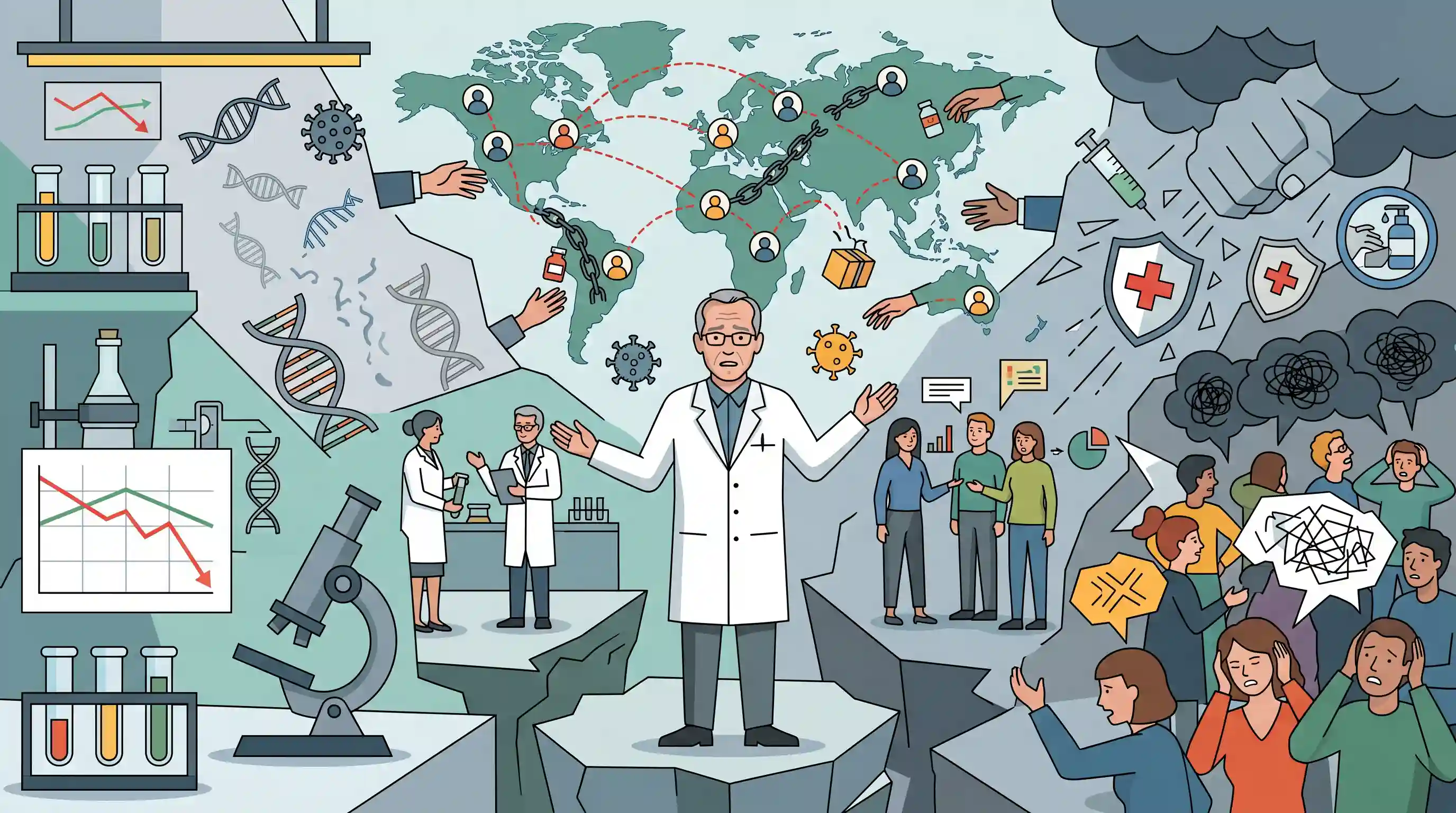
Former NIH Director Dr. Francis Collins warns that the world is currently less prepared for a pandemic than it was in early 2020. Key vulnerabilities include scaled-back research on rapid mRNA vaccine technology, disruptions to global HIV initiatives like PEPFAR, and a severe crisis of public trust driven by misinformation that jeopardizes basic public health measures.
Key Points
- Declining support for advanced mRNA vaccine research severely compromises the ability to design rapid-response vaccines (e.g., within 48 hours) for novel pathogens.
- Heavy reliance on slower traditional vaccine development methods poses significant delays and risks during future outbreaks.
- Distracted focus and disruptions are threatening global health programs like PEPFAR and USAID, risking a resurgence of HIV and reversing decades of progress.
- Political polarization and widespread disinformation have eroded public trust in science, undermining basic epidemiological interventions like isolation, masking, and quarantines.
Important Terms
President's Emergency Plan for AIDS Relief (PEPFAR)

A US government initiative launched in 2003 to address the global HIV/AIDS epidemic through funding for prevention, treatment, and care, particularly in low- and middle-income countries.
UPSC context
GS Paper II (International Relations) & GS Paper III (Health). Tests knowledge of global health diplomacy and impacts of foreign aid on India's health programs.
mRNA Vaccine Technology
A vaccine platform using genetic material to instruct cells to produce a viral protein (e.g., spike protein), triggering an immune response without using live or inactivated viruses.
UPSC context
GS Paper III (Science & Technology). Essential for understanding biotechnological advancements, pandemic response, and the 2023 Nobel Prize in Medicine.
National Institutes of Health (NIH)
The primary medical research agency of the US government, responsible for fundamental biomedical research and often collaborating globally on vaccine development and public health protocols.
UPSC context
GS Paper III (Science & Tech). Relevant for international scientific cooperation and the institutional framework of global health research.
USAID
An independent US agency that leads international development and humanitarian efforts, serving as a major bilateral donor and implementer for global health programs like PEPFAR.
UPSC context
GS Paper II (International Relations). Relates to the role of donor agencies in global governance and development assistance.
Infodemic
An overabundance of information—including false or misleading content—during a disease outbreak, which undermines public trust and complicates the implementation of public health measures.
UPSC context
GS Paper III (Internal Security/Health). Critical for analyzing the impact of social media and misinformation on national health security and social trust.
Prelims Trap
mRNA vaccines alter the host's genetic makeup by integrating synthetic RNA directly into human DNA.
mRNA never enters the cell nucleus where DNA is stored, and it degrades quickly after instructing the cell to make the antigen. It does not and cannot alter human DNA.
Static Concepts Connected
How do mRNA vaccines differ fundamentally from traditional vaccines?
- Mechanism: mRNA provides genetic instructions to host cells to produce a viral antigen (e.g., spike protein), rather than injecting a live-attenuated or inactivated virus.
- Speed & Adaptability: Synthetic mRNA sequences can be updated rapidly for new variants without the slow cell-culture scaling required for traditional vaccines.
- Storage Constraints: Lipid nanoparticle encapsulation makes mRNA fragile, often requiring ultra-cold chains that complicate deployment in resource-poor developing nations.
What are the pillars of a proactive Pandemic Preparedness framework?
- Disease Surveillance: Integrating real-time genomic sequencing and wastewater tracking into national health networks to detect novel pathogens early.
- Strategic Stockpiling: Maintaining strategic reserves of active pharmaceutical ingredients (APIs), PPE, and establishing emergency vaccine banks for rapid deployment.
- Infodemic Management: Proactively debunking misinformation to sustain public trust in epidemiological interventions like quarantines, masking, and vaccination drives.
Cross-Topic Patterns
Global Health Diplomacy & Soft Power
PEPFAR’s potential disruption highlights how shifts in US domestic politics affect health infrastructure in the Global South, impacting US geopolitical leverage against China's expanding health diplomacy.
Misinformation as a Security Threat
The erosion of public trust in health mandates mirrors internal security challenges, where organized disinformation campaigns on social media destabilize state administration and public order during crises.

Expect a multi-statement question on mRNA mechanics paired with logistical challenges of ultra-cold supply chains in developing nations.
Linked PYQs · 3
Linked PYQs · 3
- 2022MainsGS3
What is the basic principle behind vaccine development ? How do vaccines work? What approaches were adopted by the Indian vaccine manufacturers to produce COVID-19 vaccines ?
- 2021PrelimsGS1
With reference to recent developments regarding 'Recombinant Vector Vaccines', consider the following statements : 1. Genetic engineering is applied in the development of these vaccines. 2. Bacteria and viruses are used as vectors. Which of the statements given above is/are correct?
- 2024MainsGS2
In a crucial domain like the public healthcare system the Indian State should play a vital role to contain the adverse impact of marketisation of the system. Suggest some measures through which the State can enhance the reach of public healthcare at the grassroots level.
