AI and digital public infrastructure convergence in governance
Source:Indian Express ↗
हे का महत्त्वाचे आहे
It highlights a crucial paradigm shift in India's digital governance model—moving from basic digital service access to intelligent, AI-augmented public service delivery through DPI, directly impacting GS2 (Governance/E-governance) and GS3 (Technology/AI).
सारांश
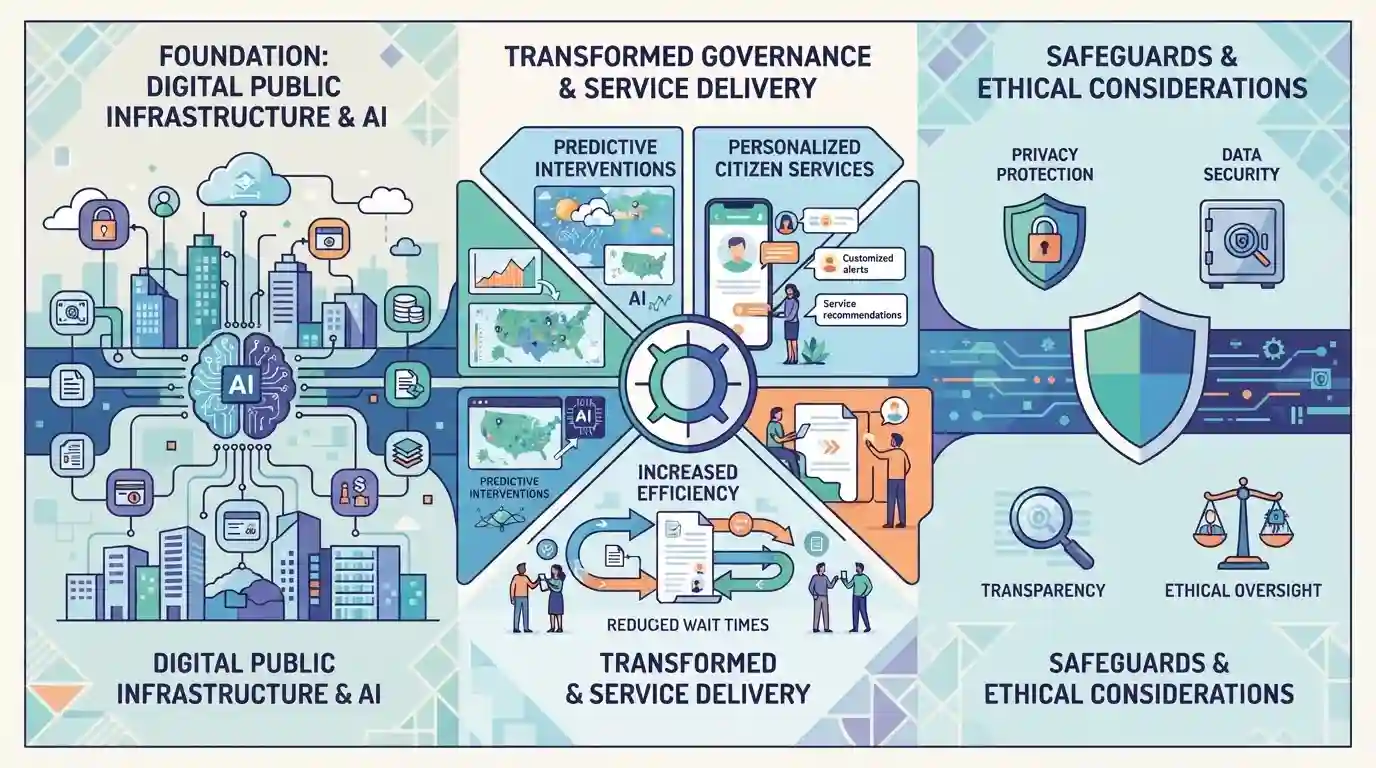
The article discusses how combining Artificial Intelligence (AI) with Digital Public Infrastructure (DPI) can transform governance, enhance public service delivery, and make state interventions more predictive, personalized, and efficient, while highlighting the need for safeguards against privacy and ethical concerns.
मुख्य मुद्दे
- The convergence of Artificial Intelligence (AI) and Digital Public Infrastructure (DPI) represents the next frontier for governance and public service delivery in India.
- DPI provides a secure, interoperable foundation, while AI adds contextual intelligence, personalization, and predictive capabilities to state interventions.
- Integrating AI into DPI can bridge bureaucratic gaps, improve transparency, and scale up targeted welfare distribution.
- Challenges such as algorithmic bias, data privacy, cybersecurity, and digital exclusion need robust regulatory guardrails.
महत्त्वाच्या संज्ञा
Digital Public Infrastructure (DPI)

Foundational digital frameworks like Aadhaar, UPI, and DigiLocker that provide population-scale identity, payments, and data-sharing layers to support inclusive public and private services.
UPSC context
UPSC GS Paper II & III: Essential for evaluating e-governance models, public service delivery, technology applications, and inclusive growth.
Digital India
A flagship program launched by the Government of India to transform the nation into a digitally empowered society and knowledge economy through robust digital infrastructure and e-governance.
UPSC context
UPSC GS Paper II: Important for assessing government policies, interventions for development, and the role of e-governance in public administration.
पूर्वपरीक्षा सापळा
Digital Public Infrastructure (DPI) operates solely as a closed, state-owned proprietary network for tax and welfare administration.
Aspirants often assume DPI is exclusively a government-owned closed network, whereas its defining architecture relies on open-source, interoperable, modular layers built through public-private partnerships.
संबंधित स्थिर संकल्पना
What are the core foundational layers constituting India's Digital Public Infrastructure (DPI)?
- Identity Layer:: Identity layer establishing unique, cryptographically secure legal identity for residents (e.g., Aadhaar).
- Payments Layer:: Payments layer enabling real-time, interoperable, peer-to-peer and merchant transactions at population scale (e.g., UPI).
- Data Layer:: Data sharing layer allowing consent-based, secure flow of personal and institutional data without data aggregation (e.g., Account Aggregator).
आंतर-विषय नमुने
AI Governance + DPDP Act Compliance
The convergence of AI with DPI frameworks like India Stack creates complex data localization and cybersecurity vulnerabilities governed by the Digital Personal Data Protection (DPDP) Act.
Digital Inclusion + Welfare Delivery Equity
Deploying predictive AI over population-scale public infrastructure risks reinforcing historical exclusion if last-mile digital literacy and vernacular accessibility are ignored.

AI + DPI convergence in governance is prime for a Mains GS-2 analytical question on moving from reactive welfare to predictive delivery.
संबंधित PYQ · 2
संबंधित PYQ · 2
- 2024MainsGS2
e-governance is not just about the routine application of digital technology in service delivery process. It is as much about multifarious interactions for ensuring transparency and accountability. In this context evaluate the role of the 'Interactive Service Model' of e-governance.
- 2023MainsGS3
Introduce the concept of Artificial Intelligence (AI). How does Al help clinical diagnosis? Do you perceive any threat to privacy of the individual in the use of Al in healthcare?
