CBI Director Appointment Process and Statutory Tenure Extension Rules
Source:Indian Express ↗
Why It Matters
The appointment process and tenure rules of the CBI Director are crucial for ensuring the independence and impartiality of India's premier investigative agency. Understanding the composition of the selection committee and the statutory provisions governing these appointments is important for GS Paper 2 (Governance and Statutory Bodies).
Summary
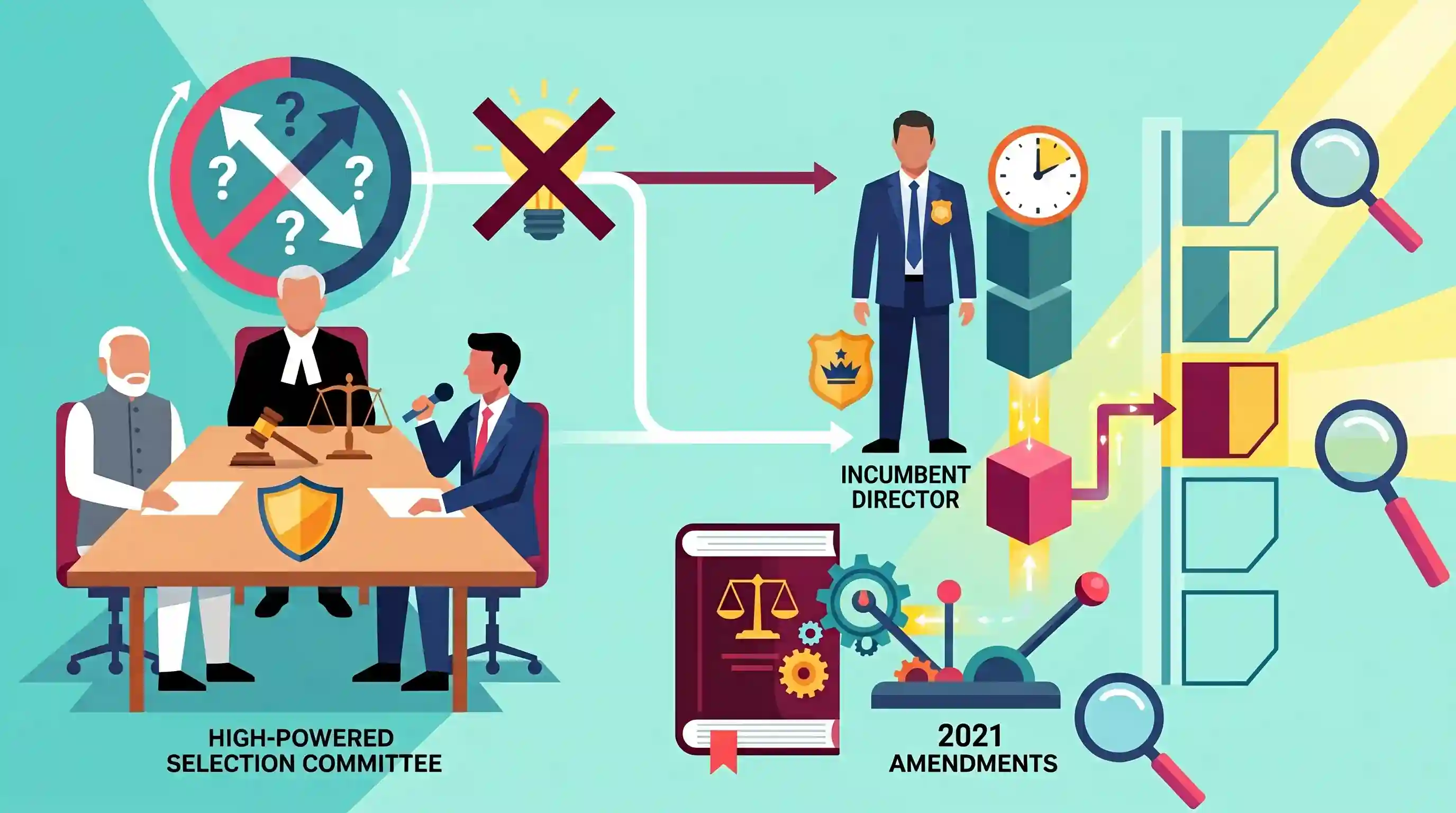
A high-powered selection committee—comprising Prime Minister Narendra Modi, Chief Justice of India Sanjiv Khanna, and Leader of Opposition Rahul Gandhi—met to select the next Director of the Central Bureau of Investigation (CBI). The committee failed to reach a consensus on a new appointee. Consequently, the incumbent Director, Praveen Sood, whose initial two-year term is ending, is expected to be granted a one-year extension. This extension is facilitated by the 2021 amendments to the Delhi Special Police Establishment (DSPE) Act and the CVC Act, which permit the government to extend the tenures of the CBI and ED chiefs up to a maximum of five years, in one-year increments. The situation draws attention to the statutory appointment mechanisms designed to maintain the independence of premier investigative bodies and the debates surrounding tenure extensions.
Key Points
- A high-powered selection committee consisting of the Prime Minister, Chief Justice of India, and the Leader of Opposition met to appoint the next CBI Director but could not reach a consensus.
- Due to the lack of agreement, incumbent CBI Director Praveen Sood is likely to receive a one-year extension as his initial two-year tenure ends.
- Under 2021 amendments to the DSPE Act and CVC Act, the central government can extend the tenures of CBI and ED Directors by one year at a time, up to a maximum total tenure of five years.
- The episode highlights the procedural complexities and political dynamics involved in the appointment of heads of critical investigative agencies in India.
Important Terms
Central Bureau of Investigation (CBI)

India's premier investigative agency for corruption, economic crimes, and serious offenses. It derives its powers from the DSPE Act, 1946, and functions under the Department of Personnel and Training.
UPSC context
GS Paper 2 (Statutory bodies/Governance); tests knowledge of agency autonomy, jurisdiction, and the interplay between executive and judicial oversight.
Delhi Special Police Establishment (DSPE) Act, 1946
The 1946 legislation providing the legal framework for the CBI. Section 4B (amended 2021) permits annual tenure extensions for the Director, while Section 6 mandates state consent for investigations.
UPSC context
GS Paper 2 (Governance); critical for understanding federalism (state consent) and the statutory basis of central investigative powers.
Central Vigilance Commission (CVC) Act, 2003
The 2003 law granting statutory status to the CVC. It governs the appointment and tenure of the Enforcement Directorate chief and oversees the CBI's anti-corruption investigations.
UPSC context
GS Paper 2 (Transparency and Accountability); relevant for studying anti-corruption frameworks and the institutional independence of watchdogs.
High-Powered Selection Committee
A statutory body (PM, CJI, and Leader of Opposition) responsible for recommending the CBI Director's appointment and subsequent tenure extensions under the DSPE Act.
UPSC context
GS Paper 2 (Appointments to various post); tests understanding of the checks and balances in executive appointments to maintain neutrality.
Enforcement Directorate (ED)
A specialized financial investigation agency under the Ministry of Finance. It enforces the PMLA (2002) and FEMA (1999) and has its chief's tenure governed by the CVC Act.
UPSC context
GS Paper 3 (Internal Security/Money Laundering); important for understanding economic security and the implementation of anti-money laundering laws.
Prelims Trap
The Central Government can unilaterally extend the CBI Director's tenure up to 5 years.
Under the 2021 DSPE Act amendments, tenure extensions still require the explicit recommendation of the high-powered selection committee (PM, CJI, LoP), not just executive fiat.
Static Concepts Connected
How is the CBI Director appointed and what is the tenure limit?
- Selection Committee: The PM (Chair), CJI (or nominated SC Judge), and Leader of Opposition (or leader of single largest opposition party in Lok Sabha).
- Base Tenure: A guaranteed minimum two-year tenure was established following the Supreme Court's Vineet Narain judgment (1997) to insulate the agency from political pressure.
- Extensions: The DSPE (Amendment) Act 2021 allows up to three 1-year extensions (max 5 years total) in the public interest, subject to committee recommendation.
What is the legal status and jurisdiction of the CBI?
- Non-statutory Status: The CBI is NOT a statutory body. It was set up by a 1963 Home Ministry resolution and derives its powers from the DSPE Act, 1946.
- Jurisdiction & Consent: Under Section 6 of the DSPE Act, the CBI requires state government consent (general or case-specific) to investigate within state borders, unless directed by the SC/HC.
Cross-Topic Patterns
CBI jurisdiction & Federal friction
The withdrawal of 'general consent' by several opposition-ruled states links the CBI's DSPE Act framework directly to broader Centre-State federal friction and basic structure debates.
ED's PMLA powers vs. CBI's DSPE framework
While both agency chiefs enjoy identical 5-year tenure extension rules under 2021 amendments, the ED derives statutory teeth directly from the PMLA, unlike the CBI's non-statutory DSPE roots.
Lokpal Act's influence on agency appointments
The 2013 Lokpal Act amended the DSPE Act to formalize the PM-CJI-LoP collegium for the CBI, reflecting a trend seen in selection panels for the CEC and Lokpal.

Expect a multi-statement Prelims question comparing the appointment committees, tenure rules, and statutory statuses of the CBI, ED, and CEC.
Linked PYQs · 2
Linked PYQs · 2
- 2021MainsGS2
The jurisdiction of the Central Bureau of Investigation (CBI) regarding lodging an FIR and conducting probe within a particular State is being questioned by various States. However, the power of the States to withhold consent to the CBI is not absolute. Explain with special reference to the federal character of India.
- 2019PrelimsGS1
The Chairmen of public sector banks are selected by the
