Diamond States Summit Reviews Bihar Governance and Roadmap
Source:medianews4u ↗
Why It Matters
This summit highlights the core policy focus areas, cabinet portfolios, and administrative targets of the Bihar Government (including drinking water, startups, road networks, and Gram Swaraj) which are highly relevant for BPSC Prelims governance and economy questions.
Summary
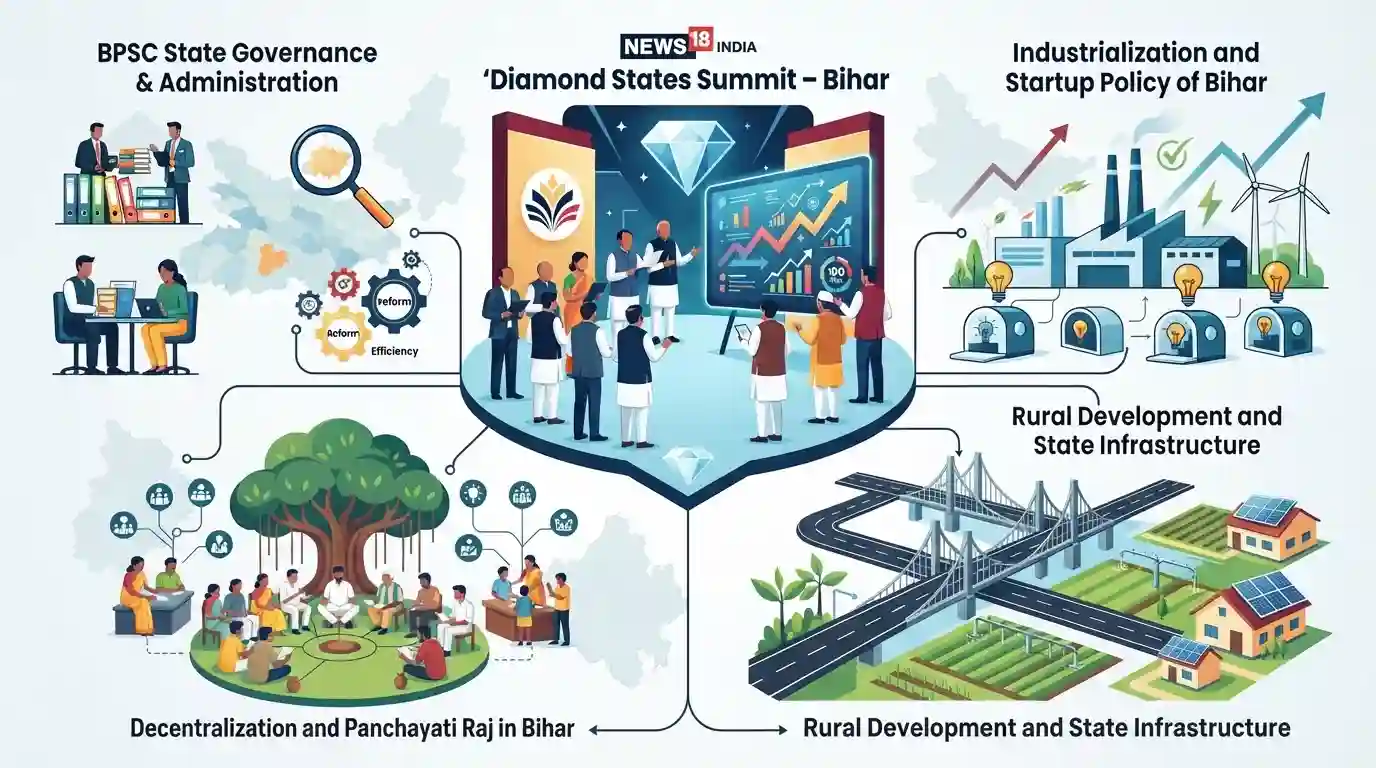
The News18 India 'Diamond States Summit – Bihar' held in Patna brought together Bihar's cabinet ministers and key policymakers to review the current state government's first 100 days in office. Centered on the theme 'Rajya Nirman se Rashtriya Nirman', the national dialogue highlighted developmental progress, policy reforms, and future roadmaps across infrastructure, rural empowerment, Panchayati Raj, industries, startups, education, and water resources.
Key Points
- Context and Theme: The 'Diamond States Summit – Bihar' was organized in Patna by News18 India, celebrating the completion of the state government's first 100 days under the theme 'Rajya Nirman se Rashtriya Nirman' (State Building to Nation Building).
- Keynote Address: Deputy Chief Minister (referred as CM in the article) Samrat Choudhary highlighted achievements in law and order, investment, infrastructure, education, and employment under the banner of 'Viksit Bihar, Viksit Bharat'.
- Industrial and Sports Initiatives: Shreyasi Singh, Minister of Industries and Sports, discussed measures taken to accelerate industrial investment, employment generation, the Bihar startup ecosystem, and sports infrastructure.
- Panchayati Raj & Rural Empowerment: Panchayati Raj Minister Deepak Prakash and Rural Development Minister Shravan Kumar emphasized decentralization, Gram Swaraj, and the successful implementation of welfare programs at the grassroots level.
- Basic Services and Water Resources: Sanjay Singh (PHED Minister) and Santosh Kumar Suman (Minor Water Resources Minister) shared progress on safe drinking water projects and minor irrigation for enhancing agricultural productivity.
Important Terms
Saat Nishchay (Seven Resolves)

The flagship multi-phase development agenda of the Bihar government, defining seven priority commitments to drive inclusive, sustainable state-level growth across employment, infrastructure, and welfare sectors.
UPSC context
BPSC GS Paper II (Economy of Bihar); tests understanding of sub-national developmental models, welfare governance, and state-specific policy frameworks.
Bihar Startup Policy 2022
A state policy launched in 2022 to boost entrepreneurship, providing a seed grant of up to 10 lakh rupees as an interest-free loan alongside additional incentives for female, SC, ST, and differently-abled entrepreneurs.
UPSC context
BPSC GS Paper II (Bihar Economy); tests knowledge of regional industrialization, entrepreneurship promotion schemes, and state employment policies.
Gram Swaraj
Mahatma Gandhi's vision of village self-governance, advocating for fully decentralized, self-reliant rural local bodies, which serves as the foundational philosophy behind India's modern Panchayati Raj Institutions.
UPSC context
UPSC GS Paper II (Polity/Decentralization); tests historical roots of democratic decentralization, local self-government, and grass-roots democracy.
Public Health Engineering Department (PHED), Bihar
The nodal state government department in Bihar responsible for providing safe drinking water, maintaining sanitation infrastructure, and implementing flagship water resource projects like 'Har Ghar Nal Ka Jal'.
UPSC context
BPSC GS Paper II (Infrastructure & Social Sector); tests knowledge of rural infrastructure, public health systems, and state welfare delivery.
Urban Development and Housing Department (UDHD), Bihar
The nodal department of the Bihar government responsible for planned urban growth, provisioning municipal services (housing, sanitation, transport), and driving administrative and regulatory reforms in Urban Local Bodies.
UPSC context
BPSC GS Paper II (Urbanisation and Local Governance); tests municipal administration, smart city frameworks, and local governance reforms.
Prelims Trap
Ahar-Pyne is a naturally occurring wetland ecosystem in the plains of South Bihar.
Ahar-Pyne is a constructed, man-made gravity-based rainwater harvesting and irrigation system, rather than a naturally occurring wetland ecosystem.
Static Concepts Connected
What is the traditional Ahar-Pyne system of water harvesting?
- Core definition: It is an indigenous, gravity-based rainwater harvesting and irrigation system native to the flood and drought-prone plains of South Bihar.
- Ahar structure: Ahars are artificial catchment basins embanked on three sides to store runoff water from seasonal hilly rivers.
- Pyne system: Pynes are artificial diversion channels led off from rivers to distribute collected water to agricultural fields.
- Ecological value: They act as flood-mitigation tools during monsoons and critical groundwater recharge sources during dry spells.
What are the constitutional bases for decentralization (Gram Swaraj) in India?
- Article 40: Article 40 (DPSP) directs the State to organize village panchayats and endow them with necessary self-governing powers.
- 73rd Amendment: The 73rd Amendment Act of 1992 added Part IX and the 11th Schedule, institutionalizing a three-tier local governance structure.
- Article 243G: Article 243G empowers state legislatures to devolve powers, authority, and responsibilities to Panchayats for economic development and social justice.
Cross-Topic Patterns
Traditional irrigation + Climate adaptation
Revitalizing heritage irrigation systems like Bihar's Ahar-Pyne links historic community water management with modern climate adaptation goals under India's National Water Mission.
Cooperative federalism + State startups
State-level startup initiatives like the YUVA framework reflect competitive-cooperative federalism, translating Central mandates like Startup India into regional economic contexts.

Traditional water conservation techniques like Ahar-Pyne and their role in climate-smart agriculture will likely be tested in GS-3/Prelims.
Linked PYQs · 3
Linked PYQs · 3
- 2020BPSC_PRELIMSGS1
Which of the following is not included in Seven Resolves (Saat Nishchay) of Bihar Government?
- 2025BPSC_PRELIMSGS1
Which of the following is NOT one of the components under the YUVA framework of the Bihar Startup Policy 2022?
- 2025BPSC_PRELIMSGS1
What is the main purpose of Panchayati Raj?
