Witness Murder in Saran Triggers Protests and SIT Probe
Source:indiatvnews ↗
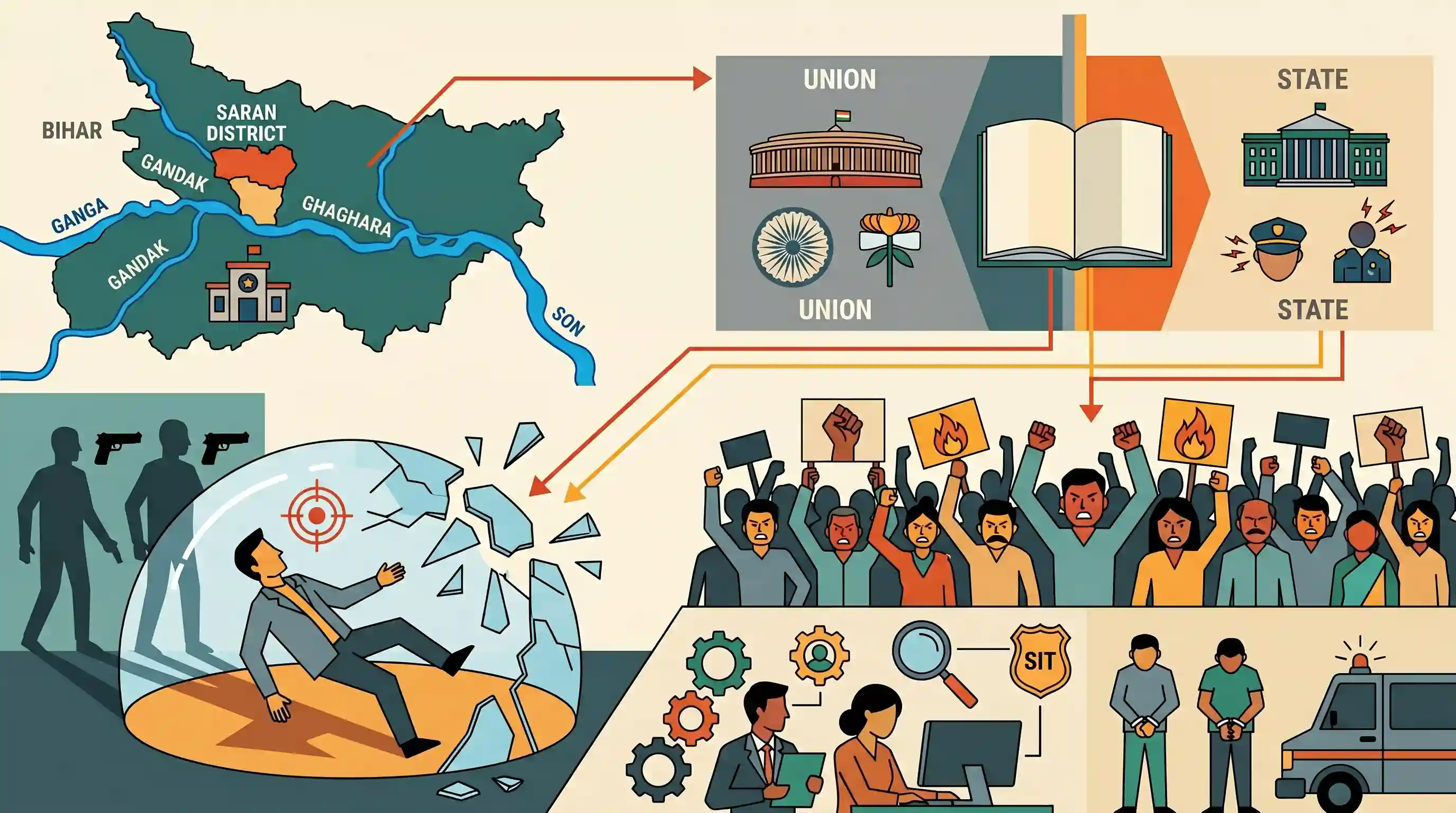
Why It Matters
The safety of judicial witnesses is fundamental to the rule of law and the criminal justice system. Under Section 398 of the newly implemented BNSS (2023), state governments are statutory owners of witness protection. This incident highlights the gaps in executing these schemes and stresses the state's liability under List II of the Seventh Schedule to maintain public order.
Summary
Pankaj Rai, a key witness in a double murder case under the jurisdiction of the Mufassil police station, was shot dead by unidentified assailants in Saran district, Bihar. The murder sparked massive public protests, leading local police to set up a Special Investigation Team (SIT) and detain two suspects. The case raises critical administrative, legal, and security questions regarding witness protection and state-level police management.
Key Points
- On June 28, 2026, Pankaj Rai, a resident of Methwalia and a key witness in a high-profile double murder case, was shot dead by unidentified motorcycle-borne assailants in Saran, Bihar.
- Another resident, Manish Kumar, sustained severe injuries and was referred to Patna for advanced medical treatment.
- Pankaj Rai had already recorded his statement in court under police protection, indicating a potential lapse in protection mechanisms and a targeted attack by criminal elements.
- The incident triggered violent public protests, with locals blocking roads at Methwalia Chowk to demand swift justice and better security.
- In response, the Saran district administration formed a Special Investigation Team (SIT) and detained two suspects based on early intelligence inputs.
- This incident highlights critical challenges in witness protection, state-level law and order administration, and judicial security in Bihar.
Important Terms
Bharatiya Nagarik Suraksha Sanhita (BNSS), 2023

India's modernized criminal procedure code replacing the 1973 CrPC. Section 398 provides statutory recognition to witness protection, mandating state governments to formulate and implement official Witness Protection Schemes.
UPSC context
GS Paper II (Polity & Governance): Critical for questions on criminal justice system reforms, legal modernization, and protection of citizen rights.
Witness Protection Scheme, 2018
A landmark national framework approved by the Supreme Court of India under Articles 141 and 142. It categorizes witnesses based on threat levels to provide protective measures like identity change and relocation.
UPSC context
GS Paper II (Judiciary & Governance): Relevant for questions on witness rights, improving conviction rates, and judicial guidelines on safety in trials.
Code of Criminal Procedure (CrPC)
The legacy procedural law of 1973 that governed the administration of criminal justice, investigation, and trial procedures in India before being replaced by the Bharatiya Nagarik Suraksha Sanhita (BNSS), 2023.
UPSC context
GS Paper II (Polity & Governance): Relevant for comparative analysis of legacy vs. modern criminal laws and procedural reforms in India.
Special Investigation Team (SIT)
An ad hoc, specialized investigative body constituted by the courts or executive governments to conduct impartial, focused probes into complex, high-profile, or sensitive criminal cases where standard investigations are deemed inadequate.
UPSC context
GS Paper II (Governance & Law Enforcement): Key for discussions on police accountability, judicial oversight, and addressing administrative biases in investigations.
Bihar Police
The primary law enforcement agency of Bihar, governed under the Bihar Police Act, 2007. It functions under the state government, as 'Police' is a State Subject under List II of the Seventh Schedule.
UPSC context
GS Paper II (Federalism & Police Reforms): Relevant for studying the role of state police in maintaining public order, federal relations, and local governance.
Prelims Trap
The Witness Protection Scheme is a statutory mechanism directly managed by the Union Home Ministry under a dedicated 2018 Parliamentary Act.
The 2018 Scheme was endorsed by the SC under judicial powers (Art. 141/142), not a standalone Act. Statutory backing came only in 2023 under BNSS, which tasks State Governments, not the Centre, with implementation.
Static Concepts Connected
What is the structure of the Witness Protection Scheme, 2018?
- Judicial Origin: Approved by the Supreme Court in Mahender Chawla v. Union of India (2018) under Articles 141 and 142 of the Constitution.
- Three-Tier Threat Classification: Divides threat levels into Category A (extreme threat to life), Category B (threat to safety/property), and Category C (moderate threat/harassment).
- State-Level Funding: Secured through a dedicated 'Witness Protection Fund' maintained by State and Union Territory governments.
How are criminal justice and law enforcement divided in the Seventh Schedule?
- State List Subjects: Entry 1 ('Public Order') and Entry 2 ('Police') of List II give state legislatures exclusive authority over police administration and security.
- Concurrent List Subjects: Entry 1 ('Criminal Law') and Entry 2 ('Criminal Procedure') of List III allow both Parliament and State Legislatures to enact laws.
- BNSS Statutory Mandate: Section 398 of the Bharatiya Nagarik Suraksha Sanhita (BNSS), 2023 legally binds State Governments to notify their own witness protection schemes.
Cross-Topic Patterns
BNSS mandates vs. State policing capacity
BNSS 2023 mandates (like Section 398) depend entirely on State-controlled police machinery, highlighting the structural friction between Concurrent List criminal procedure and State List policing.
Riverine confluences and trade history
Saran's economic and cultural history is deeply tied to the Gandak-Ganga confluence, where the historic Sonepur Cattle Fair connects regional geography with ancient trade networks.

BNSS Section 398's mandate for state-notified witness protection schemes will likely be tested under Seventh Schedule division of powers.
Linked PYQs · 2
Linked PYQs · 2
- 2016BPSC_PRELIMSGS1
Match the following : I. Union List a. 97 entries II. State list b. 47 entries III. Concurrent list c. 66 entries
- 2024-EBPSC_PRELIMSGS1
What is the name of the one month long cattle fair organized at the confluence of Ganga and Gandak rivers?
