Higher Education Integrates AI and Global Partnerships
Source:The Hindu ↗
Why It Matters
The article provides real-world examples of how Indian higher education is evolving to meet modern demands. It highlights the practical application of the National Education Policy (NEP) 2020 objectives, including globalizing education, promoting multidisciplinary research, and aligning academic output with industry requirements and emerging technologies.
Summary
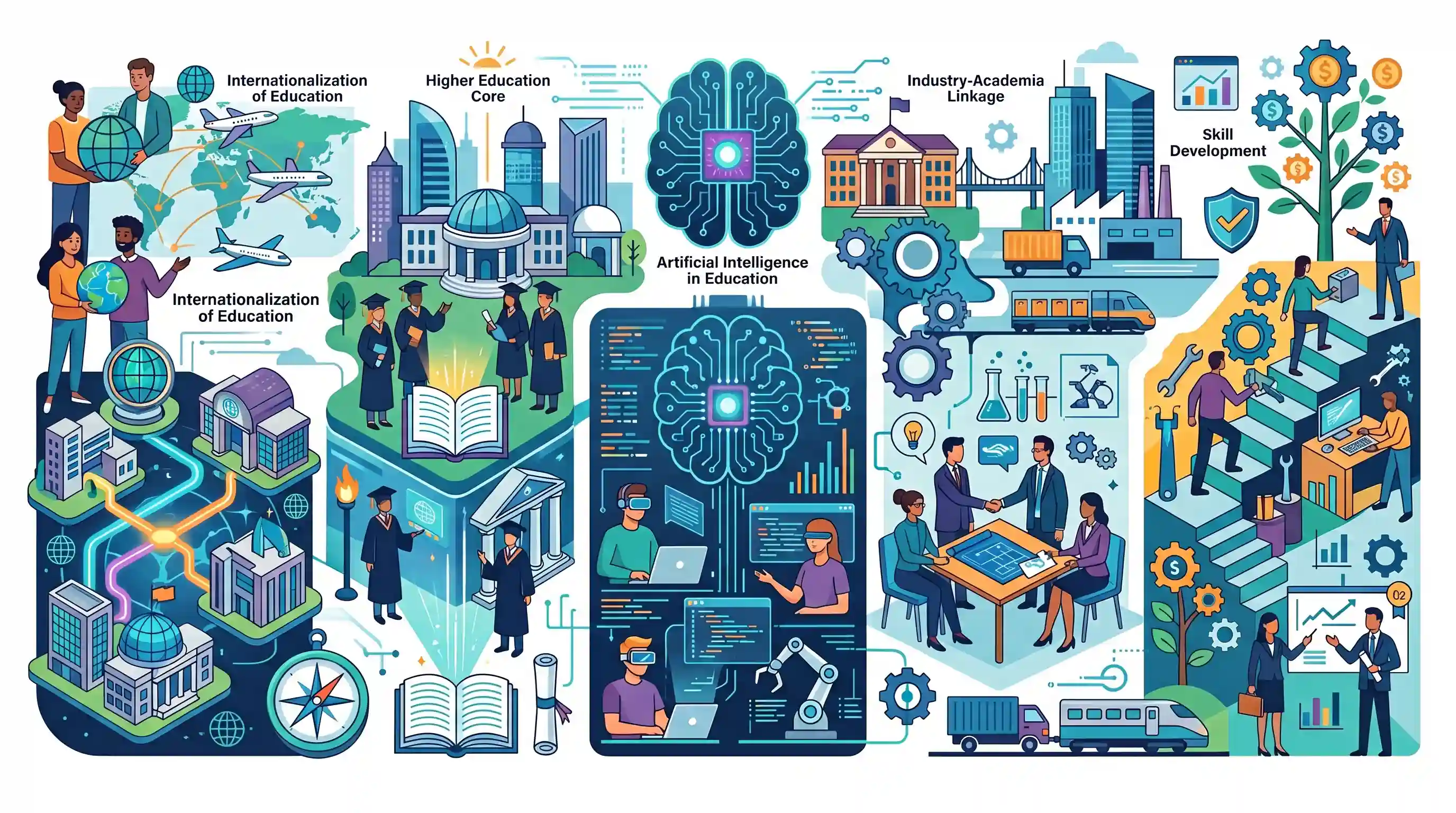
A comprehensive roundup of recent developments in higher education, highlighting a strong emphasis on international collaborations, integration of advanced technologies like AI into curricula, and robust industry-academia partnerships aimed at boosting skill development and research innovation.
Key Points
- Universities are rapidly introducing specialized programs and faculty development initiatives focused on emerging technologies like Artificial Intelligence, Data Science, and Cybersecurity.
- Internationalization of higher education is gaining momentum through strategic MoUs that offer global mobility, dual degrees, and joint research opportunities.
- Stronger industry-academia collaborations are being forged to establish specialized training centers, such as AI Hubs and Smart Factory Labs, addressing the skill gap and enhancing employability.
- Higher educational institutions are driving research and patenting innovations that address real-world challenges in fields like healthcare, environment, and automotive safety.
Important Terms
Mukhyamantri Udyamshala initiative

A Uttarakhand government initiative providing Class 11 students with structured mentorship and seed funding (₹5,000) to develop and pitch business ideas, fostering an entrepreneurial mindset within school education.
UPSC context
GS Paper II (Education/Governance); relevant for policies promoting entrepreneurship and vocational training at the secondary school level.
Kaushalam programme
A multi-state skill development initiative; notably in Andhra Pradesh, it partners with platforms like 'foundit' to create industry-ready talent pipelines and work-from-home opportunities for youth.
UPSC context
GS Paper II/III (Skill Development/Employment); tests knowledge of state-led digital employment and vocational training frameworks.
Ministry of Electronics and Information Technology
The ministry leading the 'AI Curriculum Taskforce' to overhaul technical education, emphasizing practical AI training (40-75% exposure) and shared national GPU infrastructure for colleges.
UPSC context
GS Paper III (Technology/Economy); crucial for India's AI strategy and bridging the skill gap in the digital economy.
South Asian University
An international university established by SAARC nations in New Delhi, promoting regional cooperation through higher education; recently extended admission deadlines for its diverse multicultural academic programs.
UPSC context
GS Paper II (International Relations/Education); focuses on India's role in SAARC and educational diplomacy.
National Forensic Sciences University
An 'Institution of National Importance' under the Ministry of Home Affairs, specializing in forensic science, cybersecurity, and criminology to strengthen the criminal justice system.
UPSC context
GS Paper II/III (Governance/Security); relevant for reforms in criminal justice and internal security through technology.
IIT Kanpur
A premier technical institute recently partnering with CRISIL for AI research and HCLTech for Global Capability Centers (GCCs), showcasing robust industry-academia linkage and deep-tech innovation.
UPSC context
GS Paper III (Science & Technology); highlights the role of IITs in industry-led R&D and AI advancement.
Prelims Trap
Students cannot pursue two full-time physical degree programs simultaneously under UGC guidelines.
UGC regulations allow students to pursue two academic programs simultaneously in physical mode, provided the class timings for both programs do not overlap.
Static Concepts Connected
What are the key provisions for the internationalisation of higher education under NEP 2020?
- Foreign Campuses: Top 500 global universities are permitted to set up campuses in India under UGC regulations.
- Outbound Mobility: High-performing Indian universities are encouraged to set up offshore campuses (e.g., IITs in UAE, Zanzibar).
- Collaborative Degrees: Facilitating global mobility through twinning, joint degrees, and dual degree programs with foreign varsities.
How does India promote intellectual property and patenting in higher educational institutions?
- Fee Concessions: The government provides up to an 80% reduction in patent filing fees for all recognized educational institutions.
- IP Ownership: National Innovation and Startup Policy (NISP) allows students and faculty to own IP rights generated using institutional resources.
- Innovation Ecosystem: Establishing Institution’s Innovation Councils (IICs) to foster a culture of research, patenting, and commercialization.
Cross-Topic Patterns
Higher Education + Deep Tech Policy
Integrating academic R&D and institutional patenting with the National Deep Tech Startup Policy to bridge the gap between varsity lab research and commercial industry applications.
Industry-Academia Linkage + Demographic Dividend
Connecting the establishment of AI hubs and Smart Factory Labs in universities with macroeconomic imperatives to upskill youth and harness India's peaking demographic dividend.

Expect a Mains question evaluating how industry-academia linkages under NEP 2020 can solve India's demographic dividend employability paradox.
Linked PYQs · 3
Linked PYQs · 3
- 2023MainsGS2
Skill development programmes have succeeded in increasing human resources supply to various sectors. In the context of the statement analyse the linkages between education, skill and employment.
- 2015MainsGS2
The quality of higher education in India requires major improvements to make it internationally competitive. Do you think that the entry of foreign educational institutions would help improve the quality of higher and technical education in the country? Discuss.
- 2023MainsGS3
Introduce the concept of Artificial Intelligence (AI). How does Al help clinical diagnosis? Do you perceive any threat to privacy of the individual in the use of Al in healthcare?
